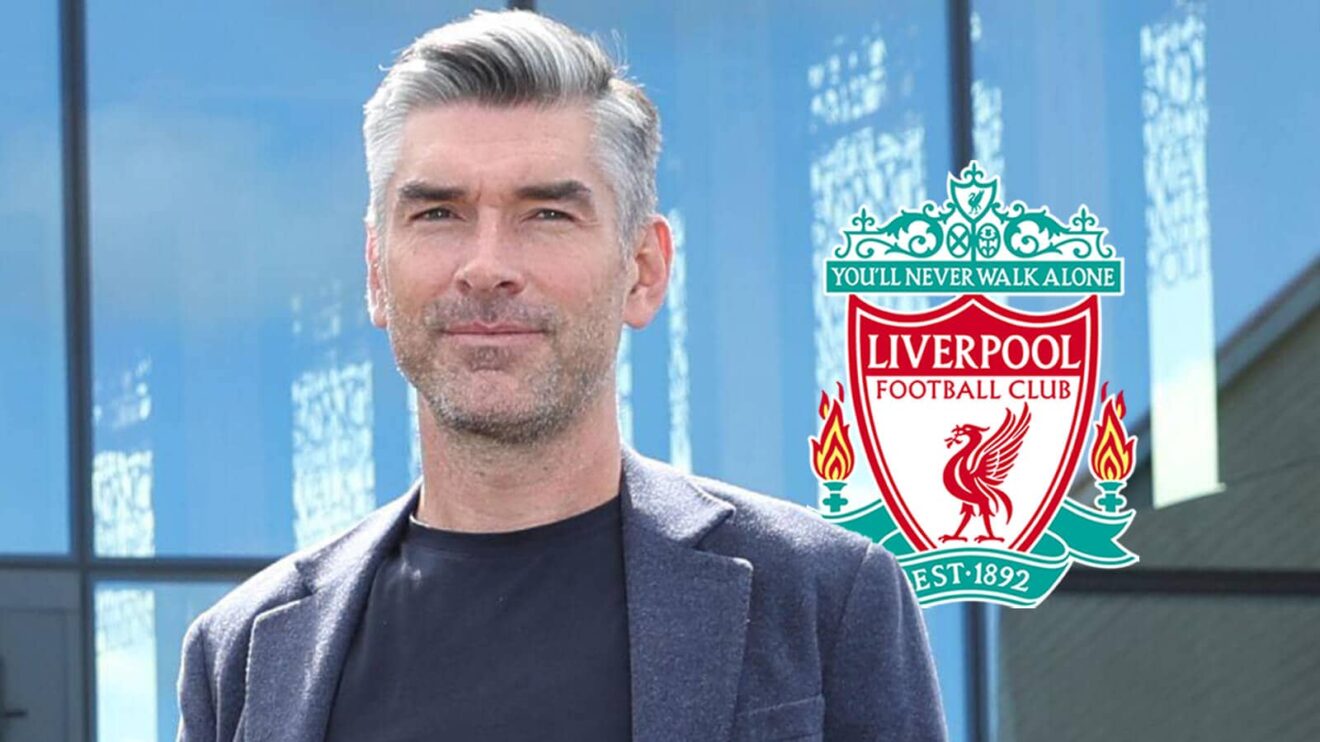
Richard Hughes’s time as Liverpool’s sporting director has come to a close after two and a half turbulent years on Merseyside, and few departures in recent Anfield history carry quite so mixed a legacy. The 47-year-old Scot arrived from Bournemouth in the summer of 2024, tasked with steering Liverpool through the delicate transition away from Jürgen Klopp, working alongside incoming CEO of football Michael Edwards to identify and appoint Klopp’s successor. That successor turned out to be Arne Slot, and Hughes’s first major call in the job paid off almost immediately: Slot delivered the Premier League title in his very first season in charge, 2024-25, finishing ten points clear of Arsenal.
It’s what has happened since that has defined, and ultimately ended, Hughes’s Anfield tenure. Reports throughout the past year pointed to a deteriorating relationship between Hughes and Slot, with suggestions of a serious rift over squad selection — most notably around the playing time afforded to academy graduate Rio Ngumoha, a disagreement some outlets characterised as sparking something close to a civil war behind the scenes at the club. Liverpool’s form cratered during the 2025-26 season regardless, with the club slipping badly behind Arsenal in the title race, prompting Slot’s eventual dismissal and the hiring of Andoni Iraola — a manager Hughes himself knew well from their overlapping days at Bournemouth, where Hughes served as technical director while Iraola managed the first team.
Hughes stayed on just long enough to oversee this summer’s rebuild under Iraola before his own departure was confirmed, with reports linking him to a sporting director role at Saudi Arabian giants Al-Hilal, following the same path as former Bournemouth colleague Simon Francis. It brings to a close a stint in which Hughes committed close to $950 million to incoming transfers, breaking Liverpool’s transfer record on multiple occasions — and yet leaves the job, by most fan assessments, as one of the more divisive figures to have occupied it, blamed by a significant portion of the Anfield support for what they view as reckless spending and questionable squad planning in the years following that 2024-25 title win.
With his time at the club now over, it’s worth taking stock of exactly what that spending bought Liverpool — the successes that will outlast his tenure, and the misfires that came to define the criticism levelled at him.
If there’s one unqualified succes from Hughes’s transfer record, it’s the signing of Hugo Ekitiké. Liverpool’s spending spree in the summer of 2025 — arriving as reigning Premier League champions, no less — ran well past $600 million, and the overwhelming majority of that outlay failed to deliver value in year one. Ekitiké was the exception. Signed for a fee in the region of $104 million including add-ons, the Frenchman made an instant impact, scoring inside four minutes of the Community Shield and following it up with goals in each of his first two Premier League appearances. He went on to register 17 goals and six assists across the season, offering a rare consistent bright spot in an otherwise miserable campaign for the Reds, before a ruptured Achilles in April brought his breakout year to a premature and painful end. Given the injury cloud now hanging over him, how Hughes’s most obvious hit is remembered may ultimately depend on how well Ekitiké recovers — but on footballing terms alone, it stands as arguably his best piece of business.
Hughes moved decisively to beat Chelsea to the signature of Jérémy Jacquet, accelerating Liverpool’s interest back in January to secure a deal for the towering young defender ahead of this summer’s arrival, for a fee reported at around $82 million. It’s admittedly early days — Jacquet’s game time so far has been limited — but the early signs have been overwhelmingly positive. Quick, physically imposing and technically composed for a 21-year-old adjusting to a new league, Jacquet looks every bit the long-term investment Liverpool intended, and represents one of the clearer examples of Hughes’s recruitment team identifying a talent before the wider market caught up.
Muñoz’s early Liverpool career has already been well documented — his headline-grabbing hijacking of a near-complete Newcastle United transfer, and his subsequent emergence as Andoni Iraola’s most plausible answer to the loss of Mohamed Salah on the right flank. From a pure recruitment standpoint, the deal looks shrewd business: Liverpool paid around $45 million for a versatile 22-year-old capable of playing either flank, a price that looks positively restrained set against the sums being thrown around elsewhere in this summer’s wide-forward market. Muñoz has already contributed to late draws in both of Iraola’s opening two matches in charge, and while it’s far too soon to declare the deal an unqualified triumph, there is a growing sense among Liverpool-watchers that this will be looked back on as one of the shrewder pieces of business Hughes sanctioned during his time at the helm
No signing captures the risk of Hughes’s transfer strategy quite like Alexander Isak. The pursuit of the Swedish striker was a saga in itself, dragging on for months and reportedly involving Isak going on strike at Newcastle United in an effort to force the move through. When it finally happened, Liverpool broke their transfer record to land him for a reported $170 million. What followed was, by any measure, a disastrous debut campaign — a long-term injury wrecked much of his first season, and Isak finished with just four goals in 22 appearances, a return wholly incompatible with his price tag regardless of the mitigating injury circumstances. The particular sting for Hughes is that this outlay came in the same transfer window Liverpool had already committed over $100 million to a striker in Ekitiké — leaving the club to explain why it needed two elite, expensively assembled forwards in the same squad. Isak has shown some encouraging form to start the current campaign, and there remains a route back to justifying the fee in the years ahead, but as things stand it ranks among the most scrutinised pieces of business of Hughes’s entire
Signed for a club-record $156 million, Florian Wirtz arrived at Anfield with a reputation as one of European football’s outstanding creative midfielders. The output hasn’t matched the billing: just 15 goal involvements across 52 appearances in his debut season represented a underwhelming return for a fee of that size. Part of the issue, by most reasonable assessments, runs deeper than individual form — Wirtz’s game, more reminiscent of the kind of possession-dominant playmaker Pep Guardiola tends to favour at Manchester City, never sat entirely comfortably within a Liverpool side built on higher-intensity, more direct principles. His signing arguably symbolised the drift toward a more measured, possession-based approach under Slot that jarred with the club’s traditional identity, and with Iraola now restoring a higher-tempo approach at Anfield, there’s a real question of whether Liverpool ever actually needed a player in the Wirtz mould in the first
Few signings looked better on paper at the point of arrival than Jeremie Frimpong. Fresh off an outstanding Bayer Leverkusen side’s title-winning 2023-24 campaign under Xabi Alonso and a strong follow-up season — 38 goal involvements across his final two years in Germany — Frimpong was considered among the most exciting young full-backs in Europe. The issue has been fit rather than talent: Frimpong made his name almost exclusively as a right wing-back in a back three at Leverkusen, and has struggled to adapt to life in a flatter back four at Liverpool, looking suspect defensively while offering minimal attacking end product in the deeper role he’s been asked to fill. A difficult start to the current season has done little to change that trajectory, and barring a significant turnaround under Iraola, Frimpong risks being remembered as one of the more underwhelming full-back signings in the club’s recent history.
Kerkez’s move to Liverpool carried a certain symmetry — Hughes had originally brought him to English football by signing him for Bournemouth from AZ Alkmaar during his time as the Cherries’ technical director, watching him flourish there under, among others, Iraola himself, before sanctioning a lucrative reunion at Anfield. On paper it looked an intelligent piece of business: an aggressive, attack-minded left-back in the Andy Robertson mould, still just 22 and with a proven track record in the Premier League. In practice, Kerkez has struggled badly to replicate that Bournemouth form, with erratic performances defensively not offset by the attacking output that made him such an exciting prospect — just four goal involvements across 48 appearances in his debut season at the club. Like Frimpong on the opposite flank, he’s another full-back yet to find his level under Iraola, and another mark against Hughes’s recruitment record during his most expensive summer at the club.
Taken together, the picture that emerges is of a sporting director whose instincts for identifying young, technically gifted talent — Jacquet, Muñoz, and to an extent Ekitiké — rarely let him down, but whose judgement on marquee, world-record-adjacent fees repeatedly came unstuck, whether through poor tactical fit (Frimpong, Wirtz), underwhelming returns relative to outlay (Isak), or simply a pattern of chasing the biggest available name rather than the player Liverpool’s system actually needed.
It’s a mixed legacy that will likely be debated for years, particularly given how much of it remains unresolved — Isak, Wirtz, Frimpong and Kerkez could all still turn their Liverpool careers around under Iraola’s fresh approach, just as easily as Ekitiké’s injury could rob the club of its clearest hit from the Hughes era. For now, though, the sporting director exits Anfield with a fanbase largely unconvinced that the nearly billion dollars spent under his watch was matched by a coherent squad-building philosophy — a verdict his successor will be watching closely as they inherit both the strongest and the most costly parts of what Hughes leaves behind.