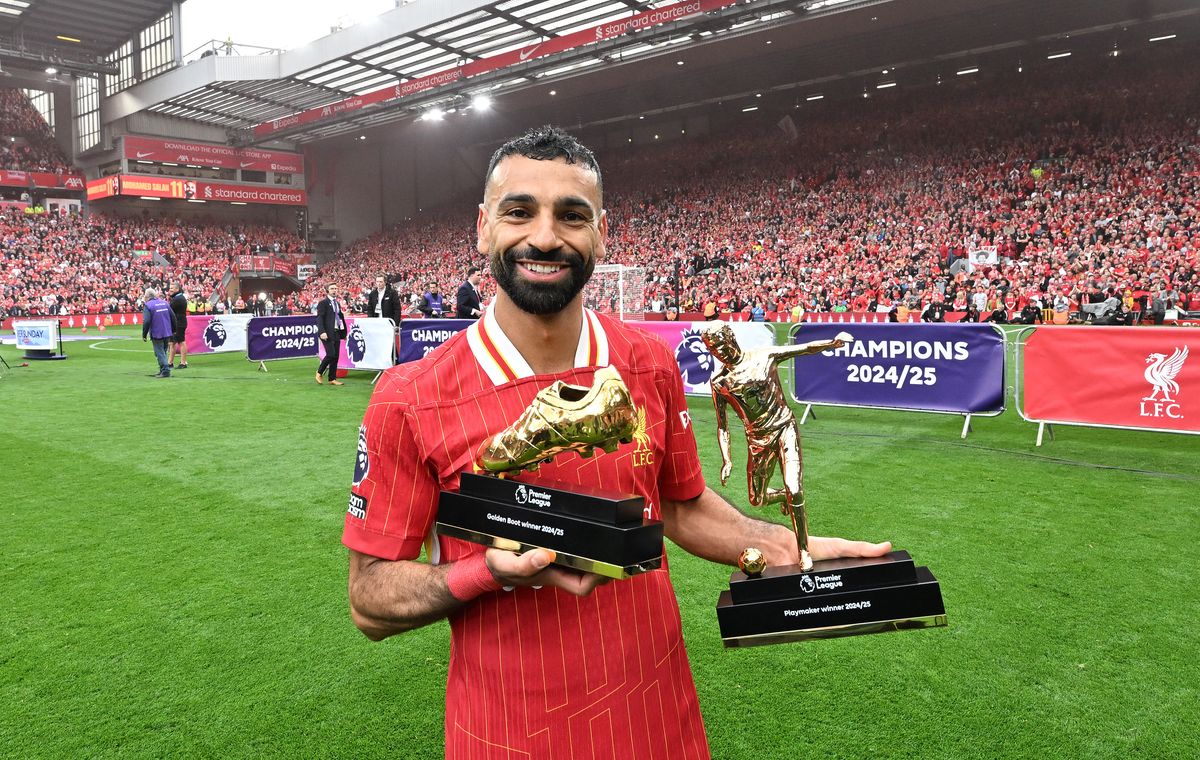
For nine seasons, the answer to “who plays on Liverpool’s right flank” was never really a question. Since arriving from Roma in the summer of 2017, Mohamed Salah became the most reliable attacking output in the club’s modern history, finishing his Anfield career with well over 250 goals and more than 120 assists in all competitions, and inspiring a Premier League title as recently as last season. So when Liverpool confirmed in the spring that Salah would leave at the end of 2025-26, it wasn’t the fact of his departure that stunned anyone connected to the club — his contract situation had been the subject of speculation for over a year — but the timing. Salah still had a season left on the extension he signed only in 2024, and after a difficult run of form that saw him dropped during the campaign, both parties agreed to end things early rather than let an uncomfortable situation fester into the final year of his deal.
What followed was a summer transfer window that Liverpool entered with unusual clarity about the size of the hole they needed to fill, and unusual difficulty actually filling it.
Liverpool’s first and clearest move to directly replace Salah wasn’t Victor Munoz at all — it was an attempt to sign RB Leipzig’s teenage winger Yan Diomande. Reports throughout the early summer had Liverpool ready to smash the Premier League’s record fee for a teenager to bring in the Ivorian, who had gone from half a dozen senior appearances at Leganes to being described by his own representatives as the subject of interest running into the tens of millions within the space of a year. Liverpool’s interest was described at various points as “approved” by the club’s senior decision-makers, with reporting suggesting a fee north of £80m was under discussion — a valuation that would have eclipsed the £58.9m Manchester United paid for Leny Yoro in 2024 as the biggest fee ever committed to a teenage player in English football.
It never happened. Leipzig, for their part, wanted to keep hold of a player they only signed from Leganes for around £17m the previous summer, and were reportedly prepared to offer him a significant pay rise to ward off suitors. As the window wore on, Liverpool’s move for Diomande stalled and ultimately collapsed, leaving the club — by its own admission, through people close to the recruitment operation — without the direct right-sided replacement for Salah it had planned around all summer.
That failure set off a scramble. Names circulated quickly and just as quickly fell away: Ibrahim Mbaye was watched, Yankuba Minteh and Ismail Sarr were explored in the window’s dying days, and Monaco’s Maghnes Akliouche was the subject of interest from a Liverpool recruitment team looking for a creator rather than a like-for-like winger, only for Paris Saint-Germain to move faster and further in the same race. None of it turned into a deal. When the transfer window shut, Liverpool had spent more on their squad than almost any club in Europe — reinforcements arrived across the pitch, headlined by big-money moves for Florian Wirtz and Alexander Isak the previous summer and further significant outlay this time around — but not one specialist right-winger had walked through the door to succeed
The scale of the problem only becomes clear when you look at what Liverpool actually have available out wide. Victor Munoz, Rio Ngumoha, Cody Gakpo and Bradley Barcola have all built their careers playing predominantly on the left side of the attack, cutting inside off that flank rather than driving at defenders from the right. With Salah gone, that leaves Liverpool with, depending on how loosely you want to categorise Jeremie Frimpong’s forward forays from right-back, essentially no recognised right-sided forward in the building at all.
That is not a small oversight for a club of Liverpool’s resources. It means new head coach Andoni Iraola — who arrived at Anfield this summer after Arne Slot’s departure — is not choosing between options on the right so much as deciding which of his naturally left-sided players is least uncomfortable being asked to invert the habits of a career. Every matchday, in effect, Iraola has to shift one of his left-forwards over to a position they have never really called
Sorting through that quartet of left-footed, left-sided attackers, the case for Victor Munoz playing on the right stands out for reasons that have more to do with footballing profile than convenience.
Cody Gakpo’s game is built around cutting inside, getting his head up, and picking a pass or a shot as an auxiliary playmaker rather than a traditional winger who wants to get to the byline. Asking him to flip sides doesn’t just move him ten yards across the pitch, it asks him to become a different type of attacker entirely. Rio Ngumoha, still only eighteen, has similarly built his early breakthrough around cutting in off the left and attacking goal on his stronger foot; shifting him to the opposite flank at this stage of his development is asking a lot of a teenager who hasn’t yet found his level. And Bradley Barcola, signed for a fee in the region of €130m, was bought to do a specific job on the left of Liverpool’s attack — repurposing him now, so soon after that outlay, would be an odd use of a player Liverpool paid a club-record sum to secure.
Munoz is different. His game is built on a directness that doesn’t depend on which foot the ball ends up on or which side of the pitch he starts from — instinctive, reactive running at defenders, chasing down loose balls and second contacts, adjusting on the fly to whatever the situation in front of him presents. If a deflection breaks loose, he follows it. If he beats his man on the outside, he keeps going and drives a ball across the box rather than looking to cut back inside. If the space opens up centrally, he attacks it. It’s a skill set that, unlike Gakpo’s or Ngumoha’s, isn’t tied to a particular side of the pitch. Pre-season performances hinted at exactly that adaptability, and it showed up in a competitive fixture too: Munoz scored from the flank in Liverpool’s match against Nottingham Forest, doing so from a role that wasn’t the left-wing berth he was actually signed to fill.
He wasn’t bought to replace Salah. But circumstance, more than design, has turned him into the closest thing Liverpool have to an
The story of how Liverpool actually got their hands on Munoz is itself one of the summer’s more dramatic subplots. Newcastle United believed they had a deal in place to sign the Osasuna forward, with an initial £29m plus £4.3m in add-ons — around £33.3m in total — accepted by the Spanish club. Munoz had reportedly agreed personal terms with Newcastle, told the Tyneside club he wanted to join, and the two sides had even begun making arrangements for a medical in the United States, where Munoz was on World Cup duty with Spain. Everything, from Newcastle’s perspective, pointed to a done deal.
Then, in the space of roughl 24 hours, it wasn’t. Munoz’s representatives instructed Newcastle to wait, and Liverpool — who had been in the conversation throughout rather than arriving as pure late interlopers — moved to trigger terms of their own, ultimately completing a deal worth around £34.5m, payable in two instalments. Liverpool’s official statement framed it as their first signing of the Iraola era, confirming Munoz had put pen to paper on a long-term contract after clearing a work permit application and international clearance, with the move completed while he was still away at the World Cup wit
Born in Barcelona in July 2003, Munoz’s development reads like a tour of Spanish football’s biggest academies before he ever kicked a ball for a senior side that mattered: Sant Gabriel as a young boy, then La Masia at Barcelona from the age of eleven, before a switch to Real Madrid’s youth setup. He made a handful of first-team appearances for Real Madrid before a permanent move to Osasuna last summer, where an impressive season — 34 appearances, seven goals and five assists across all competitions in the reporting available — earned him his first senior Spain caps, including a goal on his debut against Serbia.
That form was enough to get him into Spain’s World Cup squad this summer, where his country went on to win the tournament, beating Argentina in the final, even though Munoz himself didn’t feature on the pitch during the knockout stages. It’s a modest personal footnote to a major international triumph, but it underlines the trajectory: a player who started last season on the fringes of Osasuna’s squad ended it a Spain international, a World Cup winner, and a near-£35m Liverpool signing.
Since arriving at Anfield, Munoz has spoken about the adjustment to a new country and a new dressing room, describing the move as involving personal sacrifice and calling his new environment a kind of extended family as he settles in alongside his new teammates. He has taken the number 23 shirt and, by his own account, arrived in good shape physically after his summer with the Spain squad in the United States, eager to build on that fitness base once his club pre-season got underway in earnest.
None of this changes the underlying reality that Liverpool’s summer business, at least as far as directly replacing arguably the best forward of the Premier League era is concerned, will be remembered as much for what fell through as for what got done. The market for elite right-sided attackers was, by most reporting, unusually thin this summer, and Liverpool weren’t the only club to find that out the hard way. Even PSG, chasing Monaco’s Akliouche as an alternative solution to their own version of this problem, needed multiple rejected bids before getting close to a deal.
For Liverpool, the practical consequence is that Iraola will spend this season effectively playing without a like-for-like Salah replacement in personnel terms, relying instead on tactical flexibility to paper over a positional gap that the club had a full summer, and a serious financial war chest, to try to fill. Whether Munoz’s directness and reactive style can genuinely replicate the end product Salah produced from that side of the pitch for the better part of a decade is a question that will only be answered over a full season of Premier League fixtures rather than a single pre-season goal against Nottingham Forest
A few threads are worth following as the season develops. The first is simply output: does Munoz’s goal and assist return from the right come close to justifying the positional switch, or does Liverpool’s overall attacking productivity dip in the position Salah occupied for nine years? The second is squad management — whether Iraola continues rotating which left-sided forward fills in on the right depending on the opponent, or settles on Munoz as the long-term incumbent regardless of fixture. And the third is the transfer market itself: with the failed Diomande pursuit still fresh, and Leipzig’s asset now presumably more expensive than ever after a strong platform season, it would be no surprise to see Liverpool revisit the right-wing question again in a future window, treating Munoz’s conversion as a solution for now rather than forever.
For a club that spent the summer being asked, again and again, who replaces Mohamed Salah, the answer that has emerged isn’t a marquee arrival bought specifically for the job. It’s a versatile 23-year-old World Cup winner who was signed to play on the opposite flank, and who now finds himself, mostly by necessity, as Liverpool’s most credible option to fill the biggest boots at Anfield.