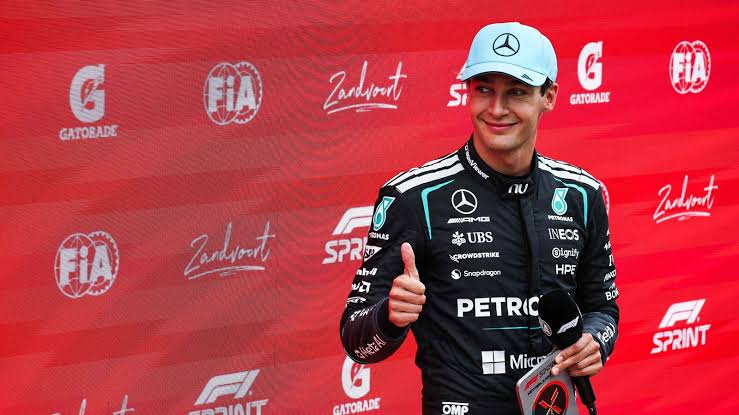
George Russell delivered exactly the response Mercedes needed after Formula 1’s summer break, converting pole position into a comfortable and controlled Sprint victory at the Dutch Grand Prix, leading every single lap of the twenty-four lap dash around the tight and twisting Circuit Zandvoort to claim his third Sprint win of the 2026 season. It was, in many ways, the perfect way to kick off the second half of the campaign for a driver who had endured a difficult opening portion of the year relative to his teammate, and the manner in which he managed the race from lights to flag, rather than simply relying on straight-line speed to disappear into the distance, spoke to a driver very much back in control of his own destiny heading into the business end of the championship. With rain arriving at Zandvoort almost the very moment Russell crossed the finish line, the timing of his victory could scarcely have been better, sparing him and Mercedes any late scare on a circuit notorious for punishing drivers who get their tyre strategy even slightly wrong once the heavens open.
The story of Russell’s Saturday actually began the day before, during Sprint Qualifying, where the Briton profited from a slice of misfortune that befell his own teammate. Championship leader Kimi Antonelli had topped the timesheets in the sole practice session of the weekend, appearing to be the man to beat heading into qualifying, but the young Italian’s hopes of building on that pace were dashed when he suffered an off at the penultimate corner during the first qualifying segment, an incident that cost his Mercedes a reported twenty-five points of downforce due to floor damage. That mistake opened the door for Russell, who seized the opportunity in ruthless fashion, going quickest through the remaining segments of qualifying to claim pole position ahead of Lando Norris’s McLaren, with Charles Leclerc’s Ferrari lining up third and Norris’s teammate Oscar Piastri rounding out the second row in fourth. Antonelli, hampered by the damage picked up in that earlier off, could only manage fifth on the grid, a considerable blow for a driver who had looked the fastest man at Zandvoort just hours earlier and who would go on to feel the consequences of that lost track position throughout the race itself.
When the lights went out for the Sprint itself, Russell made exactly the kind of start Mercedes would have been hoping for, holding position at the front of the field and successfully fending off any early pressure from Norris, who lined up alongside him on the front row. It wasn’t the cleanest getaway imaginable, but it was more than good enough to secure the position that mattered most at a circuit like Zandvoort, where the narrow, flowing layout makes overtaking notoriously difficult and track position at the opening corner often proves decisive for the remainder of the race. Immediately behind the front two, there was early drama as Antonelli produced a sweeping move around the outside of Piastri at Turn 1, a bold and well-executed piece of driving that instantly clawed back one of the positions he’d lost in qualifying and set him up for what would become a lengthy and ultimately fruitless pursuit of the podium places ahead. That opening-lap swap between Antonelli and Piastri would prove to be one of the very few genuine changes of position anywhere in the top ten for the remainder of the race, underlining just how processional the Sprint would go on to become once the early skirmishes had sttled down.
Once clear at the front, Russell set about doing exactly what a driver in his position should do: managing the race intelligently rather than trying to disappear into the distance in a manner that might compromise his tyres for the closing stages. Rather than pushing flat out from the outset, Russell was deliberately conservative with his pace during the opening exchanges, nursing his tyres through the first ten laps or so while ensuring he retained just enough of a buffer over Norris to keep the McLaren driver outside of the overtake mode threshold that could have given him a genuine chance of a move. It was a mature, controlled approach that reflected a driver fully aware of exactly how fine the margins can be at a circuit as unforgiving of mistakes as Zandvoort, and it paid dividends once Russell was given the green light from his engineers to properly unleash his pace around the ten-lap mark. From that point onwards, the gap to Norris began to grow steadily, and what had briefly looked like it might develop into a genuine scrap for the lead instead settled into a comfortable, unchallenged cruise to the chequered flag for the polesitter.
The most significant action of the entire Sprint actually unfolded behind Russell, in the battle for what would ultimately become second and third place. Ferrari had made a bold and slightly contrarian strategic call ahead of the race, opting to start Charles Leclerc on the softer compound of tyre while virtually every other frontrunner, Russell and Norris included, lined up on the more durable medium compound. It was a gamble that initially looked like it might not pay off, with Leclerc unable to immediately capitalise on any grip advantage the softer rubber theoretically offered, and for the majority of the race’s first half he found himself simply sitting on the rear wing of Norris’s McLaren, unable to find a way past despite clearly carrying a pace advantage over the sister car ahead. That persistent pressure eventually told, though, and on lap eighteen of the twenty-four-lap contest, Leclerc finally pounced, using the extra grip afforded by his softer tyres to complete a decisive move on Norris into the first corner after closing right onto the McLaren’s tail down the pit straight. It was a well-judged and cleanly executed overtake, and once through, Leclerc rapidly opened up a gap over Norris, confirming in the process that the McLaren driver had indeed been carrying a genuine rear-tyre disadvantage in the closing stages that left him unable to muster any kind of response.
For Norris, the concession of second place to Leclerc represented a frustrating end to what had otherwise been a solid weekend, and it continued something of a theme for McLaren at Zandvoort, with the team having struggled for outright pace in the low-speed sections of the circuit throughout the event. Still, Norris did at least have something to hold onto, managing his tyres and his defensive lines well enough in the aftermath of Leclerc’s pass to keep Antonelli at arm’s length for the remainder of the race and secure third place on the podium. Antonelli, for his part, produced arguably the most eye-catching recovery drive of the entire Sprint, closing right onto the back of Norris’s McLaren in the closing laps and getting to within half a second of the position at one stage, but ultimately finding no realistic opportunity to complete a pass given how narrow and difficult to overtake on the Zandvoort layout proves to be, even for a car that appeared to have the pace advantage. The championship leader was left to settle for fourth, a position that, while respectable given his difficult start to the weekend following the qualifying mishap, will nonetheless have stung slightly given how close he came to snatching a podium away from his direct title rival in Norris.
Behind that gripping four-way battle at the front, the remainder of the points-paying positions fell largely into place based on grid order and settled there for the majority of the race, a further reflection of just how difficult wheel-to-wheel racing proves to be around Zandvoort’s tight confines. Oscar Piastri came home fifth for McLaren, unable to find a way back past Antonelli after losing out to the Italian at the start, while home favourite Max Verstappen brought his Red Bull across the line in sixth place. There was a particularly pointed subplot to Verstappen’s relatively modest result, arriving as it did mere days after the four-time World Champion had committed his long-term future to Red Bull with a new contract running through to 2030. To see the Dutchman qualify and race in the midfield in front of his own passionate home crowd at what is being billed as the final Dutch Grand Prix before Zandvoort potentially drops off the Formula 1 calendar felt like a slightly deflating juxtaposition against the show of long-term faith he’d just placed in his team, though anyone familiar with Red Bull’s recent form patterns will know the team has developed something of a habit of looking off the pace on Fridays and Saturdays before discovering genuine performance by the time Sunday’s Grand Prix rolls around, meaning Verstappen and his supporters will hold out hope of a significantly stronger showing when the points that truly matter are on offer.
Lewis Hamilton endured a thoroughly disappointing afternoon by his own considerable standards, finishing seventh in the second Ferrari and never appearing to be in genuine contention throughout the Sprint, a result that will do little to ease the growing scrutiny on his season as he continues searching for the kind of consistent pace that might yet ignite a serious title challenge over the remaining months of the campaign. Pierre Gasly rounded out the points-scoring positions in eighth for Alpine, successfully holding off a determined challenge from Audi’s Gabriel Bortoleto and Racing Bulls’ Arvid Lindblad to claim what will feel like a valuable haul of points for a team not habitually found competing at the sharp end of the field. Further back, there was late drama in the midfield too, with both Carlos Sainz and Fernando Alonso forced to start from the pit lane following set-up changes made to their respective cars, while Liam Lawson deputised for the injured Isack Hadjar at Red Bull’s sister team, finishing eleventh just ahead of his own Racing Bulls replacement, Yuki Tsunoda, who was making his first race start back at the team having lost out to Franco Colapinto’s Alpine at the opening corner in what was, in fairness, his first experience of the considerably more complicated start procedure demanded by this generation of Formula 1 cars
For Russell himself, this victory carries significance that extends well beyond the simple accumulation of Sprint points on a Saturday afternoon. It marked his first win in any race format, Sprint or Grand Prix, since his triumph at the Austrian Grand Prix back in June, meaning the summer break arrived at a genuinely opportune moment for a driver who had watched his teammate Antonelli establish and extend a commanding lead at the top of the World Championship standings during the opening half of the season. Reflecting on his afternoon’s work afterwards, Russell was characteristically understated, praising the quality of his getaway off the line as the foundation for everything that followed, and admitting that he was relieved the rain held off until the very moment he crossed the finish line rather than arriving even a lap or two earlier, when it could have thrown the entire complexion of the race into chaos and potentially cost him a victory he had otherwise managed with real precision and control. It’s a mark of how tight the margins remain even in a race as processional as this one ultimately proved to be that a downpour arriving just sixty seconds sooner could plausibly have changed the entire outcome, and Russell will know exactly how fortunate the timing worked out in his favour.
The result also carries meaningful implications for the championship picture as Formula 1 heads into the second half of an already fascinating 2026 season. Russell’s victory trimmed the gap to Antonelli in the standings, even if the Italian’s fourth-placed finish meant he still walked away from Zandvoort having extended his overall advantage at the summit of the championship table, moving three points clear to a lead reported in the region of fifty-three points over his teammate. That’s still a commanding cushion for Antonelli to carry into the remainder of the campaign, and it underlines just how dominant his opening half of the season has been despite the minor setback of losing track position in qualifying at Zandvoort. But Russell’s ability to bounce back so emphatically from a difficult start to the year, delivering a lights-to-flag Sprint victory that never looked remotely under threat once he’d established his early advantage over Norris, will offer genuine encouragement to Mercedes as they look to keep both of their championship contenders firmly in the mix heading towards the campaign’s climax. There’s also a broader subplot at play within the Mercedes garage itself, with reports suggesting the team has had to actively manage some tension in the relationship between its two title-chasing drivers as the stakes have risen throughout the season, and results like this one, where Russell comprehensively outperforms his more highly-fancied teammate over an entire race weekend, will only add fresh intrigue to how that intra-team dynamic continues to play out over the remaining rounds.
Beyond the individual storylines, this Sprint also carried a certain poignancy given the wider context surrounding Zandvoort’s future on the Formula 1 calendar. With reports suggesting this could prove to be the final Dutch Grand Prix held at the seaside circuit for the foreseeable future, there was an added weight to proceedings that went beyond the usual championship considerations, and the sight of Max Verstappen, the driver whose extraordinary popularity essentially single-handedly resurrected Zandvoort’s place on the modern Formula 1 schedule after decades away from the calendar, competing only in the midfield in what could be his final home Sprint at the venue added a slightly bittersweet undertone to what was, on paper, a fairly straightforward and unremarkable strategic afternoon at the front of the field. Whether Zandvoort does ultimately disappear from future calendars remains to be seen, and there will undoubtedly be plenty of Dutch fans hoping this proves not to be a permanent farewell, but for now the narrow, undulating dunes-lined circuit has provided one more slice of genuine Formula 1 drama, even if the drama on this particular Saturday was concentrated almost entirely in the fight for the podium places rather than for the win itself.
Attention now turns to Sunday’s Grand Prix proper, where Russell will start from provisional pole once again, though the grid for the main event will ultimately be determined by a separate qualifying session rather than simply carrying over Saturday’s Sprint order. With Verstappen historically finding extra pace once qualifying for the Grand Prix arrives, and with Ferrari having demonstrated genuine race-winning speed through Leclerc’s impressive tyre management and overtaking display in the Sprint, there’s every reason to expect a considerably more competitive and unpredictable battle for Sunday’s main event than the largely processional affair that unfolded on Saturday afternoon. For Russell and Mercedes, though, the priority right now is simply banking the maximum available points and carrying that momentum forward, and after a summer break that arrived at exactly the right time to reset his campaign, converting Sprint pole into Sprint victory in such comprehensive fashion represents about as ideal a way as possible to kick off the second half of what remains a fiercely contested and fascinating World Championship fight.