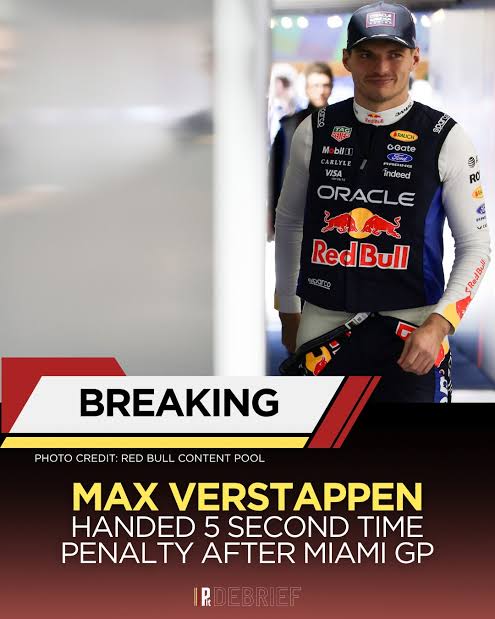
Max Verstappen’s race at the Miami Grand Prix didn’t end without controversy, as the Red Bull star was handed a five-second time penalty following a pit lane infringement. While the sanction ultimately didn’t alter his finishing position, it has sparked renewed discussion about race control decisions and the fine margins that define modern Formula 1.
The penalty stemmed from Verstappen’s sole pit stop on Lap 9, which occurred under safety car conditions after incidents involving Isack Hadjar and Pierre Gasly. As Verstappen exited the pit lane, he was noted for potentially crossing the white line—a clear violation under FIA regulations designed to ensure safety during pit exits. Unlike most in-race infringements, the decision was not made immediately, with officials opting instead to review the incident after the race.
Following a detailed post-race investigation, stewards analyzed multiple camera angles and onboard footage before confirming that the outer edge of Verstappen’s front-left tyre had indeed crossed the designated boundary line. This placed him in breach of Appendix L, Chapter IV, Article 6(c) of the FIA’s International Sporting Code. Despite Verstappen being consulted during the process, the visual evidence proved decisive, leaving little room for interpretation.
Interestingly, the timing of the decision had minimal impact on the race outcome. Verstappen retained his fifth-place finish largely due to a separate penalty handed to Charles Leclerc, who received a 20-second sanction for repeated track limit violations on the final lap. Without that penalty, Verstappen’s position could have been under serious threat, especially with Lewis Hamilton finishing within a manageable gap behind.
From an analytical perspective, this incident highlights the increasing reliance on post-race reviews in Formula 1, particularly when immediate evidence is inconclusive. While this approach ensures accuracy, it also raises questions about consistency and the potential influence on race strategy if penalties are delayed. Teams and drivers must now operate with the understanding that decisions may come after the chequered flag, adding another layer of unpredictability.
Looking ahead, Verstappen’s aggressive yet calculated style continues to walk a fine line between brilliance and risk. As the championship battle intensifies—with emerging threats and shifting team dynamics—such minor infractions could carry greater consequences in tighter races. If Red Bull aims to close the gap to front-runners, eliminating these small but costly errors will be just as crucial as improving outright performance.