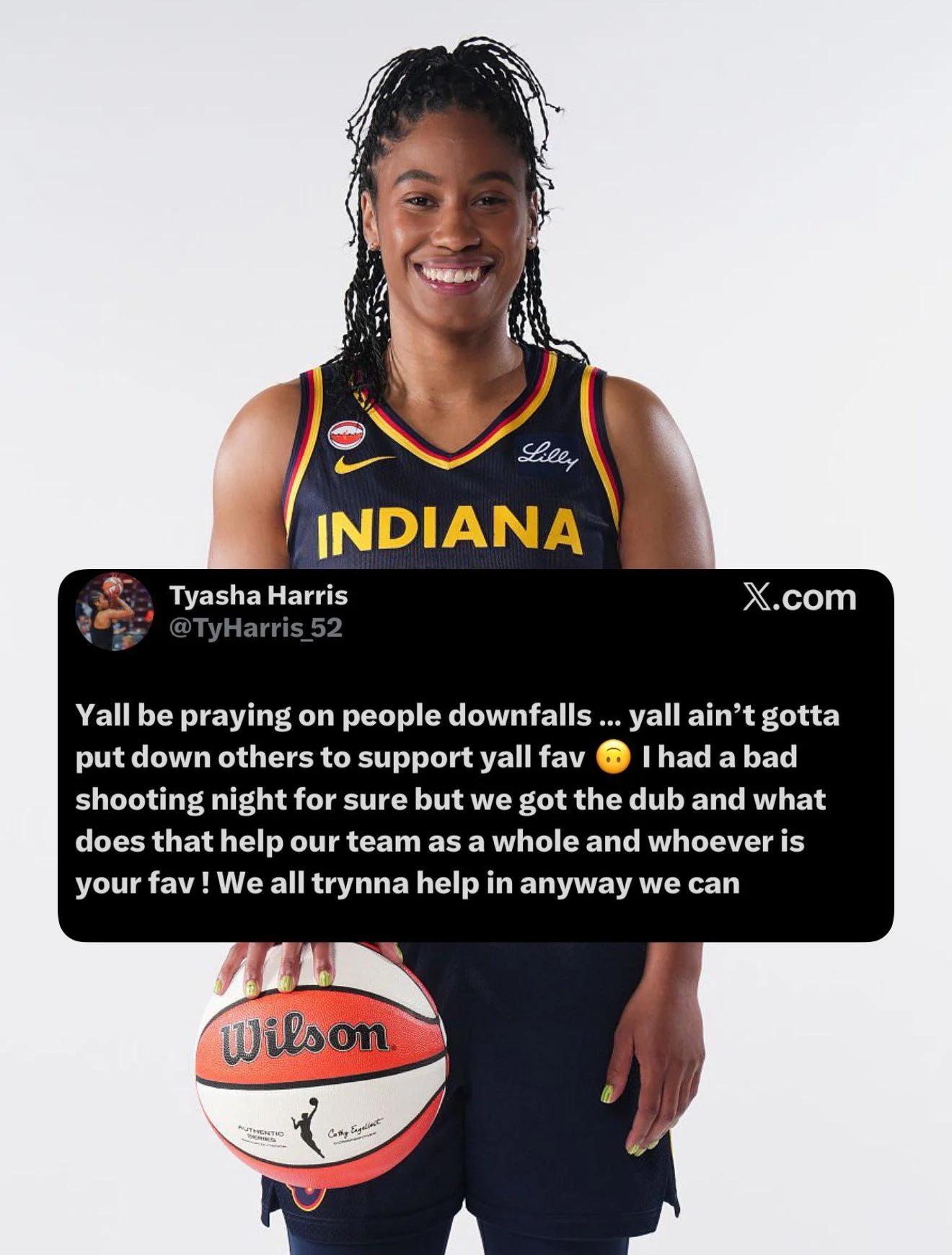
The Indiana Fever continue to chase championship ambitions, but with greater expectations comes greater scrutiny. Every missed shot, turnover, or cold shooting performance quickly becomes a talking point on social media—especially for a roster filled with recognizable names.
That reality prompted Indiana Fever guard Tyasha Harris to speak out after a difficult offensive performance despite the team earning an important victory.
In a post on X, Harris acknowledged her struggles while delivering a broader message to fans. She wrote that people shouldn’t celebrate players’ bad games simply to elevate their favorite athlete, adding that although she had “a bad shooting night,” the Fever still secured the win and every player is trying to contribute to the team’s success.
THE BIGGER ISSUE GOES BEYOND ONE BAD GAME
Every player experiences off nights. Even elite shooters go through stretches where the basket seems smaller than usual.
What made Harris’ comments resonate wasn’t her admission that she struggled—it was her reminder that basketball is ultimately a team sport.
The Fever aren’t built around one player carrying the entire load every night. Their championship aspirations depend on role players producing when needed, stars trusting their teammates, and everyone accepting that individual statistics sometimes take a back seat to winning.
That message is especially relevant for Indiana, whose rapidly growing fan base has brought unprecedented attention—and criticism—to nearly every possession.
SOCIAL MEDIA HAS CHANGED THE WNBA EXPERIENCE
The Fever are among the league’s most talked-about teams, meaning every performance is analyzed in real time.
When a player misses open shots, social media often fills with criticism before the final buzzer. Harris’ post reflects the growing challenge athletes face in balancing public expectations with the reality that consistency is difficult over a long season.
Rather than focusing on individual struggles, Harris encouraged fans to support the team as a whole.
That mindset is one championship-caliber organizations often embrace internally.
WHY ROLE PLAYERS MATTER IN A TITLE CHASE
Championship contenders rarely succeed because of star power alone.
Indiana’s biggest strength is its depth. Players like Harris provide valuable minutes as a backup guard, helping stabilize the offense, defend opposing guards, and keep the team’s stars fresh throughout the season.
Even if the shots aren’t falling on a particular night, there are countless ways to impact winning through defense, passing, communication, hustle plays, and leadership.
Those contributions don’t always appear in the box score, but coaches value them tremendously.
THE FEVER’S LOCKER ROOM APPEARS UNITED
Harris’ message also hints at the culture Indiana is trying to build.
Instead of making excuses for her shooting, she accepted responsibility while emphasizing the team’s victory.
That accountability often strengthens chemistry inside a locker room.
Teams capable of making deep playoff runs usually avoid finger-pointing after poor individual performances. Instead, they focus on correcting mistakes while celebrating wins.
If the Fever maintain that approach, they’ll be better equipped to handle the inevitable ups and downs of a long WNBA season.
WHAT THIS MEANS MOVING FORWARD
Fans should expect Harris to continue playing an important supporting role.
Veteran guards don’t lose confidence because of one difficult shooting night. More often than not, they respond by trusting their preparation and continuing to take quality shots.
For Indiana, that’s exactly what matters.
The Fever don’t need perfection from every player every game. They need resilience, depth, and a commitment to team basketball.
If Harris quickly bounces back—as experienced veterans often do—Indiana’s rotation becomes even stronger heading into the most important stretch of the season.
FINAL THOUGHTS
Tyasha Harris’ message wasn’t just about defending herself after an off night.
It was a reminder that winning teams succeed because every player contributes, whether through scoring, defense, leadership, or hustle. Individual shooting slumps are temporary, but a united locker room can become a lasting competitive advantage.
As expectations continue to rise around the Indiana Fever, Harris’ comments serve as a timely reminder that supporting the entire roster—not just individual stars—could be one of the biggest keys to the team’s championship hopes.