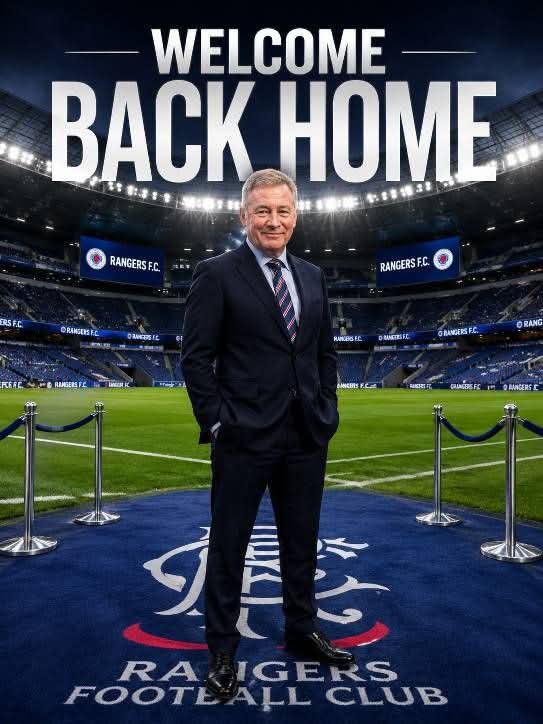
# The Boy Done Good: Derek McInnes’s Long Road Back to Ibrox
There is a particular kind of story Scottish football loves to tell itself, and it goes something like this: a boy grows up on the terraces, or close enough to them, worshipping a club that seems impossibly big and impossibly far away. He gets the chance to pull on the jersey as a player, lives out a piece of the dream, and then leaves. Years pass. He builds a career elsewhere, proves himself, gets knocked back, gets written off, gets talked about as a nearly-man. And then, when almost nobody is expecting it anymore, the call finally comes. That is more or less the shape of Derek McInnes’s return to Rangers Football Club in the summer of 2026, and it is a story that took the better part of a decade to actually arrive.
McInnes was appointed Rangers head coach in June 2026, stepping into a dugout that had become something of a revolving door in recent seasons. He replaced Danny Röhl, the German coach who had lasted only eight months at Ibrox after being lured away by RB Salzburg, one of the more aggressively ambitious clubs on the continent. Röhl himself had arrived in October 2025 as a mid-season fix following the sacking of Russell Martin, whose own tenure had been brutally short: appointed in June 2025 on a three-year deal, sacked by October after a run of one win in seven league games left the club sitting eighth in the Scottish Premiership. Two managerial changes inside twelve months is the kind of chaos that would rattle any institution, and Rangers, a club that measures itself constantly against Celtic and against its own storied past, is not an institution that handles chaos gracefully. Into that unsettled picture stepped McInnes, at fifty-four years old, with a Rangers shirt already in his past and, by his own account, unfinished business with the club he had supported since he was a boy.
The connection between McInnes and Rangers is not a manufactured one, dreamed up by a marketing department looking for a feel-good headline. He played for the club between 1995 and 2000, part of the Nine in a Row era, turning out under two of the most significant managers in the club’s modern history, Walter Smith and Dick Advocaat. That kind of lineage matters at Ibrox in a way it might not at other clubs. Rangers under recent ownership have experimented with head coaches from very different footballing cultures, and while some of those appointments made sense on paper, there has often been a sense among supporters that something essential was missing, some grasp of what the job actually demands emotionally as much as tactically. McInnes, whatever else can be said about his managerial record, is not a coach who needs that explained to him. He has lived it.
What makes the appointment even more interesting is that it very nearly happened almost a decade earlier. Back in 2017, with Rangers in the market for a new manager after parting ways with Pedro Caixinha, McInnes was the name most heavily linked with the vacancy. He was then in charge of Aberdeen, where he had built a genuinely impressive body of work: three successive second-place finishes behind Celtic in the Premiership and a Scottish League Cup triumph in 2014, a rare piece of silverware prised away from the Old Firm duopoly. Rangers made their approach, Aberdeen initially rebuffed it, and McInnes spent an uncomfortable few days locked in private deliberation while the Scottish football press worked itself into a frenzy speculating about which way he would jump. In the end, he chose to stay at Pittodrie, citing unfinished business there and the weight of the decision for his family. Aberdeen chairman Stewart Milne declared himself the happiest man in the world. Rangers were sent back to square one in their managerial search. For McInnes, it was the second time in six months he had turned down an approach from a bigger club, having also rejected interest from Sunderland earlier that year.
That decision to stay loyal to Aberdeen in 2017 has taken on a certain retrospective significance now that the move has finally happened almost nine years later, on very different terms and after a very different journey. In the years between, McInnes’s reputation went through something of a wringer. His eventual departure from Aberdeen, after eight years in charge, was not the clean, celebrated ending that a man of his achievements there might have deserved; by the time he left, some of the shine had come off, and the conversation around him in the media had shifted from promising young-ish manager to a coach whose ceiling people thought they understood. He took charge at Kilmarnock, and later had a spell at Hearts that did a great deal to restore his standing in Scottish football. It was at Tynecastle, in fact, that McInnes produced arguably the finest season of his managerial career, guiding Hearts to a runners-up finish in the Scottish Premiership, agonisingly close, by his own admission, to something even more remarkable. He was reportedly within minutes of guiding the club to an actual title challenge that would have upended the established order of Scottish football, a order that has essentially belonged to Celtic and Rangers for the club’s entire modern history bar a couple of exceptions.
That Hearts season is really the foundation on which the Rangers job offer was built. When Röhl departed for Salzburg in June 2026, Rangers moved with a speed and a clarity of purpose that had been notably absent in some of their previous managerial searches. Chief executive Jim Gillespie and the club’s ownership group, led by American businessman Andrew Cavenagh alongside fellow consortium figures including Paraag Marathe, reportedly settled on McInnes with a framework of thinking that one senior figure at the club later described in strikingly simple terms: there are, broadly speaking, two archetypes of modern football manager, the front-foot, aggressive, chance-creating type in the mould of Jürgen Klopp, and the more possession-dominant, positional type associated with Pep Guardiola. Rangers, in this framing, wanted the former, and identified McInnes as fitting that Klopp-adjacent profile, a coach whose teams are set up to be direct, energetic, and front-footed rather than patiently probing. Whatever one makes of comparing any Scottish Premiership manager to two of the most decorated coaches in the history of the sport, it does tell you something about how deliberately Rangers approached this appointment, and how much store they set by finding the right cultural and stylistic fit rather than simply reaching for the most famous available name.
There was also, by all accounts, real diligence in the process itself, described by those involved as wanting to see, almost literally, the whites of a candidate’s eyes before committing. McInnes reportedly had plenty of questions of his own for the club during the process, which is perhaps unsurprising for a man who had watched the Ibrox job come and go once before and who understood better than most exactly what he would be walking into. A compensation package was agreed with Hearts, described as a six-figure sum, and McInnes made the move north up the road to Glasgow along with a chunk of his backroom staff. Assistant coaches Alan Archibald and Paul Sheerin followed him from Tynecastle, both men having worked with McInnes previously and clearly trusted enough to be brought along for this next, much bigger, chapter. Craig Clark, a coach McInnes had worked with during his time at Kilmarnock, also joined the setup at Ibrox. It is the kind of backroom continuity that suggests a manager who knows what he wants and who he trusts to help him deliver it, rather than someone parachuting in cold to inherit whatever staff happened to be left behind.
McInnes signed a three-year contract, running through to the end of the 2028/29 campaign, a length of commitment that signals a degree of mutual confidence on both sides, club and manager, that this appointment is meant to be more than a stopgap. When he sat down for his first interview as Rangers manager, in the Blue Room off the Main Stand at Ibrox, having taken in the manager’s office at the top of the famous marble staircase, McInnes did not try to hide how much the moment meant to him. He described it as an emotional day, a privilege, and said quite plainly that it felt right, that he belonged there. He talked about supporting the club as a boy, about having always wanted this job at some point in his career, and about the particular blend of pride and pressure that comes with managing a club whose expectations are, in his own words, something you need a great deal more than just tactical know-how to deal with. He was refreshingly honest, too, about the scale of the challenge: he acknowledged that his prior knowledge of the club and its culture would help him, but stressed that ultimately he would be judged, as every Rangers manager is judged, on results and on the performances of his players on the pitch.
That honesty has been tested quickly, because Scottish football does not offer new managers, even sentimentally popular ones, much of a grace period. Rangers had finished third in the Premiership the previous season, a position McInnes himself has since described in blunt terms as simply not good enough for a club of Rangers’ size and history. His opening competitive fixture in charge, away to Dundee United, extended an increasingly uncomfortable club record: Rangers had not won an opening-day league fixture in four years, and under McInnes that unwanted streak continued, the match finishing 1-1 after United took an early lead and Thelo Aasgaard equalised in the second half. In the aftermath, an evidently frustrated McInnes admitted he had been out of order in his conduct toward the match referee, a moment of raw emotion that, while not the ideal start any new manager would choose, at least demonstrated the depth of feeling and standards he is bringing to the role from day one. There has been turbulence in cup competition too, with a chastening European exit that McInnes described as a stark illustration of the work still needed within the squad, a defeat he was quick to say he owned rather than deflect from his players.
Reaction among the Rangers support to the appointment itself, in the days immediately after it was confirmed, split roughly along familiar lines, the same lines that tend to define any big managerial call at a club with as demanding and divided a fanbase as this one. There were supporters who described it, in almost romantic terms, as the perfect appointment, a manager who represented exactly what had been missing: a proven, tactically capable, unmistakably Scottish and unmistakably Rangers voice at the helm, someone in the mould of the great Walter Smith, under whom McInnes himself had once played. Others were considerably more skeptical, pointing out that Rangers is simply a different animal to any club McInnes has managed before, a club built entirely around the expectation of winning rather than merely competing well, and predicting that the patience typically extended to a promising manager elsewhere in Scottish football would evaporate quickly at Ibrox if results did not follow fast enough. Both camps, in their own way, have a point, and the opening weeks of the season have offered enough evidence to sustain either reading depending on which results you choose to emphasise.
What is not in dispute is the scale of what McInnes has taken on. Rangers’ recent history, three different managers across barely more than a year before his arrival, reflects an ownership group under real pressure to stabilise a footballing institution that has spent much of the past decade and a half oscillating between genuine crisis, near financial collapse and relegation to the bottom tier of Scottish football in the early 2010s, and periods of real competitiveness, without ever quite recapturing the sustained, era-defining dominance of the Nine in a Row years that McInnes himself was part of as a player. The club’s current ownership consortium, fronted by Cavenagh with backing connected to 49ers Enterprises, the investment arm of the San Francisco NFL franchise, has made a series of consequential decisions since taking control, and the appointment of McInnes represents perhaps the clearest statement yet of the identity they want the club to project: less an experiment in imported footballing philosophy, more a return to something rooted, familiar, and unapologetically Scottish.
There is an obvious symmetry in all of this that Rangers supporters, and McInnes himself, will not have missed. A boy who supported the club, who played for it during one of its most successful periods, who was courted for the manager’s job nearly a decade ago and chose loyalty to another club instead, has finally arrived at the top of that famous marble staircase at an age and a stage of his career where the disappointments and vindications of the years between feel almost like necessary preparation. Whether that story ends the way the romantics among the support hope it will, with silverware, with a genuine title challenge, with the kind of era that gets its own nostalgic retelling decades from now, is impossible to say with any confidence this early into his tenure. Scottish football, and Rangers in particular, has not been especially forgiving of sentiment in recent seasons. But for now, at least, the club has a manager who does not need the significance of the job explained to him, who has already lived through the version of this story where the answer was no, and who by every indication intends to make sure this second chance, so long in coming,is not wasted.