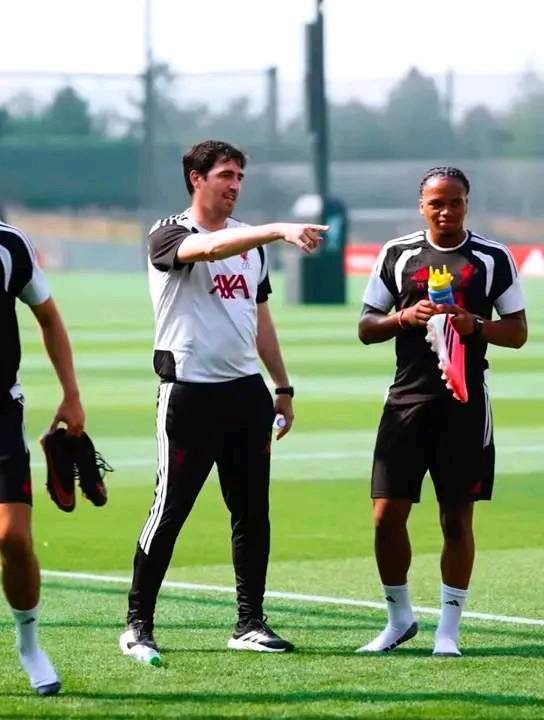
Rio Ngumoha will be eligible to sign a 5 year contract when he turns 18 at the end of the month
There are certain stories in football that feel less like news and more like an inevitability finally arriving on schedule, and Rio Ngumoha’s next Liverpool contract is exactly that kind of story. Every follower of the club’s academy pipeline has known this moment was coming since the day he put pen to paper on his first professional deal, and now the calendar has simply caught up with the expectation. On August 29, Ngumoha turns 18, and the instant he does, Liverpool are free to offer him the kind of long-term contract that reflects what he has already become rather than what he might still turn into. It is a small quirk of football regulation that has kept one of the most exciting teenagers in England tied to a deal signed under rules designed for children, and in a matter of days that quirk disappears for good.
The regulation itself is simple but easy to forget about unless you follow academy football closely. Under FA rules, no player under the age of 18 can sign a contract longer than three years. It doesn’t matter how good the player is, how much a club wants to protect their asset from circling suitors, or how obvious it is that the relationship is going to last a decade. The three-year ceiling exists to protect young players from being locked into arrangements before they are legally adults, and it applies to everyone regardless of talent. Ngumoha ran into that ceiling last September when he signed his first pro contract, a deal that was reported to run until 2028. At the time it was the maximum Liverpool were allowed to offer him, even though everyone inside the building clearly wanted to do more.
That first contract came off the back of a breakout autumn that few could have scripted. Ngumoha had only joined Liverpool’s academy in September 2024 after moving from Chelsea, and within a year he was already making senior appearances for the champions of England. The moment that really put his name in front of a national audience came against Newcastle United, when he came off the bench and scored a stoppage-time winner in the 100th minute, turning a game that looked like it might slip away into three points. He was 16 years and 361 days old at the time, which made him the youngest goalscorer in Liverpool’s Premier League history and the fourth-youngest scorer the competition has ever seen, behind only James Vaughan, James Milner, and Wayne Rooney. For a club with as much history as Liverpool, being mentioned in the same breath as those names within days of a first senior goal is not a small thing.
That Newcastle goal wasn’t a one-off flash either. A few weeks earlier he’d become the youngest player to ever start a match for Liverpool when he was named in the side against Accrington Stanley in the FA Cup back in January. He also featured in the Champions League that season, coming off the bench in a win over Atletico Madrid at Anfield, adding continental experience to a resume that was filling up remarkably fast for someone who still had a year and a half of being a teenager left to go. By the time his first professional contract was announced, Liverpool were simply formalizing what results on the pitch had already made clear: this was not a academy prospect anymore, this was a first-team player who happened to still be a teenager.
The wage structure attached to that first deal is a useful reminder of just how differently academy football treats even its brightest talents compared to the finished product. Ngumoha had been earning around £1,200 a month on his scholarship terms before signing professional forms, and his new contract reportedly bumped him up to something in the region of £52,000 a year, described at the time as the maximum permitted for a first-year professional at the club. That’s a serious jump in absolute terms, but it’s worth sitting with the fact that a teenager who was already scoring famous late winners for Liverpool in the Premier League was, by football’s grandest standards, still being paid something closer to an entry-level salary. It reflects a deliberate philosophy at Liverpool of keeping young players hungry and motivated by opportunity rather than by money, something manager-level voices at the club have spoken about in the past when discussing how they handle emerging talent. The financial reward, in this worldview, is meant to follow the football rather than precede it.
And the football kept coming. Across last season Ngumoha made 29 appearances in all competitions, with nine of those being starts, contributing goals against both Newcastle and Fulham in the Premier League. His minutes were managed carefully in the early part of the campaign, reportedly totaling around 349 minutes across the first 38 games of the season, before that number nearly doubled to roughly 603 minutes across the final 19 matches as coaching staff grew more comfortable trusting him with bigger roles. Over the full campaign he was up around 952 minutes, a figure that returned two goals and an assist, modest on paper but significant in context given how selectively those minutes were rationed for a player still legally a child for most of the season.
Beyond the club level, the interest from England’s senior setup is arguably the clearest external signal of how highly Ngumoha is rated. Thomas Tuchel brought him into the senior England squad as a training player ahead of the World Cup preparation camp in the United States, a remarkable inclusion for someone who wasn’t even guaranteed a regular starting role at club level yet. He didn’t end up making the World Cup squad itself, and voices around the England set-up, including Liverpool legend John Barnes, urged caution about piling too much pressure and expectation onto a player still so young, drawing comparisons to how Theo Walcott’s early exposure to a World Cup at 16 was handled. But simply being in and around that conversation, being talked about as a plausible senior England option before he’d even signed his second professional club contract, tells you everything about the trajectory people around the game believe he’s on.
That trajectory hasn’t gone unnoticed elsewhere in Europe either. Reports emerged over the summer that Bayern Munich had shown interest in testing the waters over a potential move, with suggestions that the German club had been exploring terms with representatives. Liverpool’s response, according to reporting at the time, was one of clear irritation, with sources describing the club as unhappy about any suggestion that a deal had progressed and firm in their position that Ngumoha’s long-term future was never genuinely in doubt. Whether or not those Bayern reports reflected serious intent on Munich’s part, they underline the broader point: this is a player other elite clubs are watching closely, and Liverpool have made it clear internally that he is considered close to untouchable. Sources close to the situation reportedly described him as being seen as both the present and the future of the club, language you don’t often hear applied to a player who has barely made a thousand senior minutes.
All of which brings the story back to the calendar and to the very specific mechanics of why everyone has had to wait until now. Because his first contract was signed as a 16-year-old bound by the three-year maximum, Liverpool have been unable to offer him anything longer no matter how much they wanted to, even as his stock rose across an entire season of first-team football, an England call-up, and transfer interest from a genuine European giant. The framework for the longer deal has reportedly already been agreed in principle, laid down when his first professional terms were finalized last year, essentially banking the intention to extend it as soon as the rules allowed. What was missing was simply the legal ability to put it on paper. Turning 18 removes that barrier entirely, opening the door to the kind of contract length Liverpool offer their established first-team players and new marquee signings rather than the constrained terms reserved for minors.
According to reporting from The Times’ Paul Joyce, the expectation is that Ngumoha will be tied down on a five-year contract once his birthday passes on August 29, taking his terms through to 2031. That would represent a substantial statement of intent from the club, treating him not as a promising academy graduate on trial in the first team but as a core piece of the squad’s medium-to-long-term planning. Alongside the extended length, the deal is expected to come with a significant wage increase, moving him further away from the scholarship-era numbers and closer to first-team-regular territory, reflecting his emergence as someone the coaching staff is building around rather than simply blooding gradually.
That coaching context matters too, because the man overseeing Ngumoha’s next phase of development is not the same manager who gave him his big early moments. Arne Slot managed him carefully through that breakout campaign, but Liverpool have since moved into a new era under Andoni Iraola, and reporting suggests the new head coach views Ngumoha as central to his attacking approach. Interestingly, some of that reporting suggests Iraola is pushing Ngumoha to prove his versatility by operating on the right side of the attack, even though his more natural and instinctive position has been as a left winger cutting inside. That kind of tactical stretching, asking a young talent to become comfortable on both flanks, is often a sign a coach sees a player as important enough to build multiple options around rather than slot into a single fixed role. If Ngumoha can make himself equally dangerous cutting in from either side, it makes him significantly harder for opposition defenses to plan against and gives Iraola more flexibility in how he shapes his forward line.
It’s also worth remembering the timeline compression here. Ngumoha only arrived at Liverpool’s academy in September 2024, having come through Chelsea’s youth system before that, with a compensation tribunal reportedly still working out what fee was owed between the two clubs for the move. Less than a year later he was scoring famous Premier League winners. Less than two years later he’s on the verge of a long-term contract that ties him to the club through 2031 and being talked about as a plausible senior England international. That is an extraordinarily fast rise even by the standards of academy football, where hype cycles around teenage prospects are common but rarely translate into sustained first-team minutes at a club competing at the very top of the Premier League and in the Champions League simultaneously.
None of this means the road ahead is risk-free, and it would be naive to pretend otherwise. Teenage prospects who look like the finished article in flashes can still hit plateaus, get overtaken by injuries, or simply find that the step up to being a guaranteed week-in, week-out starter is a different challenge to being a talented impact substitute. Liverpool’s own history is littered with academy graduates who shone brightly in cameo roles before their development stalled or their opportunities dried up once squad competition intensified. The caution voiced by figures like John Barnes about not overloading Ngumoha with expectation, and the club’s own pattern of carefully managing his minutes rather than throwing him in for every fixture, suggests there is real awareness of that risk inside Anfield. A five-year contract is a vote of confidence, not a guarantee, and the football world has seen plenty of long-term deals handed to eighteen-year-olds that didn’t play out the way anyone hoped when the ink went down.
Still, it’s hard to look at the pattern of the last twelve months and not feel like this is exactly the kind of situation clubs dream of finding themselves in. A teenager arrives from a rival academy, breaks into the senior side faster than almost anyone in the club’s history, scores headline-grabbing goals in his first taste of Premier League and Champions League football, earns interest from the national team and from one of European football’s genuine superpowers, and does all of it while still legally a child under football’s own contractual rules. Liverpool have had to sit patiently through the entire process, offering the maximum terms allowed at each stage while privately lining up the bigger commitment they always intended to make. Now, with his 18th birthday just days away, that patience is about to pay off in the form of a deal that should carry Ngumoha through the prime early years of what looks like it could be a genuinely special career.
Liverpool are reportedly expected to confirm the new deal around the end of the month, though there’s a reasonable chance the formal announcement gets delayed slightly, mirroring what happened with his first professional contract, which wasn’t confirmed publicly the exact moment it was agreed either. Fans shouldn’t be surprised if there’s a short gap between the birthday itself and any official statement from the club, since these things often move through internal processes before a press release goes out. But the substance of the story is no longer really in question. The three-year ceiling that has quietly capped Ngumoha’s contractual situation for the better part of a year is about to disappear, and in its place Liverpool are set to lock in one of the most exciting young attacking talents in English football on terms that match the seriousness with which the club now views him. Turning 18 is usually just a birthday. For Rio Ngumoha, it’s the moment the paperwork finally catches up to the football.