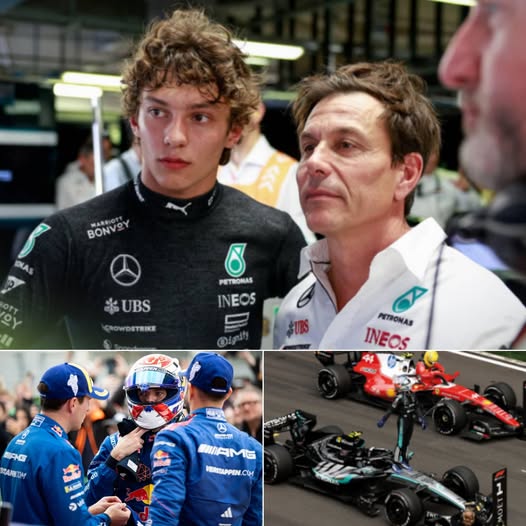
The growing tension between modern Formula 1’s corporate structure and the raw spirit of old-school racing erupted again this week after the Mercedes-Benz Group reportedly refused to allow championship leader Andrea Kimi Antonelli to pursue a Nürburgring racing permit.
The decision came immediately after Max Verstappen’s headline-grabbing appearance at the legendary Nürburgring 24 Hours, where the Dutch superstar delivered one of the most talked-about crossover performances in recent motorsport history.
While Verstappen’s spectacular run through the “Green Hell” captivated racing fans around the world, Mercedes responded by drawing a hard line around their own rising star — a move that has sparked fierce debate throughout the Formula 1 paddock ahead of the Canadian Grand Prix.
Why Mercedes Refused To Let Antonelli Race At Nürburgring
According to reports from the Nürburgring paddock, Mercedes management quickly shut down the idea of Antonelli obtaining the required Nordschleife permit after the young Italian publicly expressed interest in competing at the iconic German circuit.
The response from Mercedes leadership was direct and uncompromising.
Team executives reportedly made it clear that Antonelli’s full concentration must remain on his Formula 1 title campaign, especially with the 19-year-old emerging as one of the breakout stars of the 2026 season.
The timing of the decision immediately fueled speculation across the motorsport world.
Many observers believe Mercedes’ stance was influenced not only by safety concerns but also by the extraordinary attention Verstappen generated during his Nürburgring appearance.
Max Verstappen’s Nürburgring Performance Changed The Conversation
Verstappen’s participation in the Nürburgring 24 Hours became one of the biggest motorsport stories of the year.
Driving a Mercedes-AMG GT3 machine under the Verstappen Racing banner alongside experienced endurance specialists, the reigning Formula 1 champion adapted to the brutal Nordschleife with astonishing speed.
For large portions of the race, Verstappen and his teammates appeared capable of fighting for overall victory before mechanical problems eventually ended their challenge.
Even without a win, the impact of the performance was enormous.
The Dutchman’s pace through the high-speed sectors of the circuit generated massive praise from drivers, engineers, and broadcasters, with many comparing his adaptability to legendary multi-discipline racers from previous generations.
More importantly for Formula 1 teams, Verstappen once again proved that his personal brand extends far beyond the boundaries of grand prix racing.
The Corporate Fear Behind Mercedes’ Decision
From a business perspective, Mercedes’ refusal makes complete sense.
Modern Formula 1 teams invest hundreds of millions into driver development programs, sponsorship agreements, media campaigns, and long-term championship planning. Antonelli is no longer simply a rookie driver — he is viewed internally as one of the central figures in Mercedes’ future.
Allowing him to compete at the Nürburgring would expose the team to enormous risks.
The Nordschleife remains one of the most dangerous circuits in world motorsport. Unlike modern Formula 1 venues filled with expansive runoff areas, the Nürburgring features narrow barriers, blind corners, dramatic elevation changes, and constant traffic from multiple racing classes.
A single mistake could result in injury, lost championship momentum, or severe reputational damage.
For Mercedes executives, protecting Antonelli’s Formula 1 campaign likely outweighs the marketing value of a GT3 endurance appearance.
Why Verstappen Is Different From Other F1 Drivers
What makes Verstappen unique is the level of freedom he appears to possess outside Formula 1.
While most elite drivers operate within tightly controlled corporate structures, Verstappen has consistently embraced side projects, sim racing competitions, endurance racing programs, and independent motorsport ventures.
That independence has helped create an image that many fans now associate with classic racing icons.
In an era where drivers are often carefully managed brand ambassadors, Verstappen’s willingness to race outside the Formula 1 bubble has strengthened his reputation as a pure racer first and a commercial athlete second.
That creates a difficult situation for rival teams.
If younger stars like Antonelli begin demanding similar freedoms, manufacturers could lose some of the control they traditionally maintain over their drivers’ careers.
The Safety Debate Dividing Motorsport Fans
The reaction to Mercedes’ decision has sharply divided the motorsport community.
Some fans believe the team is being overly protective and preventing Antonelli from developing into a complete racing driver. They argue that racing at circuits like the Nürburgring builds adaptability, mental resilience, and racecraft that cannot be replicated in simulator sessions.
Others support Mercedes completely.
From their perspective, Antonelli is currently fighting for a Formula 1 championship, and adding endurance racing to his schedule introduces unnecessary physical and psychological strain during a critical season.
There is also the issue of fatigue.
The Nürburgring 24 Hours is among the most demanding races in the world, requiring drivers to manage nighttime conditions, unpredictable weather, heavy traffic, and long stints behind the wheel. Balancing that environment alongside an intense Formula 1 calendar would be extremely challenging for any driver — especially one still in the early stages of his F1 career.
The Technical Challenge Of Switching Between F1 And GT3 Cars
The transition between Formula 1 machinery and GT3 endurance cars is far more complex than many fans realize.
Modern F1 cars rely heavily on aerodynamic downforce, ultra-sensitive braking systems, and aggressive cornering characteristics. GT3 cars, by contrast, are heavier, less aerodynamic, and require a completely different driving style.
Drivers must adapt their braking points, throttle application, tire management, and steering inputs almost instantly.
Verstappen’s ability to switch between those disciplines so effectively is part of what made his Nürburgring performance so remarkable.
Mercedes engineers may fear that repeatedly alternating between radically different machines could affect Antonelli’s muscle memory and consistency during an already pressure-filled Formula 1 season.
At the highest level of motorsport, even tiny changes in driving rhythm can influence qualifying performance and race pace.
Could Antonelli Race Nürburgring In The Future?
Despite the current restriction, few expect Antonelli’s interest in endurance racing to disappear permanently.
The young Italian has openly spoken about his admiration for legendary circuits and his desire to test himself beyond Formula 1. If he continues developing into one of the sport’s elite talents, pressure may eventually grow for Mercedes to loosen its restrictions.
There is also a broader industry trend working in favor of crossover racing.
The success of endurance championships, combined with growing fan demand for drivers competing across multiple disciplines, has encouraged manufacturers to explore more flexible racing programs.
Verstappen’s Nürburgring appearance may ultimately accelerate that shift.
What This Means For Formula 1’s Future
The controversy surrounding Mercedes and Antonelli reflects a much larger philosophical battle taking place inside modern Formula 1.
On one side are corporate manufacturers focused on protecting investments, maximizing championships, and controlling risk.
On the other are fans and drivers who still romanticize the era when racing legends competed in Formula 1, Le Mans, touring cars, and endurance events all at the same time.
Verstappen’s success outside traditional grand prix racing has intensified that debate dramatically.
His Nürburgring appearance demonstrated that Formula 1 drivers can still thrive in dangerous, unpredictable, old-school racing environments — and fans clearly want to see more of it.
For now, Mercedes appears determined to keep Antonelli fully focused on Formula 1 glory.
But as Verstappen continues expanding his influence beyond the F1 grid, the pressure on rival teams to offer their own stars greater freedom may only continue to grow.
Final Thoughts
Mercedes’ decision to block Andrea Kimi Antonelli from pursuing Nürburgring competition may protect their championship ambitions in the short term, but it has also highlighted the growing divide between modern Formula 1 management and the traditional spirit of motorsport.
Max Verstappen’s electrifying Nürburgring performance reminded fans why drivers willing to embrace risk and challenge themselves outside their comfort zones still command enormous respect across the racing world.
Whether Mercedes eventually changes its position remains uncertain.
What is clear, however, is that Verstappen has already reshaped the conversation around what elite Formula 1 drivers should be allowed to do beyond the grand prix paddock — and the rest of the sport is now scrambling to respond.