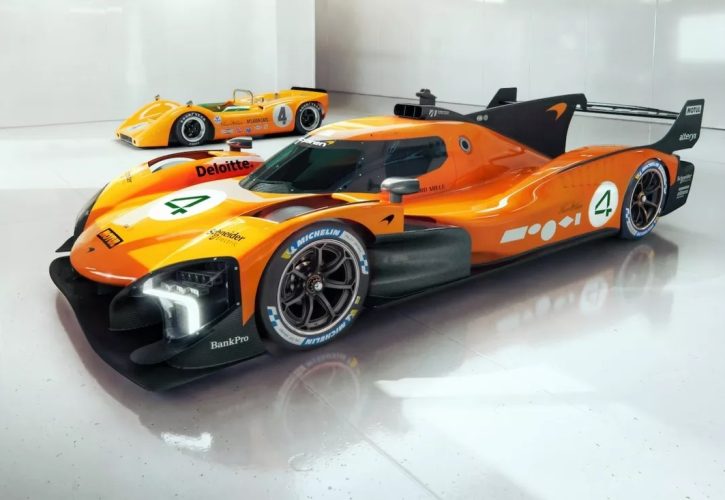
McLaren has officially ignited excitement across the racing world with the unveiling of its MCL-HY LMDh prototype, a bold machine designed to lead the brand’s long-awaited return to endurance racing’s top class. Set to compete in the FIA World Endurance Championship and target glory at the legendary 24 Hours of Le Mans in 2027, the MCL-HY represents far more than a new car—it signals a revival of unfinished ambition rooted deep in McLaren’s DNA.
Built on a Dallara chassis and powered by a V6 twin-turbo engine developed through collaboration between McLaren Racing and McLaren Automotive, the MCL-HY stands as a technical powerhouse. However, beyond its engineering sophistication, it was the car’s striking test livery that captured global attention. Inspired by the iconic McLaren M6A, the design pays tribute to founder Bruce McLaren and his dominance in the 1967 Can-Am series—a legacy that still shapes the team’s competitive identity today.
This tribute is more than aesthetic; it is symbolic. After contributing to a historic Le Mans victory with Ford in 1966, Bruce McLaren envisioned returning to the French endurance classic with a car bearing his own name. That dream, tragically, was never realized during his lifetime. Now, nearly six decades later, the MCL-HY carries that vision forward, blending heritage with cutting-edge innovation in a bid to reclaim a place at the pinnacle of endurance racing.
McLaren’s ambitions extend beyond a single race or championship. CEO Zak Brown has made it clear that this program is part of a broader strategy to position McLaren as motorsport’s most versatile powerhouse. With active campaigns in Formula 1, IndyCar, and now WEC, the team is uniquely placed to pursue the coveted Triple Crown of Motorsport—winning the Monaco Grand Prix, the Indianapolis 500, and Le Mans. This multi-series approach not only elevates McLaren’s global brand but also sets a benchmark few competitors can realistically match.
Looking ahead, the driver lineup already hints at serious intent, with talents like Mikkel Jensen, Richard Verschoor, and others involved in early development and testing. As United Autosports prepares to manage the Hypercar program, the groundwork is being laid for a highly competitive entry. The biggest question, however, remains: can McLaren translate its legacy and resources into immediate success against established endurance giants like Ferrari, Toyota, and Porsche?
The answer will unfold over the coming seasons, but one thing is certain—the return of McLaren to Le Mans is not just another entry on the grid. It is a statement of purpose. If development progresses as planned, the MCL-HY could emerge as a genuine contender by 2027, potentially rewriting the modern narrative of endurance racing. And if history has taught anything, it’s that when McLaren commits to a challenge, it rarely does so quietly.