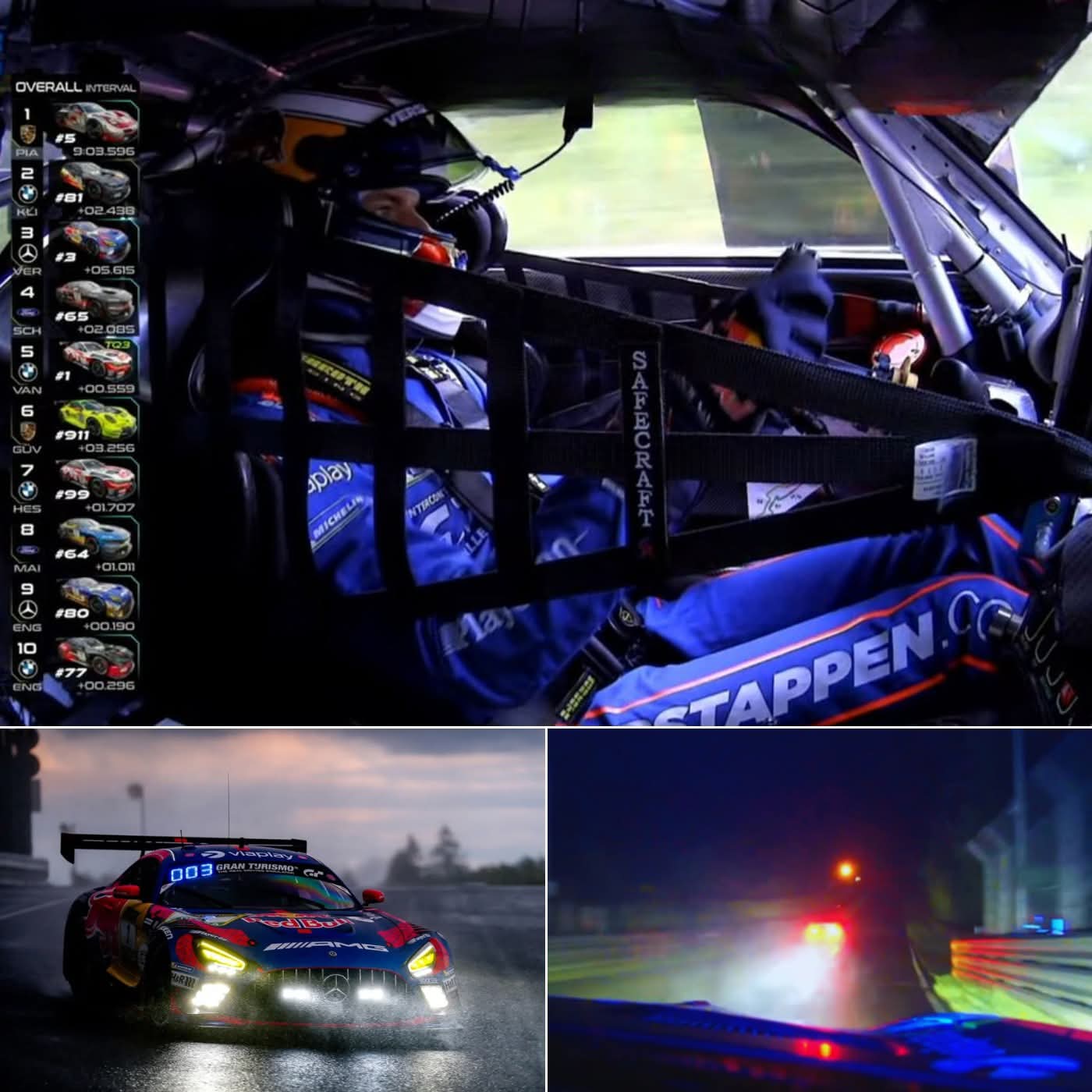
The Nürburgring Nordschleife has built its reputation as one of the most unforgiving circuits in motorsport history, but recent events involving Max Verstappen created a level of intrigue that extended far beyond a normal race weekend. Reports of Verstappen heading onto the legendary “Green Hell” during chaotic weather conditions immediately sent discussions throughout the paddock into overdrive. Heavy mist, hail, and deteriorating visibility transformed the circuit into a dangerous challenge, yet the Dutch driver reportedly embraced the conditions rather than avoiding them.
What made the situation fascinating was not simply the act of driving in difficult weather, but the deeper implications behind it. Formula 1 has evolved into a sport where data can sometimes carry equal value to outright speed. Teams no longer view track time solely as an opportunity to complete laps; they treat every session as a laboratory for understanding tire behavior, aerodynamics, and performance limitations. In Verstappen’s case, observers quickly began wondering whether this was another example of his relentless approach toward finding advantages others fail to see.
The Nürburgring itself presents an entirely different challenge compared to modern Formula 1 circuits. With more than 20 kilometers of twisting asphalt, dramatic elevation changes, blind corners, and rapidly changing weather patterns, drivers often describe the circuit as unpredictable even in ideal conditions. Add hail and thick fog into the equation, and conventional racing logic immediately shifts toward caution rather than aggression. Yet Verstappen’s reputation has increasingly become associated with operating comfortably in situations where others hesitate.
Beyond the dramatic narrative, there is also a practical side to why conditions like these matter. Modern simulators have become extraordinarily advanced, but they still struggle to perfectly recreate unpredictable environmental variables. Wet surfaces mixed with ice particles, sudden grip changes, and fluctuating temperatures produce real-world variables that software cannot entirely duplicate. Teams spend millions attempting to simulate uncertainty, but nature frequently introduces factors that technology cannot fully reproduce. If Verstappen and his team were exploring these scenarios, they may have been gathering information that could prove useful in future races where weather becomes a deciding factor.
The psychological effect of such moments should not be underestimated either. Formula 1 drivers are among the most confident athletes in the world, but confidence often shifts when competitors repeatedly demonstrate unusual levels of adaptability. The image of Verstappen pushing through conditions others consider extreme contributes to a growing perception that he approaches racing differently from the rest of the grid. Rival drivers do not only race against lap times; they race against the mental pressure created by an opponent’s reputation.
There is also growing conversation surrounding how evolving technology could reshape motorsport development. Engineers continuously search for better methods of understanding tire temperature management, airflow behavior, and vehicle stability in unpredictable conditions. If unusual testing environments provide insights into these areas, teams could discover gains that eventually appear on race weekends. Tiny improvements in Formula 1 often determine championships, and history repeatedly shows that innovation frequently emerges from unconventional experimentation.
Looking ahead, this episode could become more than just another dramatic Nürburgring story. As Formula 1 enters a new era of technical regulations and changing power unit philosophies, teams will continue searching for methods to gain advantages outside traditional development routes. Verstappen has repeatedly shown that he is willing to push boundaries, not only as a driver but also as a competitor seeking every available edge.
Whether the Nürburgring session was simply an intense training exercise or something more strategic, one thing remains clear: moments like these reinforce why Verstappen continues to be viewed as one of the sport’s defining figures. While others saw dangerous weather and uncertainty, he may have seen opportunity. If the lessons learned from the Green Hell translate onto Grand Prix circuits later in the season, the rest of the grid could once again find themselves trying to catch a moving target.