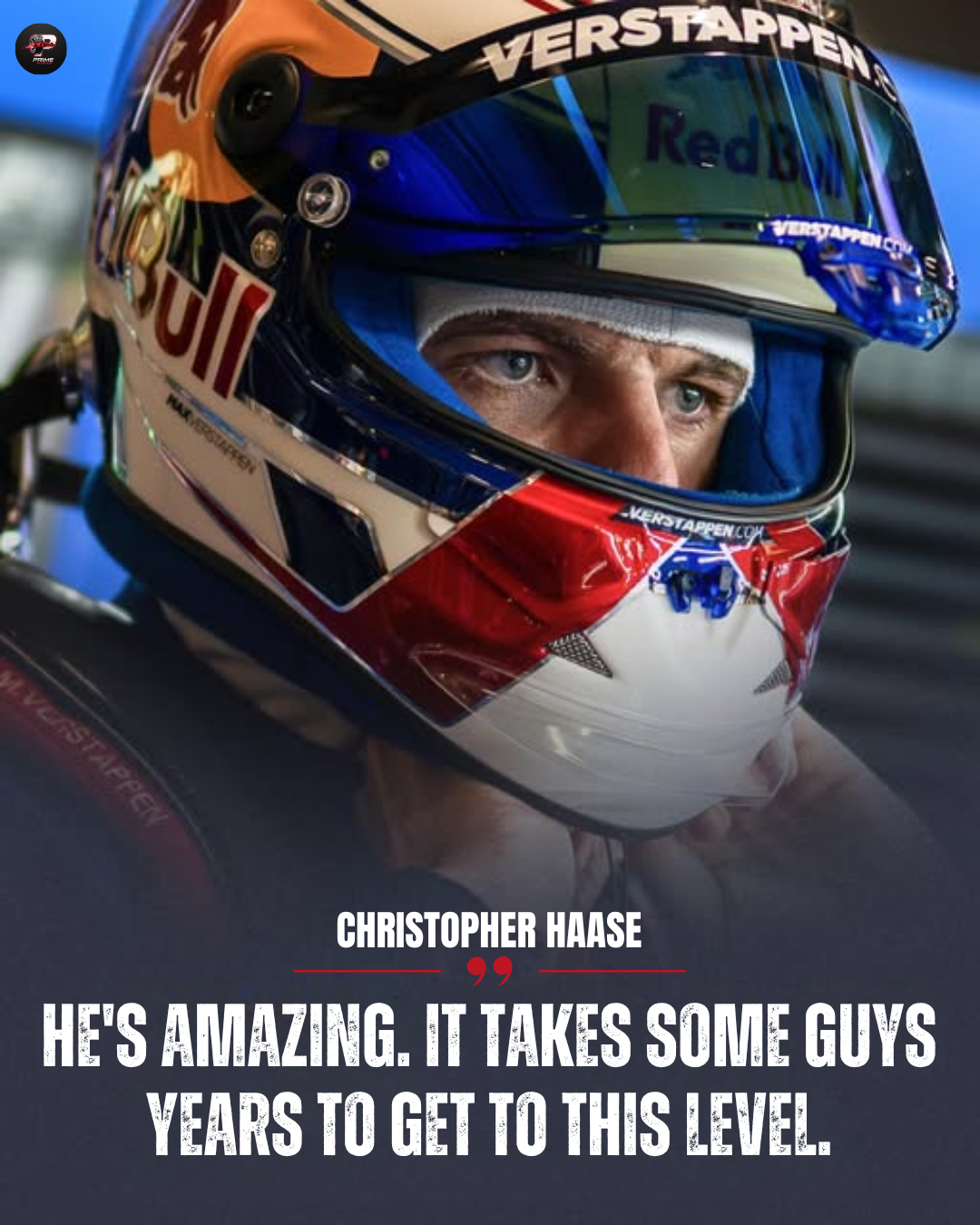
The debate over whether Max Verstappen is currently the most complete racing driver on the planet has intensified once again after the Dutch superstar stunned endurance racing veterans with his extraordinary performance at the Nürburgring 24 Hours.
While Verstappen’s maiden appearance at the legendary endurance event ultimately ended in heartbreak following a late mechanical failure, the four-time Formula 1 world champion still managed to leave an unforgettable impression on the motorsport community. His raw pace, calm decision-making, and especially his unique traffic management technique became one of the most talked-about stories of the race weekend.
Now, experienced Nürburgring specialists including Christopher Haase and Markus Winkelhock have revealed exactly why Verstappen’s driving style has shocked even seasoned GT3 racers.
Why Verstappen’s Nürburgring Performance Turned Heads
The Nürburgring Nordschleife is widely regarded as one of the most dangerous and technically demanding circuits in motorsport history. Stretching over 20 kilometers through Germany’s Eifel mountains, the track combines blind crests, high-speed corners, rapid elevation changes, and unpredictable weather conditions that can challenge even the most experienced drivers.
Unlike Formula 1, where grids are relatively small and performance gaps are often dictated by car development, the Nürburgring 24 Hours places drivers into chaotic multi-class traffic involving more than 150 cars with enormous speed differences between categories.
That environment usually takes years to master.
Yet Verstappen appeared to adapt almost instantly.
Driving the #3 Mercedes-AMG GT3 alongside teammates Lucas Auer, Jules Gounon, and Daniel Juncadella, Verstappen consistently ran at the front of the field before a driveshaft issue ended the team’s hopes of victory.
Although the final classification showed only 38th place, many insiders believe the result failed to reflect the true scale of Verstappen’s impact.
The Traffic Management Skill That Shocked Endurance Racing
According to rival Audi driver Christopher Haase, Verstappen’s greatest strength was not simply outright speed — it was his ability to manage traffic with an intelligence normally only seen in drivers who have spent a decade racing on the Nordschleife.
Haase described Verstappen’s approach as “incredible,” explaining that the Red Bull star instinctively knew when to sacrifice entry speed into corners in order to maximize momentum on corner exits.
That subtle technique is crucial at the Nürburgring because getting trapped behind slower cars through high-speed sections can destroy lap times and rhythm.
Instead of aggressively forcing overtakes at every opportunity, Verstappen appeared to read traffic several corners ahead — a skill many endurance specialists spend years developing.
The German driver admitted he was stunned by how quickly Verstappen understood the flow of the circuit.
How Formula 1 Experience May Have Helped Verstappen
Several experts believe Verstappen’s background in Formula 1 has actually given him an unexpected advantage in dealing with Nürburgring traffic.
Modern F1 drivers constantly manage “dirty air” — the turbulent aerodynamic wake created by another car ahead. Following closely at high speed without losing grip requires exceptional sensitivity and positioning.
At the Nordschleife, that same awareness becomes essential when weaving through slower traffic while maintaining momentum.
Markus Winkelhock explained that Verstappen’s ability to stay close behind rivals through difficult sections of the circuit was particularly impressive because the Nordschleife punishes even small aerodynamic disturbances.
For many observers, it was Verstappen’s composure that stood out most. While some drivers become impatient in traffic-heavy conditions, Verstappen appeared completely relaxed, often setting up overtakes several corners in advance instead of forcing risky moves.
That level of patience is unusual for drivers transitioning from Formula 1 sprint racing into endurance competition.
Verstappen Is Redefining the Modern F1 Driver
Verstappen’s Nürburgring appearance has also reignited a wider discussion about the evolution of modern Formula 1 drivers.
For years, critics argued that today’s F1 stars were too specialized, too corporate, and too protected from the unpredictable realities of classic motorsport. However, Verstappen has increasingly challenged that narrative.
Whether through sim racing, GT3 testing, or endurance competition, the Dutchman has consistently demonstrated a desire to race beyond the traditional F1 environment.
That mentality has earned admiration from racing purists who believe versatility is one of the greatest measures of driver talent.
His Nürburgring performance also exposed how rare true adaptability has become in modern motorsport. Transitioning from a ground-effect Formula 1 car to a much heavier GT3 machine requires major adjustments in braking style, weight transfer, tire management, and throttle application.
Yet Verstappen appeared comfortable almost immediately.
Why Rival Drivers Respect Verstappen’s Approach
One reason Verstappen has earned so much respect from endurance racers is because he did not arrive at the Nürburgring expecting special treatment.
Instead, he immersed himself in the discipline, studied onboard footage, participated in preparation races, and openly acknowledged the complexity of the circuit.
Drivers like Haase recognized that attitude immediately.
In endurance racing, reputation means little once the race begins. Consistency, awareness, and adaptability matter far more than celebrity status.
By proving he could compete at the front against Nürburgring specialists, Verstappen gained credibility within an entirely different section of the motorsport world.
Some insiders even believe his presence has helped attract new global audiences to endurance racing, particularly younger Formula 1 fans who previously paid little attention to GT competition.
Could Verstappen Race More Endurance Events?
Following the attention generated by the Nürburgring 24 Hours, speculation is already growing about Verstappen’s future outside Formula 1.
The Dutchman has repeatedly hinted that he wants to continue exploring endurance racing opportunities while still competing in F1.
Possible future targets could include:
- 24 Hours of Le Mans
- Bathurst 12 Hour
- Additional Nürburgring endurance races
- GT World Challenge appearances
Many experts believe Verstappen’s driving style naturally suits endurance racing because of his smooth tire management and advanced racecraft.
If he eventually commits to a full endurance program later in his career, some believe he could become one of the rare drivers capable of winning major titles across multiple disciplines.
The Bigger Impact on Motorsport
Perhaps the most important outcome of Verstappen’s Nürburgring appearance is the renewed spotlight it has placed on endurance racing itself.
The Nürburgring 24 Hours has always been respected within racing circles, but Verstappen’s participation dramatically expanded mainstream attention around the event.
Viewership surged, social media engagement exploded, and even Formula 1-focused audiences began discussing GT3 strategy, traffic management, and endurance racing techniques.
Christopher Haase acknowledged that Verstappen’s involvement gave the event “the boost the sport needs,” a sentiment echoed by many within the paddock.
In an era where motorsport categories often compete for global attention, Verstappen’s crossover appeal could prove hugely valuable for endurance racing’s future growth.
A Driver Operating at Another Level
Even though the result sheet will forever show a mechanical retirement rather than a victory, Verstappen’s Nürburgring debut may ultimately be remembered as one of the defining performances of his career.
The combination of raw speed, rapid adaptation, and elite race intelligence convinced many observers that they were witnessing a driver capable of excelling in virtually any racing category.
For endurance specialists who have spent decades mastering the Nordschleife, that realization was both astonishing and deeply revealing.
Verstappen did not simply survive one of motorsport’s greatest challenges.
He changed the conversation around what modern Formula 1 drivers are truly capable of achieving.