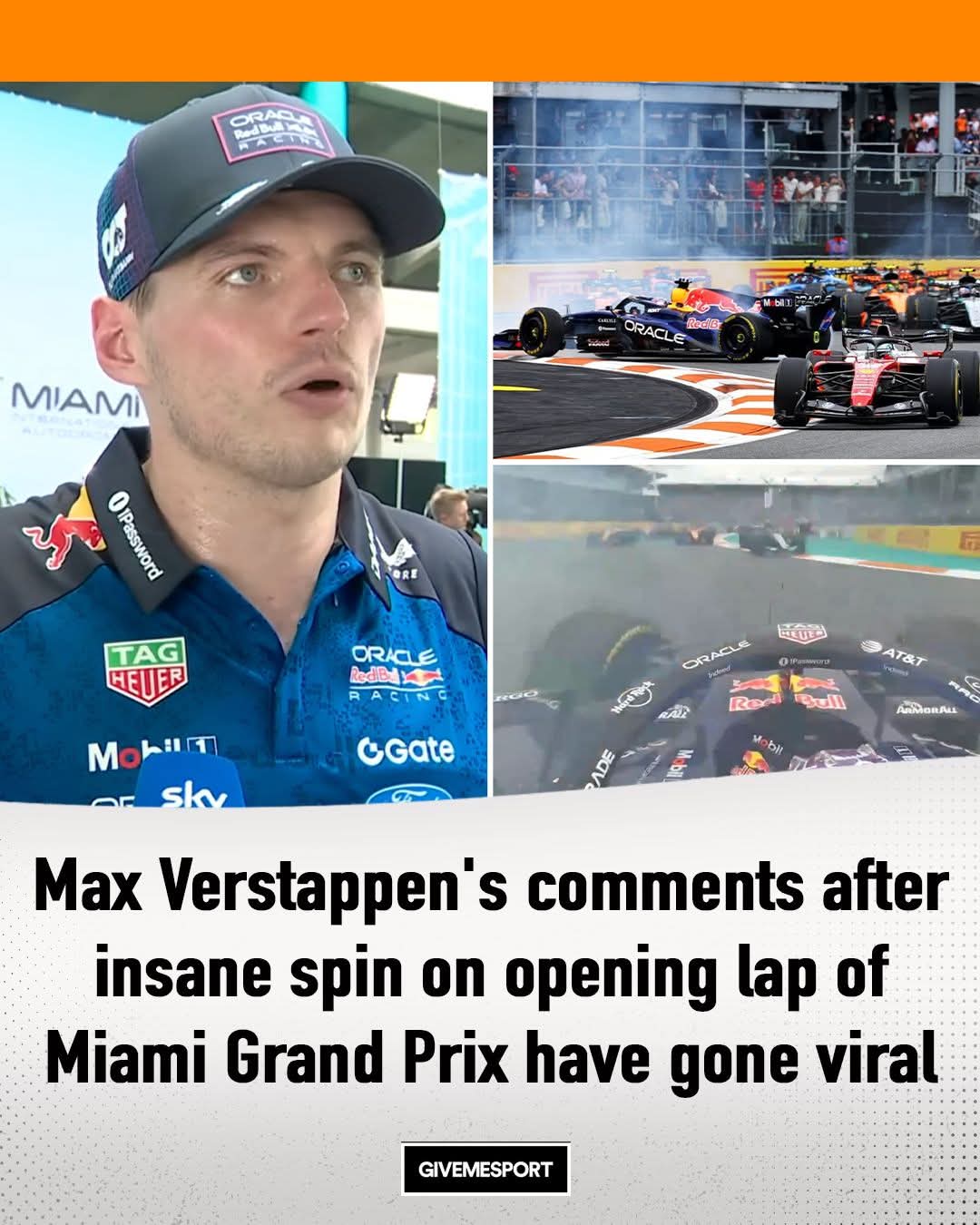
Max Verstappen delivered one of the most talked-about moments of the Miami Grand Prix after an early-race spin nearly derailed his entire weekend—yet his response afterward revealed a mix of realism, humor, and cautious optimism about Red Bull Racing’s direction.
Starting from second on the grid behind Kimi Antonelli, Verstappen looked poised to challenge for victory in what had already been his strongest qualifying performance of the 2026 season. Lining up ahead of Charles Leclerc and Lando Norris, the Dutchman got a clean launch and immediately found himself battling for the lead into the opening corners—an encouraging sign after a string of poor starts earlier in the year.
However, the race took a dramatic turn at Turn 2. Pushing hard in the opening exchanges, Verstappen lost the rear of the car and spun in a moment that could have ended in disaster. Instead, he executed an impressive 360-degree recovery, avoiding the barriers and continuing the race—though at the cost of several positions. The incident effectively ended his chances of fighting for the win, but it showcased both the razor-thin margins in Formula 1 and Verstappen’s elite car control under pressure.
Despite the setback, Verstappen recovered to finish fifth—his best result of the season so far. Up front, Antonelli converted pole into victory, while McLaren’s Norris and Oscar Piastri completed the podium. For Red Bull, the result may not have been headline-grabbing, but it marked a step forward in competitiveness compared to earlier rounds.
Speaking after the race, Verstappen kept the mood surprisingly light, joking that his spin proved he could “always go into rallying” if Formula 1 didn’t work out. Beneath the humor, however, was a clear technical explanation—he admitted the rear instability, particularly under heavy fuel, made the car difficult to control. His comments highlight a persistent issue Red Bull must address if they are to rejoin the fight at the front consistently.
From a performance standpoint, Verstappen pointed to tyre strategy as another limiting factor. While the car showed decent pace on the medium compound, the switch to hard tyres exposed further weaknesses, suggesting Red Bull still lacks the adaptability of rivals like Mercedes-AMG Petronas Formula One Team, Scuderia Ferrari, and McLaren. His remark about the steering issues earlier in the season also hints at deeper mechanical inconsistencies that have hindered performance.
Looking at the championship picture, Verstappen finds himself trailing significantly, with Antonelli leading the standings and building momentum. For a driver accustomed to dominating seasons, this represents unfamiliar territory. Yet, the Miami Grand Prix may signal the beginning of a turnaround. If Red Bull can refine their setup, improve tyre management, and eliminate instability under varying conditions, Verstappen could quickly reinsert himself into the title conversation.
Final Take: Verstappen’s spin may have cost him victory, but his recovery—and Red Bull’s gradual progress—suggest this fight is far from over. If momentum continues to build, Miami could be remembered as the moment their season finally began to shift.