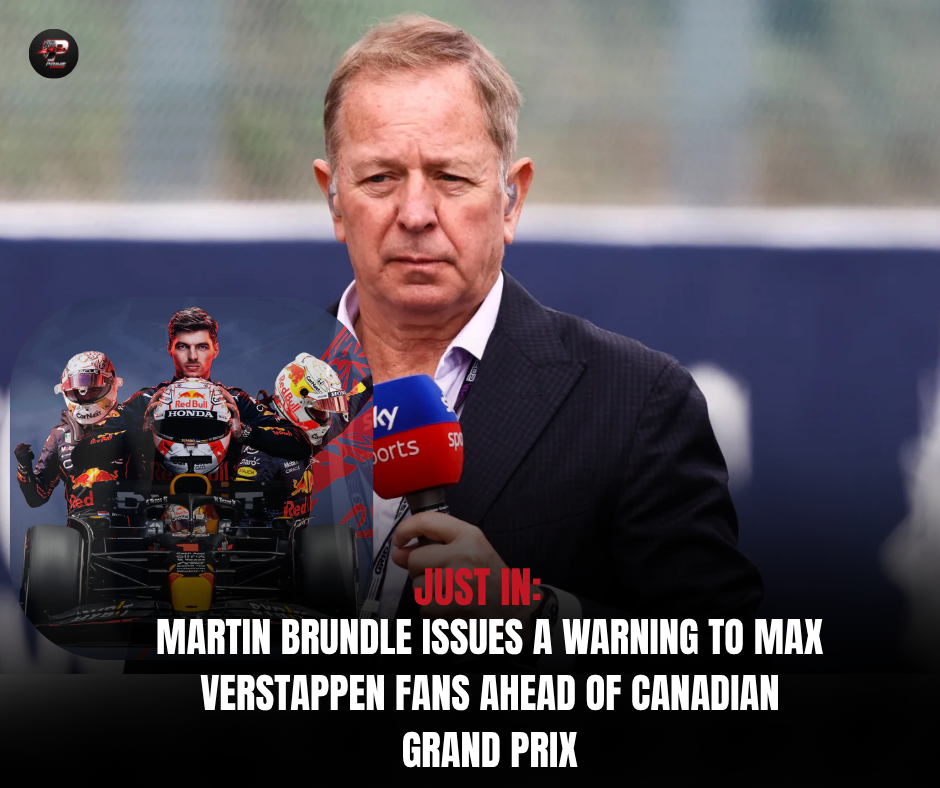
Martin Brundle has never been a man who softens his words for comfort. As Sky Sports F1’s lead pundit and one of the sport’s most respected voices — a former driver who raced wheel-to-wheel with Ayrton Senna, Michael Schumacher, and the giants of a previous era — he has earned the right to say things that others in the paddock won’t.
Ahead of the Canadian Grand Prix at the Circuit Gilles Villeneuve, Brundle has done exactly that. His warning to Max Verstappen fans is not a polite advisory. It is a frank, clear-eyed assessment of a situation that has been building for months — and it carries implications that could reshape the entire 2026 Formula 1 season.
The message, in essence: your driver is one incident away from a race ban. And his rivals know it.
What Brundle Actually Said — And Why It Matters
Speaking on Sky Sports F1 ahead of practice at the Circuit Gilles Villeneuve, Brundle did not merely observe Verstappen’s precarious penalty point situation. He offered a tactical roadmap to every team on the grid that wants to beat him.
“If I was a Mercedes, Ferrari — particularly a McLaren driver — I’d be goading him to get those extra penalty points. Because I think subconsciously, he knows he’s got to be a touch more careful,” Brundle said.
That is an extraordinary thing for a senior broadcaster, former driver, and widely respected figure within the sport to say publicly. It is not a throwaway comment. Brundle is, in practical terms, encouraging Verstappen’s championship rivals to deliberately exploit his psychological vulnerability in a wheel-to-wheel environment. He is telling them: here is your opening, now use it.
But Brundle was not done. He went further on the incident at the Spanish Grand Prix that created the situation, concluding that Verstappen’s contact with George Russell was “completely blatant” and that he was “driving with a red mist,” making “irrational decisions” under anger. He also publicly disagreed with the stewards’ verdict in Spain, arguing he would have issued the full four penalty points the guidelines permitted — plus a 30-second penalty equivalent to a drive-through — rather than the three points and 10-second penalty Verstappen actually received.
The message embedded in all of this, for Verstappen fans and neutrals alike, is uncomfortable: the most dangerous driver on the grid is not at his most dangerous right now. He is rattled. He is frustrated. And he is one bad moment away from sitting in the grandstand watching a race he should be winning.
The Background: How Verstappen Got Here
To understand the weight of Brundle’s warning, it helps to trace the path that has led Verstappen to this situation.
The 2026 Formula 1 season was supposed to be a redemption campaign for the four-time world champion. After a difficult second half of 2025, the clean-sheet regulations reset offered the promise of a fresh start — a new car, a new power unit, a new technical landscape in which Red Bull could reassert themselves.
Instead, the RB22 has struggled. Red Bull, building their own power unit for the first time under the new regulations, arrived at the season opener in Australia with a car that was clearly behind Mercedes, Ferrari, and McLaren in outright pace. Brundle himself acknowledged the Red Bull power unit had been “pretty impressive,” but noted the car itself had been “struggling a bit.”
For a driver as hardwired to winning as Verstappen — a man who has said publicly he does not enjoy driving from the back of the field, who has threatened to leave Formula 1 entirely if the 2026 regulations do not improve — this was fertile ground for frustration. The frustration finally boiled over at the Spanish Grand Prix.
The incident itself is now well-documented. In the closing stages, a late safety car scrambled Red Bull’s strategy, leaving Verstappen on hard tyres in a position not of his choosing. When the race restarted, he was battling Russell for position, was instructed to give the place back, and appeared to be complying — before the two cars made contact at Turn 5 in circumstances that Brundle described as “completely blatant.” Verstappen himself did not fully deny it, with Russell observing afterwards: “I don’t think he was trying to intentionally crash into me. He wanted to just sort of scare me a bit, but he just misjudged it.”
The stewards issued a 10-second time penalty and three penalty points. Those three points moved Verstappen to 11 on his FIA Super Licence — one away from the automatic one-race ban triggered at 12 points within a rolling 12-month period.
He arrived at the Canadian Grand Prix on that threshold.
The Penalty Points System: What Fans Need to Understand
For casual fans who do not follow the technical machinery of F1’s disciplinary framework, the penalty points system can seem abstract — until a race ban materialises and suddenly it is very concrete indeed.
The rules are straightforward. Under FIA regulations, drivers receive a one-race ban if they accumulate 12 penalty points within a 12-month period. Points are awarded for on-track incidents, ranging from one point for minor infractions to three points for the most serious collisions or reckless driving. They expire on a rolling basis — each individual penalty drops off the 12-month window on its anniversary.
The crucial detail for Verstappen heading into Canada: his first penalty points would not expire until June 30 — a date that falls after both the Canadian Grand Prix and the Austrian Grand Prix. That means for two consecutive race weekends, Verstappen was operating with zero room for error.
One penalty point — issued for even a minor incident — would trigger the ban automatically. There is no discretion available to the FIA once the threshold is crossed. It is, in F1 parlance, an absolute rule.
For all Verstappen’s complaints about the state of Formula 1 in 2026, the penalty points situation was one development he was uniquely positioned to detest. He had called the system “stupid” as far back as 2018. When he came close to a ban during the 2025 season, he called journalists who dared raise the topic with him “childish.” The irony of the most aggressive driver in the field being constrained by a points accumulation he had spent years dismissing cannot have been lost on him.
Brundle’s Deeper Concern: A Driver at War With Himself
What makes Brundle’s warning more than just tactical advice to rival teams is the psychological portrait embedded within it. The former driver is not simply identifying a sporting vulnerability. He is diagnosing something deeper about where Verstappen’s head is right now.
Brundle was blunt on Sky’s F1 Show podcast: “Max is very unfiltered. He always has been. He’s talked a lot, for a long time, about ‘I’m not in this for the long haul. I’m not going to be hanging around here in my 40s.'”
Verstappen has spent the early weeks of the 2026 season in an almost constant state of public frustration. He has repeatedly criticised the new 2026 regulations, describing the battery harvesting and deployment mechanics as making the cars unpleasant to drive, and has issued increasingly pointed suggestions that he may leave Formula 1 at the end of the season if the product does not improve. After finishing eighth at the Japanese Grand Prix, he revealed he was actively considering his future in the sport.
Brundle’s response to this campaign of discontent was characteristically pointed. “Nobody’s indispensable in this business,” he said. “I’ve seen a number of amazing people come through this sport and are no longer with us, or have worked on to something else, and the sport carries on. There are any number of Antonellis, Bearmans, Lindblads, who would do the job incredibly well for one per cent of the money. So the sport will just move on if Max decides to go — but he’s sort of doing quite a bit of damage meanwhile.”
There is a real tension in Brundle’s position here that is worth examining. On one hand, he acknowledges — generously — that Verstappen’s talent is generational. “I would hugely miss his talent. His generational speed and car control is something that very few people in the history of motorsport have had. It’s quite extraordinary,” he said. On the other hand, he believes Verstappen is currently harming both himself and the sport with his behaviour, and he is willing to say so in terms that few others would use.
The psychological picture Brundle is painting is of a driver in conflict: too good to be irrelevant, too frustrated to be at his best, too stubborn to manage the emotions that are putting his season at risk.
The “Goading” Strategy: Ruthless, But Real
Brundle’s suggestion that rivals should deliberately goad Verstappen into picking up a race-ban-triggering penalty point has drawn attention for its candour — but it should not draw surprise. This is how elite competition operates.
Brundle balanced his tactical advice with genuine praise: “He’s an aggressive driver. He was from the get go in Formula 1, and that’s how he rock and rolls. You can’t cherry pick the bits you like about a sports person. That’s how Max goes racing and he’s won the last four world championships.” He also noted that “he’s got such amazing car control that he can place his car. He knows the rules. He chances his luck and more and more he’s starting to lose out on that.”
That final observation is the key one. Verstappen has been deploying the same aggressive toolkit for a decade. It brought him four consecutive world championships. But the sport has evolved around him — stewards have become more interventionist, rivals have become more experienced at reading his patterns, and the penalty points system has given his aggression a cumulative cost it previously lacked.
The goading strategy, if any rival team chose to pursue it, would be simple in concept but complex in execution. It would involve pressuring Verstappen in close wheel-to-wheel situations, particularly in corners where he has historically defended aggressively, in the knowledge that even a minor collision could send him over the penalty threshold. The risk, of course, is that the goading driver collects damage or a penalty of their own. But for a team calculating title mathematics, the risk-reward equation could be compelling.
There is also a subtler form of goading: simply being alongside Verstappen more often than he is comfortable with, creating the uncomfortable sensation for a driver who prefers to lead from the front that he is being crowded and challenged. Verstappen’s frustration at the Spanish Grand Prix was partly triggered by being in a position he did not want to be in — fighting over minor positions rather than leading. The Circuit Gilles Villeneuve, with its narrow walls and limited overtaking opportunities, is an environment where those close-quarters situations are almost inevitable.
Where Verstappen Stands in the Bigger Picture
It would be easy, given the current narrative, to write Verstappen off. The critics are circling. The penalty points situation is genuine. The car is not yet front-running. And his own public statements about potentially leaving the sport have created a story that runs in parallel to his on-track performance, distracting from what he does best.
But this is Max Verstappen. The driver who won four consecutive world championships not just through raw talent, but through the ability to reset, adapt, and perform when the pressure is highest. He has been in difficult positions before — most notably in the 2021 and 2022 seasons when rules changes temporarily upset Red Bull’s rhythm — and has consistently found a way through.
Brundle noted that Red Bull were expected to bring significant changes to Miami and beyond, and that Verstappen “will want to see through the midseason that they’re on top of these regulations, they’re on top of the car.” The five-week break between Japan and Miami was used precisely for this purpose — Red Bull worked extensively on their power unit deployment, and Verstappen himself described his experience at the Miami Grand Prix as significantly improved, even saying he could “see light at the end of the tunnel.”
The prediction from most analysts, Brundle included, is that Verstappen does not actually walk away from Formula 1 — as long as he ends up back in a competitive car. His management almost certainly included an exit clause at the end of 2026 tied to the Red Bull power unit’s competitiveness. If the car improves, the retirement talk cools. If it does not, the conversation becomes very different — and very complicated, given that Mercedes have firmly closed the door on a move, with Toto Wolff repeatedly stating there is “no place at this particular inn at the moment.”
Analysis: Is Brundle Being Fair?
Brundle occupies a unique position in Formula 1 media. He was a driver himself — a genuinely quick one who finished runner-up in the 1992 Drivers’ Championship — which means he speaks from experience rather than speculation when he analyses the psychological dynamics of elite competition. He is not a provocateur. He is not chasing clicks. When Martin Brundle says something uncomfortable, it generally deserves to be taken seriously.
His warning to Verstappen fans is fair precisely because it does not demand that Verstappen change who he is. It acknowledges that his aggression is inseparable from his greatness. “You can’t cherry pick the bits you like about a sports person,” Brundle said — a formulation that applies equally to fans who celebrate Verstappen’s boundary-pushing wheel-to-wheel battles while dismissing the penalties those battles generate.
The warning is, at its core, this: the same instincts that made Verstappen a four-time champion are the instincts that could cost him a race this season. Montreal is exactly the kind of circuit, under exactly the kind of pressure, where those instincts are most difficult to control. Fans who want to see him compete for a fifth title need to understand the knife-edge their driver is walking.
Prediction: Verstappen Survives Canada — But Austria Is the Real Test
The prediction here is that Verstappen gets through the Canadian Grand Prix without collecting the penalty point that would trigger a ban. The awareness of his situation is too acute, and the Circuit Gilles Villeneuve — while unforgiving — is a track where he has historically raced smartly when smart racing is required.
But the deeper tension does not resolve in Montreal. Even if he avoids further penalties in Canada, he stays on nine points for a significant stretch of the season, with his next points not expiring until the end of October. Austria comes next — a circuit where he collected two penalty points last season for a collision with Lando Norris. The Red Bull Ring is another narrow, high-pressure environment where Verstappen’s instincts and the stewards’ patience have historically been in conflict.
The 2026 Canadian Grand Prix is therefore not just a race. For Verstappen fans, it is the opening chapter of a story that could define the season. The four-time champion is playing a chess match inside a sport that increasingly punishes impulsive moves — and Martin Brundle, with characteristic directness, has made sure everyone on the board understands the stakes.
Whether Verstappen can control himself long enough to stay in the title conversation is the most compelling subplot in Formula 1 right now. And that, for fans of the sport regardless of who they support, is ultimately something to appreciate.
Sources: Sky Sports F1, PlanetF1, GPFans, Motorsport.com, RacingNews365, F1i.com, F1 Oversteer, Yahoo Sports