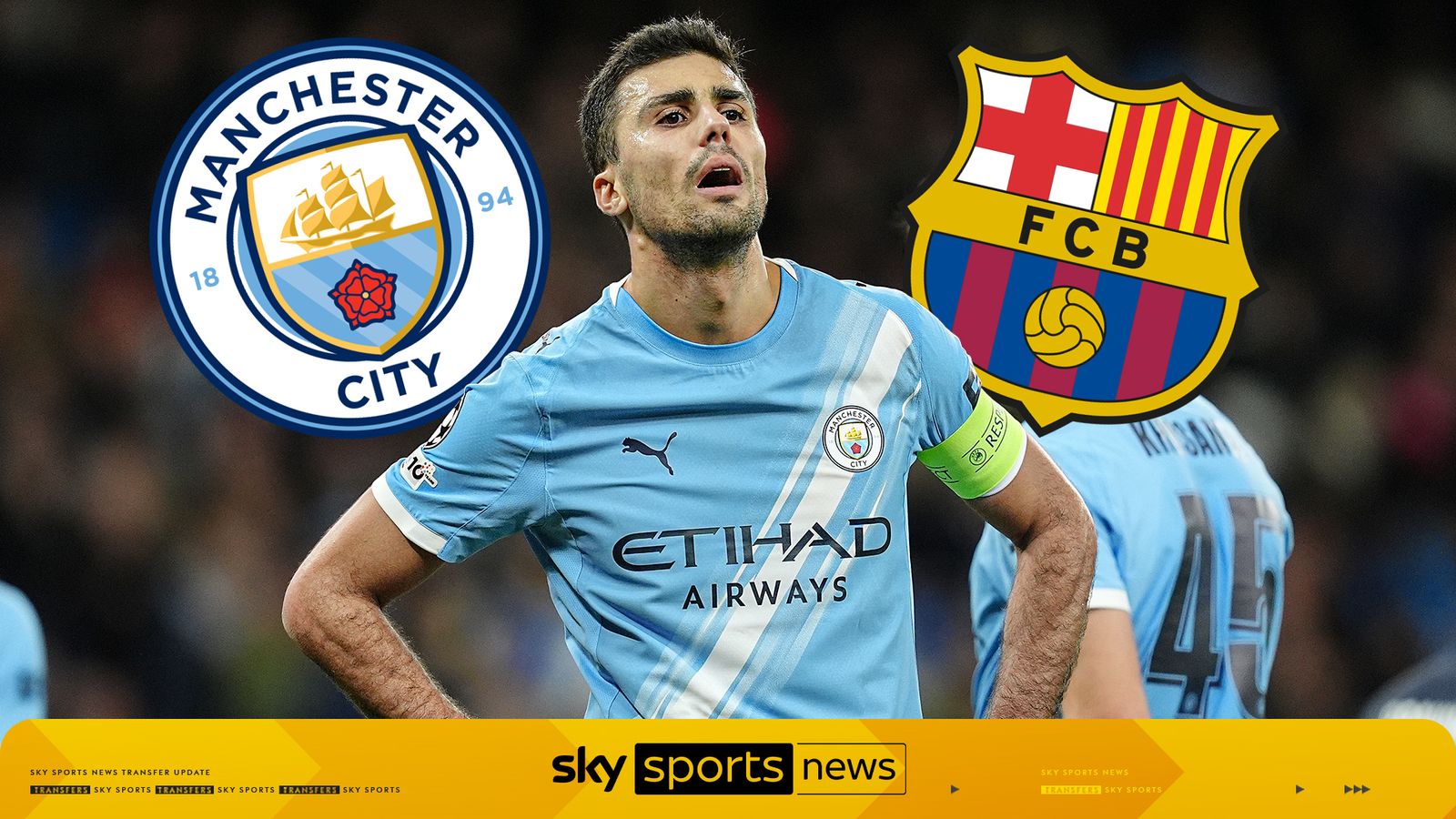
Manchester City have started to accept that Rodri is going to Barcelona, and the more you look at how this saga has unfolded over the past few weeks, the more obvious it becomes that this was never really going to end any other way. This is not a club digging in its heels, refusing to entertain the idea of losing one of the most important players of the modern era, and it was never going to be that kind of situation. City are not the club forcing a player to stay against his wishes, especially not someone of Rodri’s stature, someone who has given the club six years of extraordinary service, someone who has won virtually everything the game has to offer in a City shirt, and someone who has now made his own preference about the next chapter of his career about as clear as a player possibly can. When a player of that calibre, that experience and that standing within the dressing room communicates plainly that his heart is set on one specific destination, the modern football business tends to accept that reality far quicker than the sentimental version of the sport that fans sometimes wish still existed. City’s approach to this entire negotiation reflects exactly that pragmatism.
The clarity of Rodri’s own position has been central to how quickly this situation has moved. Reports throughout the process have been consistent in describing a player who ruled out Real Madrid entirely, despite their historic interest and the obvious romantic appeal of a Spanish World Cup winner joining the biggest club in his home country, in favour of a move to Barcelona specifically. That is not the profile of a player being pushed reluctantly toward an exit by financial pressures or a club looking to cash in. That is the profile of a player who has made a genuinely personal decision about where he wants to spend the coming years of his career, and once that kind of clarity exists, clubs on the selling side generally understand there is very little to be gained from trying to talk a player out of it. City could, in theory, have taken a harder line, insisted on honouring the remainder of his contract, made life difficult for both player and buying club in the hope of extracting a slightly higher fee or simply out of stubbornness. Instead, everything about their conduct throughout this process suggests a club that recognises when a chapter has reached its natural conclusion and prefers to manage that transition with dignity rather than conflict.
That is not to say City have simply rolled over and accepted whatever Barcelona were initially willing to offer, because the financial negotiations have been anything but straightforward. Barcelona’s opening approach was, by most accounts, some way below what City considered acceptable, an initial offer in the region of forty five million euros that was swiftly rejected as nowhere near reflecting Rodri’s value even with just a single year remaining on his contract. From there, the two clubs have gone through the familiar rhythm of a genuinely contested negotiation, Barcelona incrementally raising their offer while City held their ground on a valuation comfortably north of sixty million euros, eventually pushing into figures closer to seventy or even eighty million once the structure of guaranteed money versus performance-related add-ons was factored in. That kind of gradual, structured negotiation, several offers rejected before a package both sides can live with finally emerges, is entirely normal for a transfer of this magnitude, and it should not be mistaken for City trying to block the move rather than simply trying to secure fair value for a player who has meant an enormous amount to the club’s recent history.
It helps to remember exactly what City are being asked to let go of here. Rodri arrived at the Etihad in the summer of 2019 for what was then a club-record fee, a deal completed after City triggered his release clause at Atletico Madrid, ending years of frustration in the market for a genuine defensive midfield anchor after previous pursuits of players like Jorginho had collapsed in difficult circumstances. What followed over the subsequent seasons exceeded even the most optimistic projections attached to that signing. Rodri became the deep-lying platform around which some of the most dominant football English football has ever seen was built, a player whose reading of space and tempo made him arguably the most influential deep-lying midfielder in the world during his peak years at the club. He scored the winning goal in a Champions League final. He was part of four consecutive Premier League title wins. He collected a European Championship winner’s medal with Spain, and then capped an already remarkable international career by helping Spain lift the World Cup, a tournament in which his own performances were considered good enough to earn him the Golden Ball as the competition’s outstanding player. Along the way he was recognised as the best footballer on the planet, winning the Ballon d’Or, a level of individual acclaim that very few holding midfielders in the history of the sport have ever managed to reach. Losing a player with that résumé is never going to be something any club treats lightly, and the willingness City have shown to negotiate seriously rather than simply refuse to engage reflects an understanding that trying to keep a player who has achieved everything domestically and internationally that he set out to achieve, against his own clearly stated wishes, would ultimately serve nobody well, least of all the relationship between club and player that six years of shared success has built.
There is also a practical dimension to City’s acceptance of this departure that goes beyond sentiment or negotiating tactics. This is a club that has been unusually busy and unusually decisive in reshaping its squad this summer, activity that only really makes sense when you view it as preparation for exactly this kind of departure rather than business being conducted in ignorance of it. Bernardo Silva’s move to Real Madrid on a free transfer already represented a significant departure from the core of the side that delivered City’s recent period of dominance. The agreed sale of Tijjani Reijnders to Al Qadsiah further reshaped the profile of the midfield options available. And running alongside those outgoings has been an aggressive, expensive rebuilding effort in the middle of the park, headlined by the club-record fee paid to Nottingham Forest for Elliot Anderson, a deal worth well over a hundred million pounds that reset City’s own transfer benchmark and signalled just how seriously the football department has taken the challenge of refreshing this area of the squad. Add to that the continued, high-profile pursuit of Ayyoub Bouaddi, an eighteen-year-old regarded as one of the most complete young midfield talents anywhere in the world, brought in with the explicit intention of learning directly from Rodri in what time remains before his departure, and the picture becomes clear. City have not been passively hoping Rodri stays while doing nothing to prepare for the alternative. They have been actively building the next version of their midfield in parallel with the negotiations over his departure, which is precisely why they have been able to approach the Barcelona talks with the kind of calm, business-like posture that has characterised the entire saga rather than the panicked resistance that might come from a club with no contingency plan in place.
The presence of a new head coach at the helm has added an interesting layer to how this has all played out publicly. Enzo Maresca, newly arrived at the Etihad, has been notably measured in his public comments whenever asked directly about Rodri’s future, offering the kind of carefully neutral answers that acknowledge the realities of a transfer window without either encouraging speculation or attempting to shut it down entirely. That balance, acknowledging that anything can happen once a transfer window is open while stopping short of confirming an exit before it is formally completed, reflects a coach who understands the delicate position he is in, managing a player who remains contractually his responsibility for as long as the deal is unfinished while simultaneously being fully aware that the player’s mind and, increasingly, the direction of the negotiations themselves are pointed firmly toward the exit. Rodri’s own conduct throughout this period has been notably professional given the circumstances, returning to England for pre-season training after a short delay to allow his situation to develop, working to build match fitness with City even while the finer details of his move were still being ironed out, a level of professionalism that has surely made it easier for City to manage this transition without any of the acrimony that sometimes accompanies a star player’s departure when the situation turns sour or drawn out.
What stands out most clearly when you step back and look at the full picture is just how different City’s handling of this situation has been compared to how some clubs, even some of the biggest clubs in the world, have handled the departure of similarly important players in the past. There is a version of this story where City could have leaked frustration to the press, briefed against the player through friendly journalists, dragged the negotiation out deliberately to make a point or to squeeze every last euro out of Barcelona regardless of the human cost to a player who has given the club everything he had to give. Instead, the dominant tone throughout has been one of mutual respect, a recognition on City’s part that Rodri has earned the right to choose his own next chapter, and a willingness to negotiate firmly but fairly rather than obstructively. That approach protects something valuable beyond just this single transaction. It protects the club’s reputation among other players, current and future, as an organisation that treats its people well even at the point of departure, which matters enormously when it comes to attracting and retaining talent over the long term. Players talk to other players. Agents compare notes on how different clubs behave in these situations. A club known for making difficult exits unnecessarily painful will find that reputation working against it the next time it tries to convince a coveted target that City is the right destination, while a club known for handling even its most significant departures with grace and professionalism builds exactly the kind of trust that makes future recruitment, and future retention, considerably easier.
There is also something worth saying about how this fits into the broader picture of squad evolution at the very top level of the modern game. Even the greatest teams in football history have had to navigate the departure of era-defining players eventually, and the clubs that have continued to succeed afterwards have almost always been the ones who recognised the right moment to let a legendary figure move on rather than clinging to sentiment past the point of football logic. Rodri is thirty years old, entering the final year of his contract, and has achieved literally everything the domestic and international game has to offer, a combination of factors that makes this about as clean a moment as exists for both player and club to part ways on good terms rather than allowing the situation to fester into the kind of contract standoff that benefits nobody. Waiting a year, allowing his value to diminish further as his contract ran down with no resolution, gambling on his powers not fading as he approaches his thirties, would have represented a considerably riskier path than accepting the reality of his preference now and using the resulting funds, and the timing itself, to accelerate the kind of generational transition already visible in signings like Anderson and Bouaddi.
None of this is to say the emotional weight of losing a player like Rodri will be easily brushed aside by the supporters who have watched him marshal midfield battles and dictate the tempo of some of the most important matches in the club’s history. There will understandably be sadness attached to seeing him leave, a recognition that City are saying goodbye to one of the defining figures of their most successful period, a player whose calm authority in front of the back four became almost synonymous with the control that characterised City’s dominance of English football. But there is a difference between sadness at a departure and resentment toward how that departure was handled, and everything about City’s conduct in these negotiations, from the respectful public comments to the pragmatic but fair approach to the fee, from the clear acknowledgment that Rodri has earned the right to choose his path to the parallel recruitment work already laid down to soften the transition, points toward a club determined to ensure the second category never really comes into play. Rodri leaving for Barcelona because it is genuinely what he wants, with City’s blessing rather than their resistance, is a considerably better outcome for everyone involved than the alternative scenarios that could so easily have played out instead, and the growing sense of acceptance now visible around the Etihad reflects a club that understands exactly that distinction.