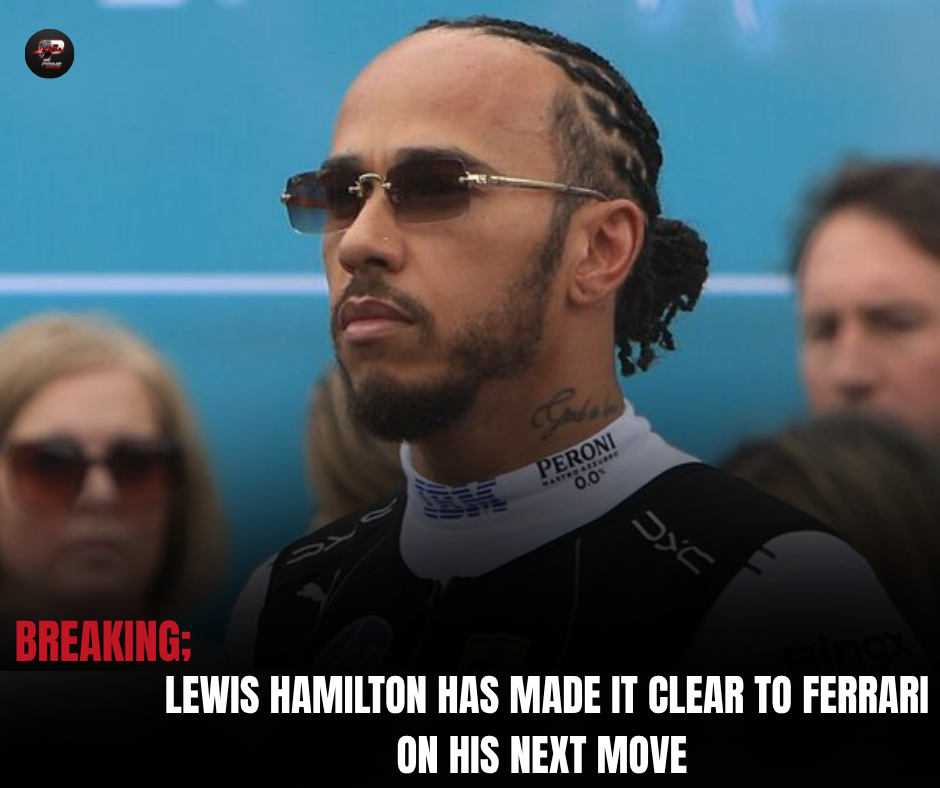
When Lewis Hamilton shocked the Formula 1 world by leaving Mercedes for Ferrari ahead of the 2025 season, the question was never really if the partnership could work — it was when. After one of the most difficult years of his career, Hamilton has since made his intentions unmistakably clear: he is not done, he is not walking away, and he is coming for an eighth world championship.
This is the story of what Hamilton has said, what it means, and why the next chapter of his Ferrari journey could be the most consequential in Formula 1 history.
A Nightmare First Season in Red
To understand where Hamilton is heading, you first have to understand what he came through.
The 2025 Formula 1 season was, by almost every measurable standard, the worst of Lewis Hamilton’s career. After 18 seasons of never failing to stand on a Grand Prix podium at least once, the seven-time world champion went the entire year without a top-three finish. His only competitive highlight was a Sprint race victory at the Chinese Grand Prix in March — a result that, while celebrated, only underlined how far short the rest of his year fell.
He finished sixth in the Drivers’ Championship, a staggering 86 points behind teammate Charles Leclerc, who himself failed to win a race all season. Ferrari ended up fourth in the Constructors’ Championship — a humbling result for what many had billed as the superteam pairing of the decade.
The numbers were painful. In qualifying, Hamilton averaged a 0.254-second deficit to Leclerc across the season — a gap that, while partially explained by adaptation challenges, was difficult to ignore for a driver who holds the all-time record of 104 pole positions. There were technical excuses — Hamilton had spent two decades racing with one brake supplier and had to transition to Ferrari’s system overnight. There were setup challenges. There was a car that Ferrari themselves admitted was fundamentally limited, choosing to shut down its development all the way back in April 2025 to focus resources entirely on the 2026 regulation overhaul.
But beyond the stats, there were the words. Hamilton was uncharacteristically raw throughout the season, describing it at various points as a “nightmare” and speaking with a frustration that alarmed fans and paddock insiders alike. There were whispers — and more than whispers — about whether he might walk away from the sport, or at the very least, walk away from Ferrari.
“I Forgot Who I Was” — But He Found Himself Again
The turning point came in the winter break.
In a candid social media post that reverberated across the F1 world, Hamilton wrote: “For a moment, I forgot who I was, but thanks to you and your support you’re not going to see that mindset again. I know what needs to be done.”
It was a remarkably honest admission from one of sport’s most decorated athletes. Seven world championships, 104 pole positions, more race wins than any driver in history — and yet a single difficult season had shaken his sense of identity. What followed, however, was equally remarkable: a deliberate, disciplined rebuilding of both body and mind.
Hamilton confirmed he began training from Christmas Day, the shortest off-season of his career. He overhauled elements of his personal environment, his working relationship with the Ferrari team, and his mental approach to the season ahead. Speaking ahead of the 2026 Australian Grand Prix, he explained the transformation: “A combination of things. The break was really positive — it was my surroundings, it was the people I was with. I always talk about cultivating a positive mental attitude, and that’s what I focused on.”
Sky Sports F1 commentator David Croft, who spoke directly with Hamilton’s team during the off-season, was unequivocal: Hamilton was not retiring, was not looking for an exit, and was returning to Ferrari more energised and more determined than ever.
The 2025 version of Lewis Hamilton — distant in media sessions, visibly drained, unsure of the path ahead — was gone. What arrived in Melbourne for the 2026 season opener was something closer to the driver who had dominated a generation.
His Intentions at Ferrari Are Now Unmistakable
Lewis Hamilton’s goals for 2026 are not dressed in diplomatic language. He is not managing expectations or offering cautious optimism. He wants to win.
“The goal is to win,” he stated flatly ahead of the Australian Grand Prix. “That’s what everyone’s working towards — every team is. But that’s our goal, to maximise on every opportunity, to be lean, to be hopefully fighting in the top group.”
That clarity of intent is matched by a transformation in his relationship with the Scuderia. Hamilton has spoken at length about how much more connected he feels to Ferrari entering his second year — how the cultural understanding, the working rhythms, and the personal relationships within the team have fundamentally changed for the better. “It’s a much nicer feeling having spent a year with the team, understanding the culture, finding ways of working together,” he said. “I feel very gelled with the team.”
Behind the scenes, that alignment appears genuine. Hamilton has been working closely with race engineer Carlo Santi, refining communication, setup feedback, and race simulation processes. Ferrari, for their part, have invested heavily in making the SF-26 suit Hamilton’s driving style — a car that rewards drivers who can manage controlled slides, something Hamilton excels at, rather than the stiff, precise setup demands of the ground-effect era that plagued him in recent years.
Ferrari themselves were bullish entering 2026, with pre-season testing in Bahrain producing encouraging long-run pace data. McLaren team principal Andrea Stella pointed to Ferrari and Mercedes as the “teams to beat.” That external validation, combined with Hamilton’s internal renewal, created a very different atmosphere at Maranello than the one that had defined 2025.
A Transformed Start to 2026 — And Why It Matters
The early races of the 2026 season backed up the optimism, at least partially.
Ferrari emerged as the closest challenger to a fast-starting Mercedes, with Hamilton and Leclerc both demonstrating strong race starts — an area that had been a weakness in 2025. Hamilton, in particular, looked like a driver transformed: vocal, energised, full of belief where 12 months earlier he had been withdrawn and guarded.
“This podium has taken longer than I had hoped,” he acknowledged, referencing the dream that brought him to Ferrari in the first place. “But they provided us a really solid car.”
The challenge remains real. Mercedes have shown pace advantages on the straights that Ferrari have yet to fully answer. A frustrating weekend in Miami — where Ferrari brought 11 upgrades to the SF-26 and still fell behind McLaren — demonstrated that the gap to the very front is not yet closed. Hamilton’s response was instructive: rather than spiralling into frustration as he might have in 2025, he calmly announced a new preparation approach for the Canadian Grand Prix, stepping back from intensive simulator work after identifying correlation issues between simulation data and live track performance.
That is a driver who has genuinely learned. A driver who knows himself. A driver who, as he himself has said, will not repeat the mindset of 2025.
The Bigger Picture: Why Hamilton Came to Ferrari
It is worth stepping back to remember why this move happened at all — because context matters when assessing where it is heading.
Hamilton had signed a fresh contract extension with Mercedes in the summer of 2023. He was, by all public accounts, intending to finish his career at the team that had defined his dominance. Then, in early 2024, an opportunity emerged. Ferrari’s new team principal Fred Vasseur — a man Hamilton had known and trusted since his junior racing days — made his move.
“The stars aligned,” Hamilton said at the time. “I think it really wouldn’t have happened without him.”
Beyond the personal connection, Hamilton was drawn by something more elemental: the romance of Ferrari, the weight of its history, and the specific challenge of ending an 18-year championship drought for the most famous team in motorsport. He had grown up watching Michael Schumacher dominate in red. He had wondered what it would feel like. And at 39 years old, staring at what might be his final chapter in Formula 1, he decided to find out.
“I’m writing my story,” he said when the move was announced, “and I felt like it was time to start a new chapter.”
That chapter started badly. But it is far from over.
Analysis: What Hamilton’s Resolve Actually Tells Us
There is a temptation in sports journalism to treat athlete resilience as a cliché — as mandatory positive spin after adversity. Hamilton’s situation is different, and it deserves to be examined seriously.
The 2025 season was not a minor setback. It was, objectively, the worst year of his professional life in motorsport. He went podiumless for the first time since 2007. He was publicly criticised by Ferrari chairman John Elkann. He admitted to the media that he lost himself. He watched paddock speculation grow about whether Ferrari might replace him with a younger driver — with Oliver Bearman’s name consistently surfacing as a future option.
And yet he stayed. He worked. He trained from Christmas Day. He demanded internal changes at Ferrari. He pushed for the team to abandon the 2025 car early in favour of a full commitment to 2026. He was, by his own admission, “the one pushing for it.”
That is not the behaviour of a driver filling time until retirement. That is the behaviour of a man who genuinely believes he has another title in him — and who is willing to absorb an entire season of pain as the price of that belief.
The question now is not whether Hamilton wants to win. It is whether Ferrari can give him the tools to do it.
The Contract Situation and What Comes Next
Hamilton’s current Ferrari contract runs through the end of 2026, with reports placing his annual salary at approximately $60 million. That deal will come up for renewal — or non-renewal — at the end of the season, and the outcome will shape not just Hamilton’s future but Ferrari’s entire driver strategy for the next era of the sport.
If 2026 delivers the title challenge Hamilton believes is possible, the conversation is straightforward: he stays, the partnership deepens, and the dream of an eighth championship lives on. If 2026 falters — if Ferrari again fails to challenge at the front — the decisions become far harder.
There is a version of events in which Hamilton ends his career at Ferrari without a championship, accepting that the car never quite arrived. There is another version in which he departs after 2026 if the results are not there, potentially stepping back from the sport entirely given his age (he will turn 42 in January 2027). And there is the version Hamilton himself has publicly committed to: one where the new regulations, the new car, and a renewed partnership produce the results that 2025 denied him.
Looking at the current 2026 season, that third scenario still appears very much alive.
Prediction: Hamilton Will Stay — And Could Still Win It All
Based on everything that has been said, demonstrated, and acted upon, the most likely outcome is that Lewis Hamilton will complete his 2026 campaign with Ferrari and push genuinely for the Drivers’ Championship. Whether he achieves it will depend heavily on how the Ferrari SF-26 development curve compares with Mercedes through the second half of the season.
The regulation overhaul of 2026 — new chassis, new power units, a fresh technical landscape — is precisely the reset that the Hamilton-Ferrari partnership needed. In a stable regulation environment, experience and institutional knowledge favour established teams and established driver-car combinations. In a reset year, everything is uncertain, and uncertainty historically benefits the boldest players.
Hamilton is a bold player. He proved it by leaving Mercedes. He proved it by demanding changes after his worst season. He proved it by committing himself to training from Christmas Day when most people would have taken a rest.
The eighth world championship remains the goal. Ferrari has the structure, the ambition, and now — finally — a driver who feels at home in red. The story is not written yet.
And that, for Formula 1 fans, is exactly the point.
Sources: Formula1.com, ESPN, Sky Sports F1, PlanetF1, Motorsport Week, ScuderiaFans