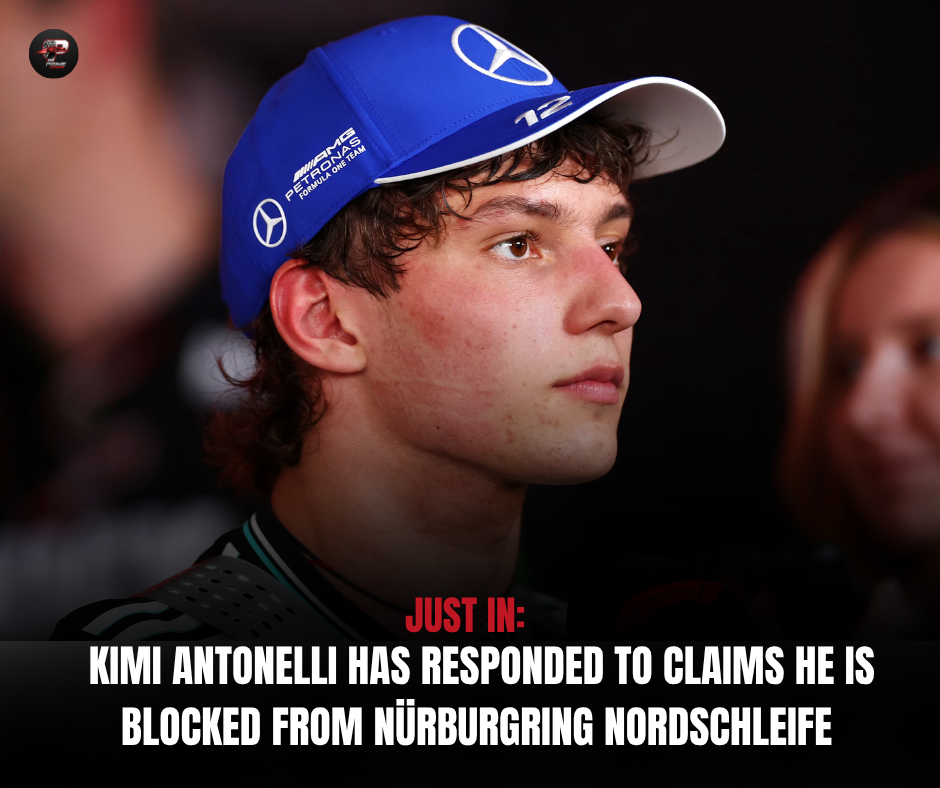
In a Formula 1 season already overflowing with storylines — championship battles, technical controversies, a teenage prodigy rewriting the record books — it was a short video that sparked one of the most talked-about paddock conversations of the week.
Kimi Antonelli, 19 years old, current Formula 1 championship leader, winner of three of the first four races in 2026, quietly mentioned in a recent social media clip that he wanted to earn his Nürburgring Nordschleife permit — the licence required to race GT machinery on the legendary 20.8-kilometre circuit known universally as “The Green Hell” — before the end of the year.
Within hours, the clip had spread across motorsport social media. Within days, Mercedes had publicly shut the idea down. And now, Antonelli himself has responded — because when you are the most talked-about driver in Formula 1 right now, nothing you say, however casually, stays quiet for long.
This is the full story: what Antonelli said, why Mercedes said no, what it tells us about how they are managing their most precious asset, and why the entire episode reveals something genuinely interesting about who Kimi Antonelli is beyond the race results.
The Video That Started It All
The sequence of events began simply enough. Antonelli — who has always been active and natural on social media compared to many of his contemporaries on the grid — spoke candidly in a video about his broader motorsport ambitions. The subject of the Nordschleife came up, and the Mercedes driver was direct about where he stood.
He wanted to obtain the DMSB Nordschleife Permit, known in German motorsport circles as the DPN, before the end of 2026. The permit is a mandatory certification issued by the German Motor Sport Authority that governs who can race on the Nordschleife in competitive conditions. It is awarded through a graduated process — drivers must progress through increasing levels of track experience, supervised runs, and assessed tests before earning the right to race GT-class machinery at speed on the circuit’s most demanding configurations.
Antonelli did not frame this as a distant fantasy. He said he had already asked about doing a test at the Nordschleife. He described it as “a track that I love.” He made clear this was something he was actively considering, not merely daydreaming about.
The video circulated. The question arrived at Mercedes’ door. The answer, delivered by deputy team principal Bradley Lord during the Nürburgring 24 Hours weekend, was one word: “No.”
Antonelli’s Response: Measured, Honest, Entirely In Character
Faced with the public confirmation that his employer had blocked the plan, Antonelli’s response was notably free of frustration or diplomatic evasion. This is a driver who has shown, even in his short time at the top level of the sport, a disarming tendency toward honesty that makes him unusually easy to follow as a public figure.
Rather than pretending the ambition was never serious, or performatively backing the team’s decision with hollow corporate language, Antonelli acknowledged the situation plainly. He understands why Mercedes have said no. He is leading the Formula 1 world championship. He is in his second season of F1. The team’s position is logical, and he is not fighting it.
What he has made equally clear, however, is that the passion driving the original comment is entirely genuine and is not going anywhere. The Nordschleife is a circuit he has studied, tested, and dreams of racing. The ambition to compete in endurance events — and specifically to one day race alongside Max Verstappen in a shared GT car — is something he has spoken about multiple times this year with consistent enthusiasm.
“I would love to do an endurance race with Max, together,” Antonelli said earlier in the season. “I think that would be pretty awesome. It’s cool because we both have the passion for GTs. On my side it came from my dad with the GT team, and occasionally I go and test when I can.”
The Nordschleife comment was not a spontaneous outburst. It was the latest expression of a motorsport identity that extends well beyond Formula 1 — an identity shaped, in large part, by the person who put him in a car for the first time.
The Father, the GT Legacy, and Why This Matters
To understand why Kimi Antonelli has such a genuine pull toward GT racing and the Nordschleife in particular, you have to understand his father.
Marco Antonelli is not a background figure in Kimi’s story. He is a racing driver in his own right — someone who competed in GT categories and who subsequently founded and runs AKM Motorsport, a team that has competed across multiple motorsport series. The younger Antonelli grew up in and around GT cars, endurance paddocks, and the specific culture of a form of motorsport that is in many ways the antithesis of Formula 1: longer, more collaborative, less individual, more rugged.
That exposure had tangible consequences. As a 16-year-old, Antonelli took an Italian GT sprint win on his competitive GT debut — a result that, for a teenager already widely regarded as the most exciting Formula 2 prospect in a generation, demonstrated that his skill set was not confined to single-seater machinery. He had tested and raced a Mercedes GT3 through his father’s team connections before Mercedes’ junior programme elevated him toward the top of the single-seater pyramid.
This background is the reason the Nordschleife ambition does not read like a celebrity driver seeking a publicity stunt. For Antonelli, endurance racing in general, and GT racing on the Nordschleife specifically, is woven into the fabric of his motorsport upbringing. When he says he “loves” the circuit, he is not speaking as someone who has watched it on television. He is speaking as someone with a documented, hands-on connection to the discipline it represents.
That context makes Mercedes’ veto understandable rather than overprotective — and it makes the eventual conversation about when, not if, more interesting than the current no.
Mercedes’ Position: “Full Focus” — and Why They Are Right
The public response from Bradley Lord, Mercedes’ deputy team principal and chief communications officer, was delivered during the Nürburgring 24 Hours weekend — the same event where Max Verstappen made his own debut in the race, driving a Mercedes AMG GT3 run by Winward Racing alongside teammates Daniel Juncadella, Jules Gounon, and Lucas Auer.
Lord’s delivery was blunt in the way that only someone who has clearly already had this conversation internally can be. When German broadcaster Nitro asked whether Mercedes would allow Antonelli to obtain the DPN permit this year, Lord replied: “No. I’ve spoken to him about it. I think he meant it more as a joke.”
He then added, grinning, that Antonelli might “give it a try after four world championships” — a pointed and deliberate nod to Verstappen’s own timeline. Lord’s underlying argument was explicit: the Red Bull driver “perhaps has a bit more range thanks to his experience” compared to the 19-year-old Antonelli. In other words, Verstappen has spent a decade in Formula 1, won four world titles, and has the accumulated motorsport capital to absorb the risk of a detour to the Nordschleife. Antonelli, in only his second F1 season, does not yet have that buffer.
The instruction from Lord was clear: “Full focus” on Formula 1.
It is difficult, honestly, to argue with that position when you examine the numbers. After four races of the 2026 season, Antonelli leads the Drivers’ Championship with 100 points, sitting 20 points clear of teammate George Russell. He has won three consecutive grands prix — China, Japan, and Miami — a run that made him the only driver in the history of Formula 1 to convert each of his first three career pole positions into race victories. Mercedes sits atop the Constructors’ Championship with 180 points, 70 points clear of Ferrari in second. The Silver Arrows have won every race of the season.
You do not ask the pilot to go sightseeing mid-flight.
The comparison to Verstappen is instructive in ways that go beyond simple career trajectory. Verstappen’s participation in the Nürburgring 24 Hours was possible precisely because of a specific circumstance: the race fell in the gap between the Miami and Canadian Grands Prix, one of the few windows in the F1 calendar wide enough to accommodate a major endurance commitment. His presence drew record attendance, with organisers confirming weekend tickets sold out for the first time in the race’s history. After leading for the majority of the event before a heartbreaking late driveshaft failure ended his team’s challenge within sight of victory, Verstappen confirmed he would try to return next year — “It will for sure try. It always depends a bit on my calendar.”
But Verstappen is 28 years old with four championships. Antonelli is 19 years old with zero — and one that is very much within reach. The two situations are not comparable, and Mercedes would be failing in their duty of care to pretend otherwise.
The Green Hell: Understanding What Antonelli Is Actually Asking For
For readers less familiar with the mythology of the Nürburgring Nordschleife, some context is essential to understand why Mercedes’ caution carries genuine weight rather than being mere corporate risk-aversion.
The Nordschleife is 20.8 kilometres of public road repurposed as a racing circuit, winding through the forests and hills of the Eifel region of western Germany. It contains 154 corners across its length. Elevation changes of up to 300 metres. Blind crests. Sections where cars become airborne at racing speed. A climate so changeable that conditions at one end of the circuit can be entirely different to those at the other.
It has claimed lives across its history — racing drivers, road users, motorcyclists — earning the “Green Hell” nickname not as marketing copy, but as a genuine description of what drivers face. Niki Lauda, one of Formula 1’s most cerebral and self-aware champions, famously campaigned for the circuit to be removed from the F1 calendar before his near-fatal crash there in 1976 proved his point in the most brutal possible way.
The modern GT racing that takes place on the Nordschleife has safety standards unrecognisable from Lauda’s era. The cars are built to absorb enormous impacts. The permit system exists precisely to ensure drivers build up experience progressively rather than arriving cold. But the fundamental nature of the circuit — its length, its complexity, its intolerance of error — remains unchanged. A moment of inattention, a mechanical failure at the wrong point, a patch of oil on a blind corner can have consequences that are impossible to manage entirely, no matter how sophisticated the safety infrastructure.
The comparison to Robert Kubica that some commentators have drawn — the 2007 crash at the Canadian Grand Prix that ended his F1 career, triggered not by a Nordschleife risk but by the inherent danger of motorsport — is an emotional rather than directly analogy. But the underlying point stands: in a sport where physical risk is irreducible, teams have a legitimate interest in limiting the exposure of their most important drivers to additional danger during a championship campaign.
Mercedes’ caution is not paranoia. It is professional responsibility.
Analysis: What This Episode Tells Us About Antonelli
Strip away the headline and the team veto, and what this story actually reveals is a portrait of a driver whose relationship with motorsport is broader, deeper, and more multidimensional than his Formula 1 results alone would suggest.
Most 19-year-olds leading the Formula 1 championship for the first time would be entirely consumed by it. The pressure, the focus required, the sheer novelty of being at the sharp end of the sport’s biggest stage — all of it would reasonably narrow a driver’s attention to the F1 bubble almost exclusively. The fact that Antonelli is simultaneously thinking about Nordschleife permits, GT endurance races, and the specific joy of doing it alongside a competitor he genuinely admires speaks to a motorsport instinct that is unusually wide-ranging for someone his age.
This is not distraction. It is perspective. And perspective, in a sport that historically destroys young talents by narrowing their world until the pressure becomes unsustainable, may be exactly what keeps Antonelli grounded in the long run.
The Verstappen parallel is not just a throwaway comparison from Bradley Lord. Verstappen has spoken extensively about how his passion for other forms of motorsport — karting, GT racing, sim racing — has kept him sharp and genuinely enthusiastic about the act of driving in a way that years of Formula 1 monotony might otherwise have dulled. The GT racing that so many F1 teams discourage their drivers from pursuing is, for Verstappen, precisely the thing that makes him more rather than less effective when he is back behind the wheel of the RB22.
Antonelli appears to understand this instinctively. He is not asking to go to the Nordschleife instead of winning the world championship. He is asking to go to the Nordschleife because he is the kind of driver who finds joy in the act of racing, not just the act of winning. Those are different things, and the distinction matters.
Mercedes’ “no” for 2026 is, in the wider arc of this story, merely a comma. The passion is real. The ambition is documented. The family connection is deep. When the championship pressure eases — this year, next year, whenever the right window opens — the Nordschleife conversation will resume.
Prediction: Antonelli Gets His Permit in 2027 — After His First Championship
The prediction here is straightforward and tied directly to the championship trajectory.
If Antonelli wins the 2026 Drivers’ Championship — which, based on the current season, is more likely than not unless his machinery or his fortunes change dramatically — the conversation about diversifying his motorsport activity will look entirely different in the winter of 2026 and the spring of 2027. A world champion who has proved his value to Mercedes in the most definitive way possible is in a much stronger negotiating position regarding personal racing interests.
The Verstappen template — four championships, then a Nürburgring 24 Hours debut — is probably not Antonelli’s path. His passion is too genuine and too long-standing to require that level of accumulated capital as a prerequisite. But one championship, a renewed Mercedes contract, and a convincing demonstration that he can manage the demands of F1 while pursuing outside interests responsibly? That is a very achievable unlock.
The Nordschleife will wait. The Green Hell has been there since 1927, and it will be there when Antonelli is ready. Mercedes’ instinct to protect their asset during a title season is correct and professional. Antonelli’s instinct to want more — to dream beyond the circuit boundaries of the current weekend — is not a problem to be managed. It is a quality to be nurtured.
For now, the answer is no. But in this particular story, “no” has a very clear expiry date.
Sources: ESPN, Formula1.com, Motorsport.com, Crash.net, Sky Sports F1, GPBlog, Yahoo Sports / Athlon Sports, Grand Prix 247, Motorsport.com (AU), Sunday Guardian Live