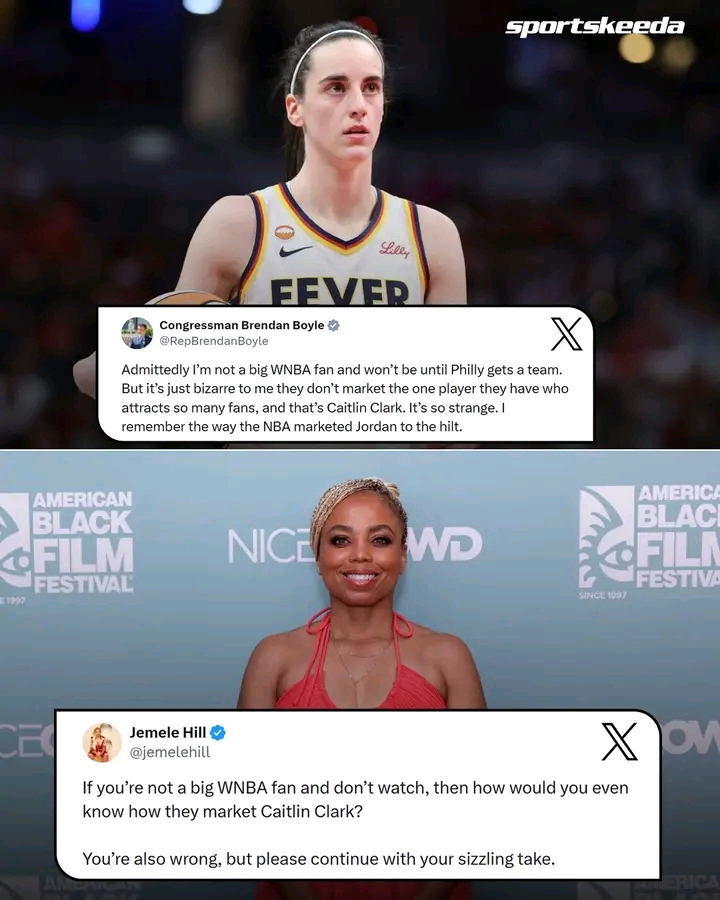
The conversation surrounding Indiana Fever superstar Caitlin Clark continues to dominate the sports world, and this time it has sparked a public exchange between a U.S. congressman and veteran sports journalist Jemele Hill.
What began as a discussion about how the WNBA promotes its biggest star quickly turned into another chapter in the ongoing debate over Clark’s influence on women’s basketball, the league’s marketing strategy, and the future direction of the WNBA.
HOW THE DEBATE STARTED
Congressman Brendan Boyle shared his opinion on social media, admitting he isn’t a regular WNBA fan and won’t become one until Philadelphia receives an expansion franchise.
However, Boyle questioned what he believes is the league’s promotional strategy, arguing that Caitlin Clark—the player drawing unprecedented fan interest—isn’t being marketed aggressively enough.
He compared Clark’s situation to how the NBA built its global brand around Michael Jordan during the 1990s, suggesting the WNBA should take a similar approach.
His comments immediately generated strong reactions from basketball fans, analysts, and media personalities.
JEMELE HILL RESPONDS
Jemele Hill wasted little time challenging Boyle’s argument.
Hill questioned how someone who openly admits they don’t regularly watch the WNBA could accurately judge its marketing efforts.
She also dismissed Boyle’s criticism, suggesting his conclusion wasn’t supported by reality and sarcastically encouraged him to continue sharing what she described as a “sizzling take.”
Her response reignited one of the most polarizing discussions in women’s basketball: Is the WNBA doing enough to promote Caitlin Clark, or is the criticism overlooking the league’s actual marketing efforts?
IS THE WNBA REALLY UNDERMARKETING CAITLIN CLARK?
The claim that the WNBA has failed to market Clark has become increasingly common among some fans.
But the evidence paints a more complicated picture.
Clark has been featured prominently across league advertising campaigns, national television promotions, social media content, All-Star voting initiatives, and merchandise campaigns. Many of the Indiana Fever’s nationally televised games have also been scheduled because of the enormous interest surrounding Clark and her team.
At the same time, critics argue that while Clark receives plenty of exposure, the league sometimes appears reluctant to fully embrace her as the singular face of women’s basketball.
Supporters of that view believe the WNBA prefers highlighting multiple stars—including A’ja Wilson, Breanna Stewart, Napheesa Collier, Sabrina Ionescu, and others—instead of centering nearly all promotional efforts around one player.
That balancing act has become one of the league’s biggest business challenges.
WHY THE WNBA FACES A DIFFICULT DECISION
Unlike the NBA during Michael Jordan’s era, today’s WNBA features numerous elite players capable of carrying the league’s image.
While Clark has unquestionably generated record television ratings, sold-out arenas, and surging merchandise sales, league executives also recognize the importance of building long-term stars across every franchise.
Relying too heavily on one player creates risks if injuries occur or if fan interest shifts.
Instead, the WNBA appears committed to promoting Clark while simultaneously elevating established MVPs and emerging young talent.
Whether that balance is perfect remains a matter of debate.
WHAT THIS MEANS FOR THE INDIANA FEVER
For Indiana Fever fans, the conversation underscores just how transformative Clark has become.
Nearly every Fever road game attracts larger crowds than previous seasons. Television audiences continue to rise whenever Indiana plays, and opposing teams frequently move games into larger arenas to accommodate demand.
The Fever have become the league’s biggest attraction, placing enormous expectations on the organization to compete for championships while handling constant national attention.
As Clark continues developing chemistry with her teammates, Indiana’s success on the court could make these marketing debates even louder.
Winning championships often settles arguments about who should become the centerpiece of a league.
THE IMPACT ON THE WNBA’S FUTURE
The larger issue extends beyond one social media exchange.
The WNBA is experiencing one of the fastest growth periods in its history. Attendance has climbed, television ratings have reached new highs, corporate sponsorships continue to expand, and media coverage has never been greater.
Clark is undeniably a major driver of that momentum, but she is also part of a league filled with elite talent.
Finding the right balance between celebrating its biggest attraction and showcasing the league’s overall depth will likely remain one of the WNBA’s most important strategic decisions over the next several seasons.
PREDICTION: THIS DEBATE IS FAR FROM OVER
As long as Caitlin Clark continues breaking records and drawing unprecedented attention, discussions about her place in the WNBA’s marketing strategy aren’t going away.
Every nationally televised game, endorsement deal, attendance record, and playoff race will fuel fresh conversations about whether the league is maximizing its biggest commercial opportunity.
For the Indiana Fever, the priority remains much simpler.
If Clark leads Indiana deep into the playoffs and eventually delivers a championship, the league’s marketing strategy may become less controversial because sustained winning naturally creates iconic stars.
Until then, expect every major voice in sports—from politicians to journalists to former players—to continue weighing in on one of basketball’s most talked-about athletes.