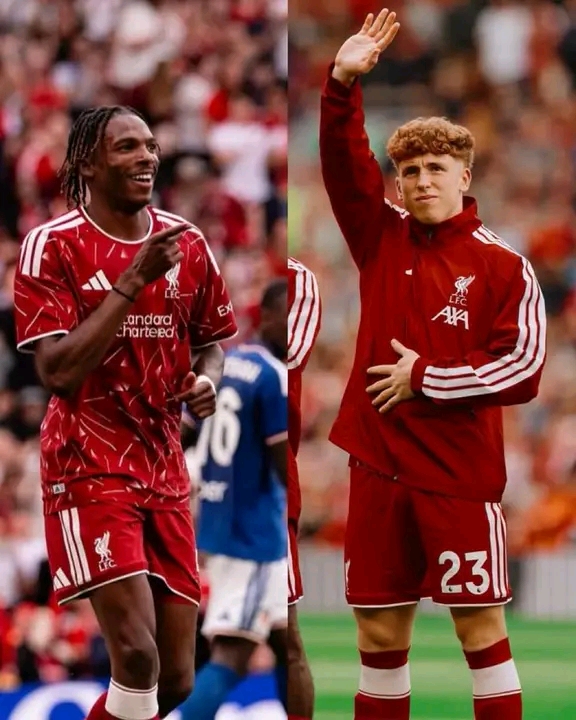
There’s a particular feeling that runs through Anfield when a new face turns up and looks, almost immediately, like they belong. It’s not something you can manufacture with a big transfer fee or a flashy unveiling video. It’s something that has to be earned on the pitch, in real minutes, against real Premier League opposition, and it usually takes months to arrive, if it arrives at all. Which is exactly why the early impressions being left by Jeremy Jacquet and Victor Muñoz feel worth stopping to talk about. It’s still early days, the sample size is tiny, and anyone who tells you they know exactly how a career at a club like Liverpool is going to unfold after a handful of appearances is getting ahead of themselves. But there is something in the way both of these two have carried themselves since arriving that suggests Liverpool haven’t just added squad depth this summer. They may have added two players who genuinely understand the size of the shirt they’re wearing.
Start with Jacquet, because his path to Anfield has been anything but straightforward. The centre-back arrived from Rennes in a deal worth around sixty million pounds, agreed back in the depths of winter, with the understanding that he would finish out the season in Ligue 1 before making the move permanent for pre-season. That’s already a slightly unusual arrangement, the kind that requires patience on both sides, and it meant Liverpool fans had months to build anticipation for a player they’d barely had the chance to watch in detail. Then came the setback that nobody wanted: a shoulder injury requiring surgery, arriving just as the ink was drying on the transfer. For a twenty-year-old moving to one of the biggest clubs in the world, that’s a cruel way to start a new chapter. Recovery from that kind of injury isn’t just physical, either. There’s a mental component to coming back from surgery before you’ve even kicked a ball for your new team, a nagging worry about whether the move itself might be compromised before it’s begun.
So when Jacquet finally did get onto the grass with his new teammates, there was always going to be scrutiny on how sharp he looked, how much rust needed shaking off, whether the recovery had genuinely been as complete as the medical staff insisted. Early signs suggest it has been. He’s a young defender by trade, still only in his early twenties, but there’s a calmness to how he reads the game that tends to separate the centre-backs who are simply athletic from the ones who are going to have real careers at the top level. Against Nottingham Forest, in a match that had all the chaos you’d expect from an early-season draw at Anfield, Jacquet more than held his own. He was strong in the air, composed on the ball, and gave the kind of account of himself that doesn’t necessarily grab headlines but absolutely earns the trust of a manager. Head coaches don’t hand out regular starting minutes to young defenders who look shaky under pressure, and the fact that Jacquet has been trusted early, in matches that matter, tells its own story.
There’s also something to be said for the mentality he’s shown in simply getting to this point. Missing pre-season training, watching from the sidelines while a new manager builds his systems and his relationships with the squad, is not the ideal introduction to a football club. Plenty of players in that situation would arrive tentative, cautious, still feeling their way in physically and emotionally. Instead, Jacquet has looked like someone determined to make up for lost time rather than intimidated by it. That’s a mentality thing as much as a talent thing, and it’s exactly the kind of hunger that Liverpool fans want to see from a player who is going to be entrusted with one of the most demanding positions on the pitch, week in and week out, at a club where every mistake gets magnified under the lights of Anfield and dissected on every phone-in and podcast in the country.
Then there’s Muñoz, whose situation was almost the opposite in terms of preparation. The Spanish winger’s move from Osasuna came together with a different kind of drama entirely, a swirl of transfer speculation involving other Premier League clubs before Liverpool moved decisively to trigger his release clause. There’s something worth noting in how that transfer saga played out. Muñoz wasn’t a player Liverpool simply outbid everyone for; he was a player other clubs had circled and, in some cases, gotten close to signing, before Liverpool’s move changed the calculus entirely. That’s not nothing. It suggests a player who was already highly rated across the league before he’d kicked a competitive ball in English football, someone whose qualities were obvious enough to spark genuine competition for his signature.
What’s followed since has, by most early accounts, backed up that competition. Muñoz arrived at Liverpool later than ideal in pure pre-season terms, having represented his country at a major summer tournament and understandably wanting a short break before diving into a new league, a new city, and a new way of working. That’s a lot to ask of anyone in a short window. Yet rather than looking like a player still adjusting to a different rhythm of football, he’s shown flashes of exactly what Liverpool fans hoped for: directness, confidence in possession, and a willingness to affect games even when he’s still getting to know his teammates’ movements and tendencies. His equaliser against Nottingham Forest, arriving deep into the second half of a match that had swung back and forth, was the kind of moment that can define how a new signing is perceived for months afterward. Score a big goal early in your Liverpool career, in a game the team badly needed something from, and the goodwill that buys you is significant. It buys patience for the inevitable quieter performances that come later in a long season, and it buys belief from teammates that this is a player capable of producing something out of nothing when the team needs it most.
What’s striking about both players, watching them in these opening weeks, is how little either of them seems fazed by the occasion. Anfield is not an easy place to make a first impression. The crowd is knowledgeable, the standards are relentlessly high, and there’s a particular kind of scrutiny that comes with wearing the shirt at a club with this much history and this much recent success to live up to. Players who arrive overawed by that tend to shrink in the moments that matter, hesitating on the ball, avoiding responsibility, playing the percentages rather than trusting their instincts. Neither Jacquet nor Muñoz has looked like that so far. If anything, both have looked eager for the ball, eager for responsibility, willing to make the mistakes that come with taking risks rather than playing it painfully safe in the hope of not being noticed.
Part of that confidence likely comes down to how the club and coaching staff have handled their integration. New eras at massive football clubs are always accompanied by uncertainty, by questions about identity and system and whether new signings will fit the vision the head coach is trying to build. Liverpool’s head coach has been vocal in his praise for both new arrivals, describing the qualities he believes each brings to the squad, and that kind of public backing matters more than people sometimes realise. Players who know their manager trusts them, who know they were signed with a specific role and specific expectations in mind rather than as a speculative squad addition, tend to play with more freedom. There’s less second-guessing, less trying to prove a point with every touch, and more simply doing what got them signed in the first place.
It’s also worth remembering just how different these two are as players and as characters, which makes their shared early impact even more interesting. Jacquet is a defender, tasked with the unglamorous but essential job of organising a backline, winning individual duels, and providing the platform from which everything else at a football club is built. Defenders rarely get the same headlines as attackers, and their mistakes tend to be far more costly and far more visible than their successes. To look composed in that role, this early, in a league as unforgiving as the Premier League, says something about temperament as much as ability. Muñoz, by contrast, is an attacking player whose job is fundamentally about taking risks, about beating a man, about creating something where nothing obviously existed a moment before. Those are different skill sets requiring different kinds of courage, and the fact that both have shown early signs of adapting well suggests this isn’t a coincidence of one lucky performance. It’s starting to look like a pattern.
None of this is to suggest either player has already arrived, in the fullest sense of that word. Football has a habit of humbling even the most promising careers, and there will be difficult afternoons ahead for both of these players, games where the opposition is set up specifically to nullify what they do best, games where fatigue and the unique physical demands of English football start to bite, games where the crowd’s patience is tested by a mistake at the wrong moment. That’s the nature of a long season, and it’s the nature of English football in particular, a competition that shows no mercy to reputations built in other leagues. A strong start is a strong start, nothing more and nothing less. It buys goodwill, but it doesn’t guarantee anything about October, or January, or the run-in come May.
Still, there’s real value in acknowledging what a good start actually represents, beyond just the results and the individual ratings. It represents a foundation. It represents trust being built, both between player and manager and between player and supporters, that can be drawn upon later in the season when things inevitably get harder. Every successful era at a football club is built on players who arrived and settled quickly enough to become important pieces before the difficult stretches of a campaign arrived. The players who take six months to find their feet are often playing catch-up for the rest of the season, while the players who hit the ground running get to spend that time building genuine understanding with teammates, developing the kind of instinctive partnerships that separate good teams from great ones.
There’s also something worth saying about what this means for the broader mood around the club right now. New eras invite scrutiny, and rightly so. Supporters who have watched their club compete at the very top of English and European football have every right to expect that standards won’t slip, that new signings will be judged not against some abstract standard but against the level required to genuinely challenge for major honours. When a summer’s transfer business is limited to a small number of additions, as it has been this time around, every one of those signings carries extra weight. There’s less room for one to simply be a squad player quietly finding his level; the pressure to contribute meaningfully, and to contribute quickly, is higher. Against that backdrop, the early performances from Jacquet and Muñoz feel even more significant. They’re not just individually encouraging. They’re a signal, however early and however provisional, that the calculated bets made in the transfer market this summer were sound ones.
It’s easy, watching football in an era of instant reaction and constant analysis, to get carried away after a handful of promising performances. Ratings out of ten after a single match, endless clips circulating of a good pass or a strong tackle, the temptation to declare a player the answer to every problem after they’ve barely had time to learn their teammates’ first names. The sensible approach is to enjoy these moments for what they are without pretending they guarantee anything about the months ahead. But there’s also a version of caution that tips over into cynicism, that refuses to acknowledge good signs simply because it’s safer not to get excited too early. That’s not really the spirit in which football is meant to be watched, and it’s certainly not the spirit that made Anfield the kind of ground it is. Supporters there have always responded to effort, to hunger, to players who look like they understand what it means to wear that shirt, and both Jacquet and Muñoz have given plenty of early reasons to believe they understand exactly that.
So where does that leave things, a matter of weeks into their Liverpool careers? Cautiously, sensibly, realistically excited. Jacquet has overcome a difficult and unusual start to his Liverpool journey to look like a defender with genuine composure beyond his years, someone capable of anchoring a backline rather than simply making up the numbers within it. Muñoz has arrived with less preparation time than most and still managed to produce a moment that will live long in the memory of anyone who was there to see it, the kind of goal that can shift how a whole fanbase perceives a new signing. Neither has done enough yet to be considered the finished article, and neither should feel any pressure to be. What they have done is give supporters something valuable in the early weeks of a new season under a new head coach: a reason to believe, a sense that the club’s recruitment has identified genuine quality rather than simply names, and the early foundations of what could become important, long-term relationships between two young players and a football club that demands everything from those who wear its badge. It’s still early days. But early days like these are exactly the kind that get looked back on fondly, years down the line, as the beginning of something that mattered. For now, that’s more than enough reason to be excited about what comes next .Up Reds.