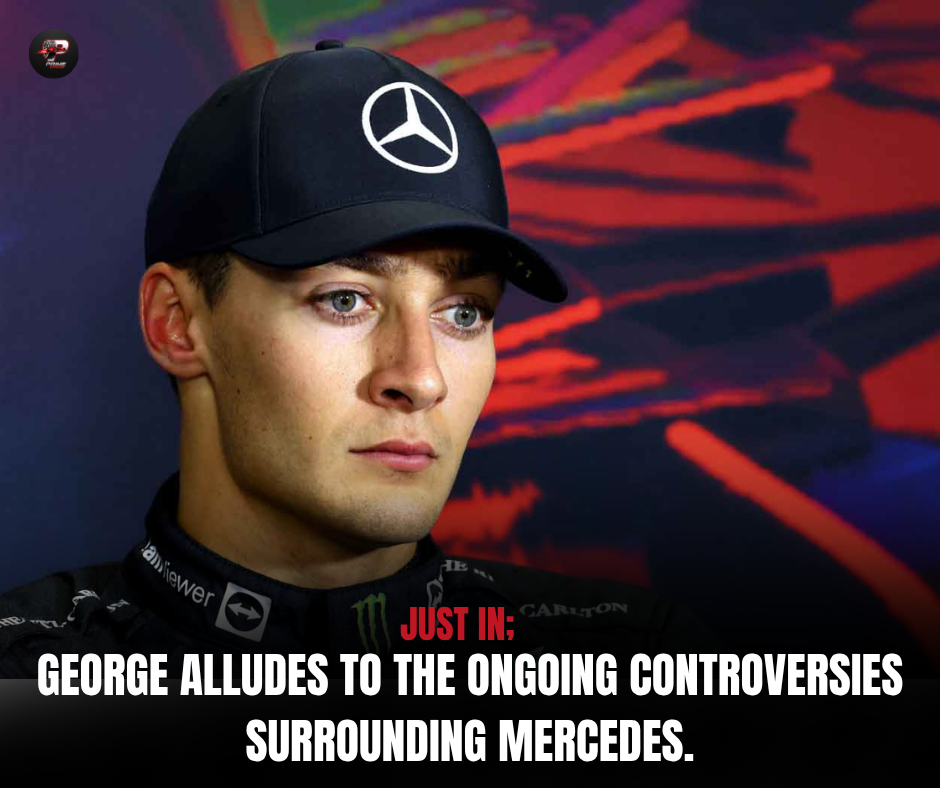
George Russell did not come to the 2026 Formula 1 season expecting to be on the defensive. He came expecting a coronation.
With Lewis Hamilton gone to Ferrari, Mercedes armed with the fastest car in the field, and a teenage teammate in Kimi Antonelli who many assumed would need time to find his feet, the narrative practically wrote itself: this was George Russell’s year. His moment. His championship. Four years of playing second fiddle — first to Valtteri Bottas at Williams, then to the greatest driver in the sport’s history — were over. The stage was cleared.
And then reality arrived, in three acts: a controversial front wing in China, a software bug in Japan, a string of victories that belong to someone else — and a driver who is now being asked, at every press conference, to explain why his team keeps winning the wrong way for the wrong man.
Russell’s responses to these controversies have been measured, combative at moments, and at times unexpectedly revealing. To understand what is really happening at Mercedes — technically, politically, and psychologically — you need to read between the lines of what he has said.
The Controversies: What Has Actually Happened at Mercedes in 2026
To appreciate the pressure Russell is operating under, it helps to catalogue exactly what has gone wrong — and exactly what has been questioned — in the opening rounds of the season.
1. The Engine Compression-Ratio Advantage
Before the cars had even completed a race lap, rival teams were raising flags over the AMG M17 E Performance power unit inside the Mercedes W17. Reports circulated that the Silver Arrows’ engine featured a compression-ratio advantage over competitors — a technical edge that, if confirmed, would explain a meaningful portion of the straight-line speed Mercedes demonstrated in pre-season testing. The FIA set a compliance deadline of June 1st for technical checks, leaving the matter officially unresolved through the opening rounds of the championship.
2. The Two-Phase Front Wing
The bigger, more visible controversy exploded after the Chinese Grand Prix. Footage circulating online showed the Mercedes W17’s active front wing behaving in an unusual fashion as the car transitioned from high-speed straights into corners. Under the 2026 technical regulations, active aerodynamic systems must transition between their open (straight-line) and closed (cornering) modes within a maximum of 400 milliseconds. The footage of Antonelli’s race-winning car appeared to show the wing moving through an intermediate state and taking longer than the regulated limit to fully close.
Ferrari were first to approach the FIA for clarification — with the initial request attributed to Italian publication Autoracer — and multiple other teams followed. The scrutiny was sharp and immediate.
The technical explanation that emerged was mundane rather than malicious: Mercedes had underestimated the aerodynamic loads acting on the wing at high speed in Shanghai’s conditions. The hydraulic pressure driving the wing closure was insufficient to overcome the air resistance pushing back against it at race speeds. The wing could not fully close until the car slowed sufficiently under braking. The team traced the issue to a miscalculation in their hydraulic system design and classified it internally as a reliability problem.
The FIA reviewed the matter, accepted Mercedes’ account, and cleared the W17 to continue racing with its existing front wing configuration. A new front wing was brought to Japan regardless, as Mercedes sought to address the underlying technical issue.
3. The Software Bug in Japan
If the front wing controversy strained Russell’s patience, what happened at the Japanese Grand Prix genuinely cost him a race result he deserved. Running in a net second position with clear pace after a well-executed stint, Russell found himself the victim of a timing mismatch at the safety car period — pitting one lap too early to benefit from the free stop that handed Antonelli the lead. Then, at the safety car restart, a bug in the W17’s software code triggered when Russell simultaneously pressed a steering wheel button and changed gear. The combination caused the power unit to enter what Mercedes called “super-clipping” mode, an energy harvesting state that depleted his battery at the precise moment he needed power to defend his position.
He lost a place to Lewis Hamilton in the moment. Then another to Charles Leclerc. What should have been a comfortable podium finish became a dispiriting fourth.
Mercedes trackside engineering director Andrew Shovlin confirmed the software defect publicly: “He then had another frustrating issue where a bug in the software code, triggered by a button press and a gear shift at the same time, caused the power unit to go into super-clip and charge the battery, which allowed Charles to pass.”
This was not a controversy in the regulatory sense — it was simply bad luck, compounded by a mechanical gremlin that had nothing to do with rivals or regulations. But it was the third straight race weekend where something had gone wrong specifically on Russell’s side of the garage.
What Russell Said — And What It Actually Means
Against this backdrop, Russell’s response to the external scrutiny was both understandable and revealing.
At the Japanese Grand Prix media day, he pushed back firmly against what he characterised as an orchestrated campaign to constrain Mercedes. “That’s just how the sport works, to be honest. It’s always been that way,” he said, when asked about the rival teams’ complaints. “We’ve worked so hard to get ourselves into this position, and the best team should prevail. We’ve obviously had a tough four years. In those four years, there were two other teams that dominated and won. Just because we’re more or less back on top, I don’t think it’s quite right that everyone is trying to hold us back.”
On the specific front wing issue, his language was clinical and careful: “It was not intentional, and it’s not an advantage for sure. It’s actually a problem, so something we’re trying to solve. It isn’t a straightforward solution, but there’s definitely no advantage to that.” He even acknowledged, pointedly, that the issue may have cost Antonelli a smoother path to victory in China — a detail that, if true, makes the controversy look not just unfounded but backwards in its assumptions.
These comments are defensible, and in large part they are correct. The history of Formula 1 is littered with dominant teams that spent their peak years fighting off protests, clarification requests, and rule changes prompted by jealous rivals. Red Bull endured the same during their era. Mercedes endured it during the hybrid dominance years. Ferrari have faced it. The pattern is well-established.
But there is a tension in Russell’s framing that is worth examining. He is simultaneously arguing that Mercedes is a dominant, meritocratic champion that deserves to be “held back” by no one — while also being a driver whose own experience of the 2026 season so far has been defined by bad luck, team-wide technical failures, and the uncomfortable reality of a teenager outscoring him three races to one. The dominant team narrative and the victimised driver narrative exist in uneasy coexistence.
The Deeper Problem: It’s Not Just the Controversies
Strip away the front wing, the engine queries, and the software bug, and you are left with a more unsettling picture for George Russell.
Kimi Antonelli is winning. Not edging ahead on strategy or benefiting from misfortune — winning comprehensively and, at times, emphatically. Following the Chinese GP, Wolff’s outfit led the constructors’ standings and Russell had claimed the spot as the first championship leader of the season. But this didn’t last long, and Antonelli has now made further history following the fourth round in Miami, becoming the only driver ever to convert his first three career pole positions into grand prix victories.
That statistic — the only driver in Formula 1 history to achieve back-to-back-to-back pole-to-win conversions from the start of a career — is extraordinary. It is also, for Russell, professionally dangerous. A 19-year-old in his second F1 season is not supposed to be making this kind of history while his experienced teammate fights for scraps.
Antonelli leads Russell by nine points at the top of the Drivers’ Championship after three rounds, a gap that tells only part of the story. The momentum — which is ultimately what controls the narrative in Formula 1 paddocks — has shifted decisively.
The qualifying numbers are damning. Russell stopped at the start of Q3 in China after a problem with his Mercedes, then made a setup change that backfired. In Japan, the combination of an ill-timed safety car and the software failure denied him the podium his raw pace deserved. These are genuine mechanical misfortunes, not driver errors — but they accumulate into a narrative that is difficult to counter with words alone.
The Contract Shadow and the Verstappen Question
Here is where the situation becomes genuinely complex, because Russell’s struggles on track are overlapping with serious uncertainty off it.
Russell’s Mercedes contract situation could be affecting his mindset as he fights Kimi Antonelli for the 2026 title, according to Juan Pablo Montoya. The former race winner was direct in his assessment, suggesting Russell appears distracted by the noise rather than channelling it. “I think what George really needs to do is figure out how to match Kimi. If he starts matching Kimi, Kimi will try to step even further to keep beating him. And I think mistakes can come.”
Russell’s situation is made even more complicated by the continued speculation linking Max Verstappen with a move to Mercedes. Verstappen’s long-term Red Bull future has been one of the biggest talking points of the season, with Mercedes repeatedly floated as the obvious destination if the four-time champion ever decides to leave.
This creates a trap that is uniquely difficult to escape. If Russell underperforms, Mercedes have both the justification and the opportunity to pursue Verstappen as his eventual replacement. If he wins convincingly, the conversation goes away. But winning convincingly requires exactly the psychological freedom that contract uncertainty and internal competition tend to erode.
The obvious risk is that Russell regards Antonelli as the “anointed one” at Mercedes. Signed by Mercedes as a 12-year-old and promoted into an F1 seat with the team earlier than expected by Toto Wolff — and rightly so given his ability — you can see why Russell could convince himself of this narrative. Once the idea that one driver is favoured takes root, it can have a corrosive effect.
The analysis from RACER’s Edd Straw is precise here: this is not necessarily about what is happening, but about what Russell allows himself to believe is happening. The stopwatch decides in the end. And Russell has the talent to make it decide in his favour.
The Canada Test: Must-Win or Must-Respond?
The Formula 1 paddock is not a subtle place. The framing going into the Canadian Grand Prix — the first race after a five-week break following Miami — has been loud and unambiguous.
Will Buxton stated on the Up to Speed podcast that Russell has to win the next race in Montreal, otherwise his world title hopes are at risk. “It’s how George reacts now is where we will learn if George has it inside himself to become a world champion,” he explained. “If he can respond to being beaten in this way by the young upstart who’s not even 20 years old and realise that he’s got to raise his level again to a level that he didn’t think he was going to have to perhaps this soon, that’s going to be the telltale sign because he will or he won’t.”
The Circuit Gilles Villeneuve has previously been a good track for Russell, and with Mercedes expected to bring upgrades to Canada, the upcoming grand prix can’t come soon enough for the Brit.
To call Canada a “must-win” overstates the mathematical urgency — there is an enormous season ahead, and a 20-point deficit with multiple sprint weekends remaining is far from terminal. But the psychological framing is accurate. Four races of Antonelli victories would permanently reshape how the Mercedes garage, the paddock, and the wider public understand the hierarchy at the Silver Arrows. Russell knows this. His team knows this. And that awareness, whether it motivates or paralyses, will define how he drives in Montreal.
Analysis: Is Russell Being Unfairly Squeezed?
The honest answer is: partly yes, partly no.
On the technical controversies, Russell is largely right. Mercedes are being held to a standard of scrutiny that arrives specifically because they are winning — not because they have done anything uniquely improper. The front wing issue was a genuine technical malfunction, the FIA investigation was resolved in their favour, and the engine compliance process is following the standard regulatory timeline. The pattern of rivals filing complaints when a team goes dominant is as old as Formula 1 itself. Russell’s comparison to the Red Bull and Ferrari eras is historically accurate.
But on the internal competition, the narrative that everything going wrong lands on his side of the garage is harder to sustain. Yes, the safety car in Japan had unfortunate timing. Yes, the software bug was a team failure, not a Russell failure. But Antonelli is not winning because Russell is unlucky — he is winning because he is genuinely fast, startlingly mature, and capitalising on every opportunity Russell is not.
The danger for Russell is conflating the two. External criticism from rivals can be deflected with a shrug and a well-placed historical comparison. Internal competition from a prodigiously talented teammate cannot be deflected at all. It can only be met.
Prediction: Russell Wins Canada — But the Season Is Far From Over
The Canadian Grand Prix is the right circuit at the right time for George Russell. The streets of Montreal reward the kind of precise, clean, consistent driving that is his signature style. Mercedes are expected to arrive with upgrades. The five-week break has given him time to reset mentally, review data, and approach the weekend without the accumulated weight of three consecutive painful results.
The prediction here is that Russell wins in Montreal — and that the victory temporarily silences the loudest voices questioning his title credentials. But one race does not resolve the underlying dynamic. If Antonelli is the real article — and the early evidence strongly suggests he is — then the 2026 championship is going to be decided between two Mercedes drivers for large parts of the season, with Ferrari and McLaren waiting for them to create the openings.
That is, improbably, a genuinely exciting prospect. The most dominant team in the field may also contain the most fascinating internal competition. The controversies surrounding Mercedes — the front wing, the engine, the software, the contract conversations — are all noise around a signal that is becoming harder to ignore: Formula 1 in 2026 has found its most compelling storyline, and George Russell is right at the centre of it.
Whether that ends in triumph or heartbreak will depend not on how the FIA rules on front wing transition times. It will depend on whether George Russell, on the fastest car on the grid, can beat the teenager in the other garage.
Sources: Sky Sports F1, PlanetF1, Motorsport Week, RACER, GPFans, Motorsport.com, F1-Fansite, NewsOnF1, Formula1.com