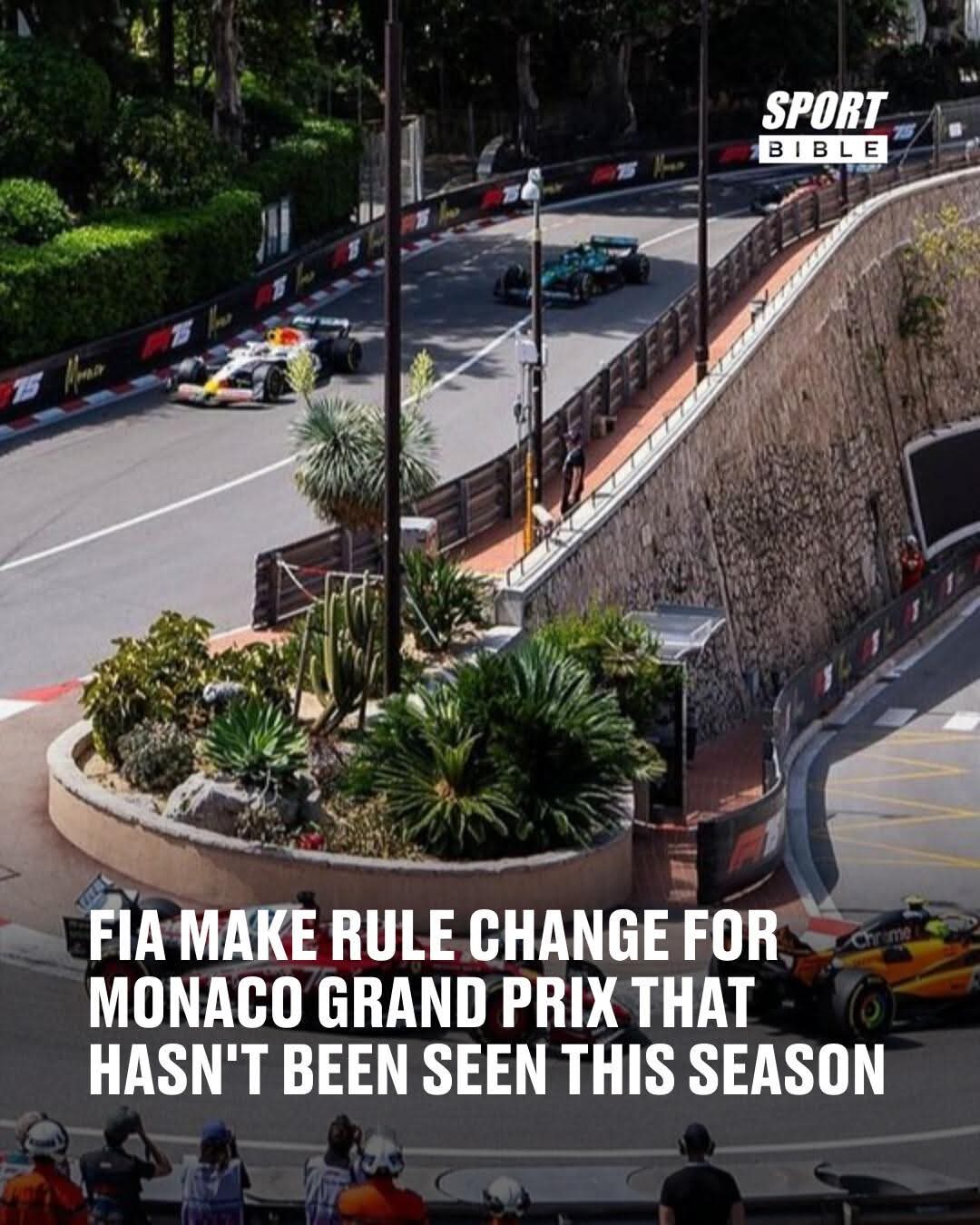
The Monaco Grand Prix has always occupied a special place on the Formula 1 calendar, and the 2026 edition is set to be even more unique after the FIA introduced a rule change that has not been seen at any other race this season. As Formula 1 continues adapting to its new generation of regulations, Monaco once again proves that its iconic streets demand a different approach from both drivers and officials.
Set against the glamorous backdrop of Monte Carlo, the 78-lap race remains one of the sport’s most prestigious events. However, it is also one of the most difficult circuits for overtaking. The narrow layout, close barriers, and lack of long straights mean that track position is often more valuable than outright pace. For decades, success in Monaco has largely been determined on Saturday rather than Sunday, making qualifying arguably the most important session of the entire Formula 1 season.
The introduction of Formula 1’s new regulations for 2026 created optimism that racing across the grid would become more competitive. The redesigned cars can follow each other more closely, theoretically increasing overtaking opportunities. In addition, the sport replaced the long-standing DRS system with a new active aerodynamics feature known as “Straight Mode.” This technology allows drivers to lower elements of both the front and rear wings at the push of a button, reducing drag and boosting top speed on designated sections of a circuit. Yet despite being a central feature of the new era, Straight Mode will not be used in Monaco.
The FIA’s decision stems primarily from safety concerns. Officials reportedly believe that the system should only operate in sections where cars are not already pushing the limits of grip. Monaco’s layout offers very few such opportunities. Drivers are constantly transitioning between braking zones, acceleration points, and high-precision corners while running inches away from barriers. The governing body has also established a minimum three-second requirement for Straight Mode activation zones, a criterion that Monaco struggles to satisfy. With the risk of instability potentially increasing in such confined conditions, the FIA has chosen caution over experimentation.
While Straight Mode has been removed, drivers will still have access to the sport’s overtake mode. The feature can be activated exiting the final corner and carried down the start-finish straight toward Sainte Devote. As a result, Turn 1 could become the most important overtaking opportunity of the weekend. However, many drivers remain skeptical that Monaco will suddenly transform into a circuit known for wheel-to-wheel action. Even with improved aerodynamics, the realities of the street circuit remain unchanged. One mistake can end a race instantly, encouraging a more calculated approach from drivers fighting for championship points.
This decision also highlights the FIA’s willingness to learn from previous experiments. Last season’s controversial mandatory two-stop rule was introduced in an effort to improve the spectacle of the Monaco Grand Prix. Instead, teams quickly found loopholes that allowed them to manipulate race strategy. Several squads used one driver to deliberately slow the field while a teammate gained track position through an early pit stop. The tactic frustrated fans and competitors alike, ultimately leading to the rule’s removal for 2026. By scrapping both the two-stop experiment and Straight Mode for Monaco, the FIA appears focused on preserving the integrity of the event rather than forcing artificial entertainment.
From a competitive perspective, the rule change could have major implications for the championship battle. Drivers such as Kimi Antonelli, George Russell, Lewis Hamilton, Max Verstappen, and Charles Leclerc will know that qualifying performance is likely to be more critical than ever. With fewer overtaking tools available, a front-row start could effectively determine a driver’s entire weekend. Teams will therefore place enormous emphasis on one-lap pace, tyre preparation, and track position throughout practice and qualifying.
Looking ahead, Monaco may serve as an important test of whether Formula 1’s 2026 regulations can genuinely improve racing at the sport’s most challenging venue. If overtaking remains limited despite the new generation of cars, calls for further circuit-specific solutions may emerge in the future. However, many traditionalists will argue that Monaco’s appeal has never depended on overtaking numbers alone. The challenge of threading a Formula 1 car through the streets of Monte Carlo at the absolute limit remains one of the greatest spectacles in motorsport.
As the championship heads to one of its most historic destinations, the FIA’s latest decision ensures that Monaco will once again stand apart from every other race on the calendar. Whether the change improves the spectacle or simply reinforces the importance of qualifying, all eyes will be on Monte Carlo as Formula 1 enters another fascinating chapter in its new era.