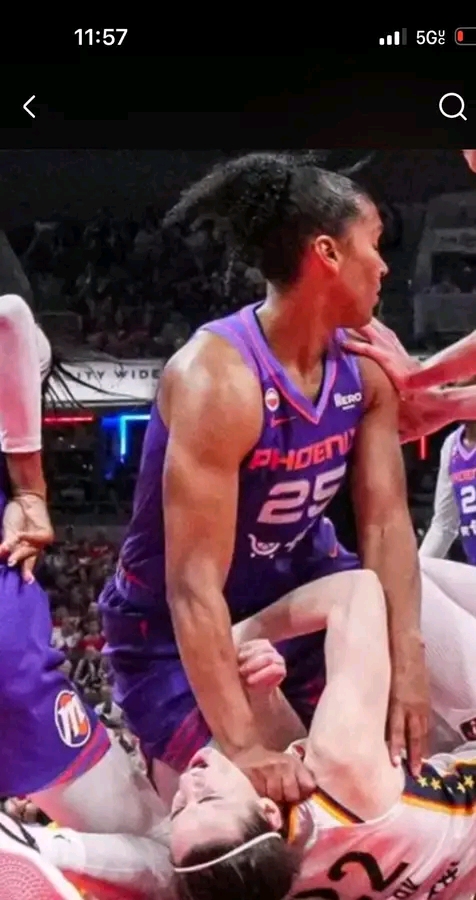
The conversation surrounding player safety in the WNBA has reached another level, with many Indiana Fever fans asking an important question: Can someone actually file a police report if a player intentionally endangers another player during a game?
Following several controversial physical incidents involving Indiana Fever star Caitlin Clark, frustration has continued to grow across social media. While hard fouls and aggressive defense have always been part of professional basketball, many fans believe there is a clear difference between tough competition and actions that appear designed to injure an opponent.
As emotions continue to rise, many are wondering whether incidents on a basketball court can cross the line from league discipline into criminal law.
THE DIFFERENCE BETWEEN PHYSICAL PLAY AND ASSAULT
Basketball is naturally a physical sport. Players accept the possibility of body contact, hard screens, blocked shots, and even flagrant fouls as part of the competition.
However, legal experts generally distinguish between normal basketball contact and intentional acts that fall completely outside the rules of the game.
If a player deliberately punches, strikes another player in the throat, or intentionally attempts to cause serious bodily harm, those actions may no longer be viewed simply as “basketball plays.” Instead, they could potentially become matters for law enforcement depending on the circumstances and available evidence.
Consent to play basketball is not consent to deliberate violence.
CAN POLICE REALLY GET INVOLVED?
The short answer is yes—but only in exceptional situations.
Police have the legal authority to investigate incidents that occur during sporting events if they believe a crime may have been committed. Just because an action happens during a professional game does not automatically place it outside the law.
If authorities determine that an incident involved intentional violence rather than legitimate athletic competition, criminal charges could theoretically be considered.
Ultimately, prosecutors—not players, teams, or fans—decide whether criminal charges should be filed after reviewing the evidence and determining whether legal standards have been met.
HISTORY SHOWS IT HAS HAPPENED BEFORE
Professional sports have seen several cases where athletes faced criminal charges after violent incidents during competition.
Basketball, hockey, soccer, rugby, and other contact sports have all produced examples where excessive violence resulted in police investigations or court proceedings.
These cases remain relatively rare because officials must prove that the conduct went well beyond what participants normally accept during athletic competition.
WHY FEVER FANS ARE SPEAKING OUT
Indiana Fever supporters believe Caitlin Clark has been subjected to repeated excessive physical play since entering the WNBA.
Many fans argue that inconsistent officiating has allowed opponents to become increasingly aggressive, creating unnecessary risks for one of the league’s biggest stars.
The concern extends beyond one player.
If fans lose confidence that elite players are adequately protected, questions naturally arise about league standards, officiating consistency, and the WNBA’s commitment to player safety.
THE WNBA FACES A DELICATE BALANCE
The league must protect its players without removing the physical intensity that makes professional basketball exciting.
No one wants every hard foul to become a suspension, but dangerous conduct cannot be ignored either.
Clear enforcement of flagrant fouls, technical fouls, suspensions, and postgame reviews helps establish boundaries before situations escalate further.
Consistent discipline also reassures players that safety remains a priority regardless of their team or star status.
WHAT THIS COULD MEAN FOR THE FEVER’S SEASON
The Indiana Fever are building around Caitlin Clark as the centerpiece of their franchise.
Keeping their franchise guard healthy is essential not only for the team’s playoff aspirations but also for the continued growth of the WNBA as a whole.
Every injury scare involving Clark draws enormous public attention because of her impact on television ratings, ticket sales, merchandise, and the league’s overall popularity.
If concerns about excessive physical play continue, pressure will likely increase on league officials to apply rules more consistently throughout the remainder of the season.
FINAL THOUGHTS
The debate over player safety is unlikely to disappear anytime soon. While criminal charges for on-court incidents remain uncommon, they are not impossible when actions allegedly go far beyond normal basketball competition.
For now, most incidents are expected to be handled through the WNBA’s disciplinary process rather than the criminal justice system. Still, every controversial play fuels renewed discussion about where the line should be drawn between tough defense and unacceptable conduct.
Indiana Fever fans continue to call for stronger enforcement of player safety rules, believing that protecting the league’s stars ultimately benefits every team, every player, and the future of women’s basketball.