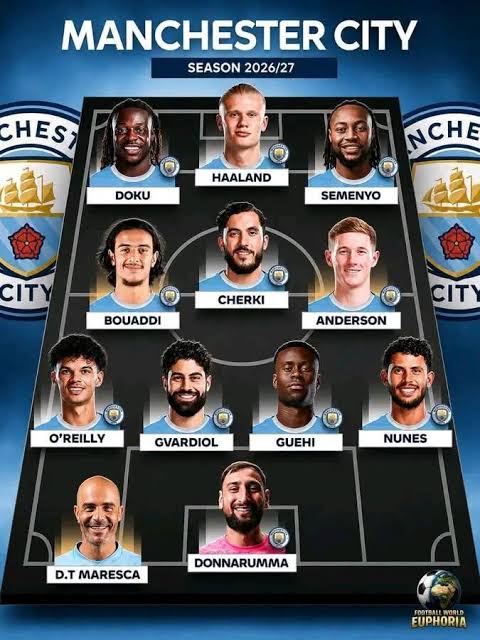
Manchester City fans have watched their club go through more change in the space of a few months than in the entire decade that preceded it, and the question hanging over the Etihad right now is as simple as it is enormous: can this squad, under a brand new manager, actually go and win both the Premier League and the Champions League in the same season? It’s a bold thing to even ask given everything that’s shifted behind the scenes, but the more you dig into where City actually stand heading into this campaign, the more it becomes clear this isn’t just idle clickbait speculation — there’s a genuinely fascinating story unfolding on the blue side of Manchester right now, and it deserves a proper look.
Let’s start with the elephant in the room, because you can’t talk about this City side without addressing just how much has changed. After ten years, six Premier League titles, a treble, and the most sustained period of dominance English football has ever seen, Pep Guardiola has left Manchester City. That sentence alone would have seemed unthinkable a couple of years ago, but here we are. Enzo Maresca was appointed as manager on 29 June 2026, succeeding Guardiola following his departure at the end of the previous season, and he arrives with a genuine pedigree of his own — Maresca led Chelsea to the FIFA Club World Cup title in 2025, so this isn’t some unproven rookie being thrown into the deep end. Still, replacing arguably the greatest club manager of the modern era is about as tough an assignment as exists in football, and Maresca has been handed one of the toughest jobs in the sport, tasked with following a man who won 18 trophies in just eight years, including a treble season.
The backdrop to his arrival is worth dwelling on too, because it explains a lot of the urgency around this City side. City missed out on the Premier League title to Arsenal last season but still secured a domestic cup double, though a limp Champions League exit to Real Madrid in the knockout stages won’t be tolerated again by supporters or ownership. City have now gone two years without a Premier League title, which is an eternity for this version of the club, and that context matters enormously when you’re asking whether this group can suddenly go and complete arguably the hardest double in club football. There’s real pressure here, not just to compete, but to actually deliver silverware in both competitions this season, and Maresca knows it.
So what does the squad Maresca has inherited actually look like, and has it been strengthened or weakened by the summer’s business? This is where things get genuinely interesting, because City haven’t stood still. A major development in early July was the signing of Elliot Anderson from Nottingham Forest, with reports indicating City had agreed a club-record fee of £116 million for the midfielder, and the transfer was completed once the player returned from his World Cup duties on 23 July. That’s an enormous statement of intent — breaking your own transfer record for a central midfielder tells you exactly where the priorities lie this summer, and Anderson arrives with genuine credibility given his summer exploits on the international stage.
But it hasn’t all been additions. City have lost some hugely significant figures too. Bernardo Silva and John Stones have both left the Etihad on free transfers as the Guardiola era comes to a close. And then there’s the biggest departure of them all: Rodri, fresh off Golden Ball-winning performances at the 2026 World Cup where he captained Spain to their second title, was widely linked with a return to La Liga, with interest from both Real Madrid and Barcelona, before Barcelona intensified their pursuit late in the window. Rodri has now joined Barcelona for a fixed fee of £51.3million, with add-ons potentially taking that figure as high as £65.4million. Losing the reigning Ballon d’Or winner and the single most important midfielder of the Guardiola era, in the same summer you lose the manager himself, would be a seismic blow for almost any club in world football. For City, it represents about as significant a rebuild as this squad has undergone in a decade.
That departure has directly reshaped how Maresca’s side will actually set up on the pitch, and this is where the tactical picture gets really compelling. The departures of Rodri and fellow midfielder Tijjani Reijnders have forced a formation shift, with Maresca opting for a 4-2-3-1 that places Anderson and Mateo Kovacic in a double pivot rather than the three-man midfield originally anticipated. In both his previous jobs, Maresca favoured the 4-2-3-1 as his base formation, varying in possession to shapes like 3-2-5 or 2-3-5 in a rigid, positional style, and at Chelsea in particular he used the 4-2-3-1 almost exclusively to maximise his number ten’s influence on the game. Under Maresca, City now utilise two defensive midfielders in front of a back three in possession, providing a more solid defensive base than the Guardiola era, when Rodri was often left to patrol central midfield largely alone, and City fans will remember only too well how exposed the team could look on the counter when that system broke down. On paper, that shift toward a double pivot looks like a sensible response to losing your best defensive midfielder, trading a touch of the old positional fluidity for greater defensive solidity.
The other major tactical departure from the “Pep way” is arguably even more eye-catching. In pre-season, wingers have been instructed to stay high and wide, tasked with isolating defenders in one-on-one situations, a clear break from Guardiola’s more interior, inverted approach to wide play. Antoine Semenyo, one of the players benefiting most from this new instruction, has apparently been delighted with the freedom it gives him, and the early pre-season numbers back up the change in approach — Semenyo had already racked up five assists in just four pre-season matches under the new manager. If that kind of directness and end product translates into the competitive season, it could give City a different, perhaps even more unpredictable way of hurting opponents than the intricate, possession-heavy football supporters became accustomed to under Guardiola.
Now let’s talk about what the actual starting XI is shaping up to look like, because this is really the heart of the question everyone’s asking. In goal, there’s continuity — City fans shouldn’t expect a change of goalkeeper after what’s been a largely excellent debut Premier League campaign from their current number one, and reports note the goalkeeper immediately showed why he’s considered one of the best in the world upon arrival, keeping fifteen clean sheets in just thirty-four starts, despite missing out on the 2026 World Cup. Behind him, the defence looks well stocked even after Stones’s exit, with Rúben Dias anchoring the backline from the centre, alongside options including Nathan Aké, Marc Guéhi, Rayan Aït-Nouri, and Joško Gvardiol. In central defence, Gvardiol has established himself as a leader of the back line and looks the likeliest cover for Dias or Guéhi in the event of injury, while Vitor Reis continues developing at this level.
The full-back situation has been one of the more fluid areas of the rebuild. Matheus Nunes and Rico Lewis are both available as right-back options, with Abdukodir Khusanov initially pencilled in for the starting right-back role in preview pieces, though more recent match-specific reporting suggests Nunes could return at right-back at the expense of Khusanov after shaking off a minor muscle problem. On the left, Nico O’Reilly has been used at left-back rather than central midfield, a positioning choice designed to still allow him to make his trademark forward runs. That kind of tactical creativity — repurposing a converted midfielder into an attacking full-back role — is exactly the sort of tinkering that suggests Maresca is trying to squeeze every ounce of value out of the versatile squad he’s inherited, rather than simply copying and pasting Guardiola’s old blueprint.
In midfield, the picture is now fairly clear following City’s record-breaking business. Kovacic has moved from a covering role into a starting double-pivot spot alongside Anderson, with the club-record signing set to take up what’s been described as the ‘Rodri role’ in midfield. That’s a significant burden to place on a player barely through the door, but Anderson’s World Cup pedigree suggests the club believe he’s ready for exactly that level of responsibility. Behind that pairing, the next line of midfield depth sits with Nico Gonzalez and Claudio Echeverri, both younger options who can contribute in cup competitions but haven’t yet been tested as starters in a genuine Premier League title challenge, which does raise a legitimate question about strength in depth should Anderson or Kovacic pick up an injury during a season that will demand rotation across four competitions.
Then there’s the forward line, and this is genuinely where City look like they could hurt anyone in Europe. The forward positions carry genuine depth, with Jeremy Doku, Rayan Cherki, Savinho, Jack Grealish, and Omar Marmoush all competing for the wide-attack berths around Erling Haaland, and Maresca is expected to continue the aggressive wide-player rotation pattern he showed at Chelsea across City’s various competitions this season. Of course, not everyone in that group is guaranteed to stick around — Savinho is heading to Tottenham, and Omar Marmoush is attracting strong interest from Atletico Madrid, so this attacking pool could look somewhat different by the time the window shuts.
And at the very centre of it all remains the one true constant through this entire summer of upheaval: Erling Haaland. Whatever else changes around him, City’s goal machine keeps doing exactly what he’s always done. Man City were top for expected goals by some distance last season, ranked number one for goals and for big chances created, with the world-class Haaland supported well by Doku’s wing play, the creativity of Cherki, and a few magical Phil Foden performances. Haaland has scored seven goals in just four opening-weekend Premier League games across his career, and recorded 22 strikes in just 14 matches in the month of August alone, a run of early-season form that suggests, whatever questions surround the rest of the rebuild, City’s centre-forward remains an absolute guarantee.
The season has already started to answer some of these questions in real time too, and the early signs offer a mixed picture. City were beaten 3-0 by Arsenal in the traditional season curtain-raiser, the FA Community Shield, on 16 August, with the Premier League champions delivering a dominant performance. That’s a sobering early reminder of exactly the gap City are trying to close domestically. There’s also been an immediate injury setback in attack — Jeremy Doku aggravated a calf issue in that defeat and has been ruled out for two to three weeks by Maresca, forcing an early reshuffle before a ball has even been kicked in the league proper, with Maresca surprisingly expected to turn to Jack Grealish on the left flank in Doku’s absence, with Phil Foden impressing enough in pre-season to be favoured in an advanced central role ahead of Cherki.
Yet even amid all this transition, upheaval, and an underwhelming pre-season result against their fiercest rivals, there remains genuine external belief that City can still compete right at the top table. Despite the huge change in dynamics — losing both the world’s best holding midfielder and the most influential manager of the modern era — seventeen BBC Sport pundits, along with Opta’s Supercomputer, still predict a top-two finish for City this season. That’s a remarkable vote of confidence given the scale of turnover, and it tells you something important: whatever questions remain about the system, the personnel, and the manager’s ability to fill Guardiola’s shoes, nobody in the analytical or punditry world is writing this squad off just because the man in the dugout has changed.
So, can this lineup really do it — win both the Premier League and the Champions League in the same season? The honest answer is that it’s an enormous ask, and probably a lot to expect in year one of a genuinely significant transition. You’re talking about a new manager still bedding in a new formation, a midfield rebuilt around a club-record signing who’s yet to play a competitive minute for the club, the loss of a Ballon d’Or winner in the base of midfield, and a squad that’s already shown defensive vulnerability in its first big test of the season against Arsenal. Doing the double is hard enough for a settled, stable squad in full flow — doing it in a season of this much upheaval would represent one of the great managerial achievements in recent Premier League history.
But write this City side off entirely and you’d be making a mistake too. The raw materials are still extraordinary. Haaland remains one of the most ruthless finishers on the planet and shows no signs of slowing down. The wide areas are stacked with match-winning talent even before considering who might yet leave before deadline day. Anderson arrives with the profile of a genuine star in the making, fresh off a World Cup that suggests he’s more than ready for the step up. And Maresca himself, whatever the size of the task in front of him, arrives with a Club World Cup on his CV and a clear, coherent tactical identity rather than simply trying to imitate his predecessor. The Community Shield defeat stings, and the Doku injury is untimely, but the season is 38 games long, and City have both the squad depth and the individual quality to be right in the mix come May, in both England and Europe, even if landing both trophies in the same campaign remains the toughest of asks in year one of the post-Guardiola era.