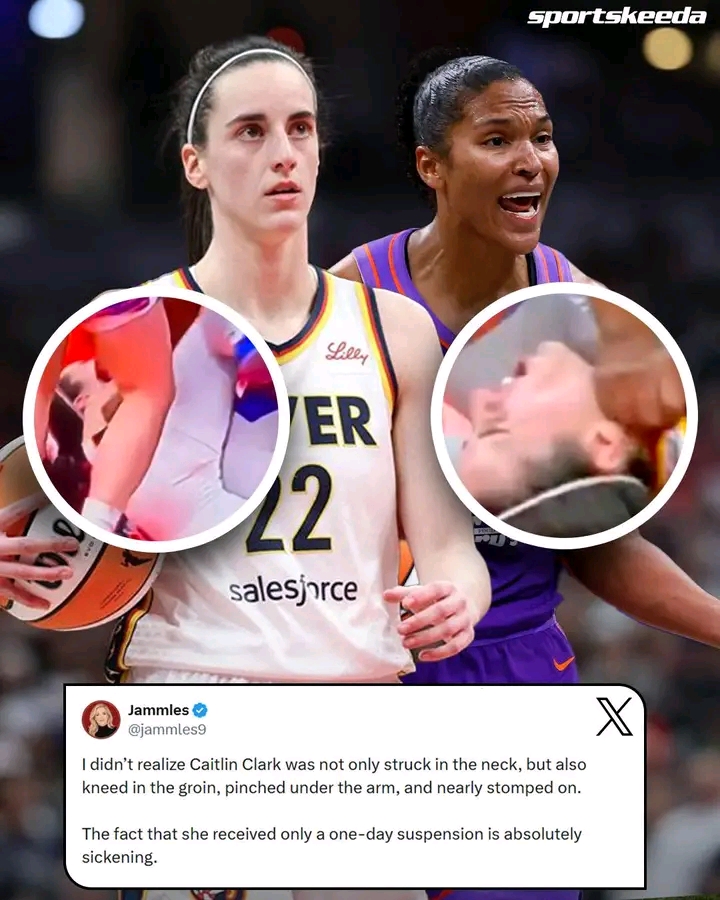
The conversation surrounding Indiana Fever superstar Caitlin Clark has once again shifted from her incredible basketball ability to the physical punishment she continues to endure on the court. A viral social media post has sparked fresh debate after an X user highlighted multiple moments from a recent game, claiming Clark was not only struck in the neck but also kneed in the groin, pinched under the arm, and nearly stepped on during a chaotic sequence.
While the clips have spread rapidly online, they have also reignited questions about player protection, officiating standards, and whether the league is doing enough to safeguard one of its biggest stars.
VIRAL VIDEO PUTS THE SPOTLIGHT ON CLARK’S TREATMENT
The social media post quickly gained traction because it appeared to show more than just a single hard foul. Instead, fans pointed to what they believed was a series of physical incidents occurring within moments of each other.
Supporters argued that the footage illustrated the cumulative punishment Clark regularly absorbs throughout games. Critics, however, cautioned against drawing conclusions from isolated video clips without considering the full context or game speed.
Regardless of differing opinions, the discussion reflects a growing trend: nearly every physical interaction involving Clark now becomes a major talking point across basketball media.
WHY EVERY CAITLIN CLARK FOUL BECOMES A NATIONAL STORY
Clark entered the WNBA carrying unprecedented expectations after rewriting the NCAA record books and becoming one of the most recognizable names in women’s basketball history.
Her arrival has dramatically increased television ratings, ticket sales, merchandise revenue, and media attention for the league. That level of visibility means every hard foul, every controversial whistle, and every emotional reaction receives far more attention than similar incidents involving many other players.
This isn’t simply about one athlete. Clark has become the face of a rapidly growing league, making her treatment on the court a subject that extends well beyond individual games.
THE FINE LINE BETWEEN PHYSICAL DEFENSE AND EXCESSIVE CONTACT
Basketball has always rewarded tough defense. Elite players routinely face aggressive coverage because opponents want to disrupt rhythm and force mistakes.
Clark’s deep shooting range, exceptional passing, and constant movement without the ball naturally invite defenders to play with greater physicality. Teams understand that allowing her space can quickly lead to offensive explosions.
However, the challenge for officials is determining where legitimate defensive pressure ends and unnecessary contact begins.
If players believe excessive physical play will consistently go unpunished, games can become increasingly difficult to officiate fairly.
OFFICIATING REMAINS UNDER THE MICROSCOPE
The WNBA has invested heavily in improving the quality and consistency of officiating, but controversial moments remain inevitable in a fast-paced sport.
Every season produces debates over missed fouls, technical fouls, replay reviews, and inconsistent whistles. Clark’s popularity simply magnifies those discussions.
League officials face the difficult task of protecting players without removing the physical competitiveness that many fans appreciate. Finding that balance will continue to be one of the league’s biggest challenges as television audiences continue to grow.
THE IMPACT ON THE INDIANA FEVER
For the Indiana Fever, keeping Clark healthy is essential to both their short-term success and long-term ambitions.
She serves as the team’s primary playmaker, offensive engine, and emotional leader. Any injury or prolonged absence would significantly affect Indiana’s playoff hopes.
The Fever have shown steady improvement as their young core develops chemistry, but maintaining Clark’s availability throughout the demanding WNBA schedule remains a top priority.
Her teammates have also become increasingly willing to defend her during physical contests, creating another layer of intensity whenever games become heated.
FANS REMAIN DIVIDED
The latest viral clips have once again split basketball fans into opposing camps.
One group believes Clark receives unnecessary contact because opponents understand her importance and attempt to disrupt her physically. Another argues that she is experiencing the same aggressive defense that every elite scorer faces throughout professional basketball.
The truth likely lies somewhere in between. Star players naturally attract more defensive attention, but officials must also ensure that games remain safe and fairly officiated.
WHAT THIS MEANS MOVING FORWARD
As Clark’s career continues, similar debates are unlikely to disappear. Her combination of elite talent, competitive personality, and massive popularity ensures every controversial moment will be analyzed from every angle.
For the WNBA, this presents both an opportunity and a responsibility. Increased attention means greater exposure for the league, but it also places greater pressure on officials to maintain consistency and transparency.
If the Fever continue their push toward postseason contention, every game involving Clark will carry even greater significance, making officiating decisions an even bigger part of the national conversation.
FINAL THOUGHTS
The viral claims surrounding Caitlin Clark highlight more than one controversial sequence—they underscore the enormous spotlight now surrounding the WNBA’s biggest attraction.
Whether fans believe the contact was excessive or simply part of a physical basketball game, one fact remains clear: Clark’s presence has transformed every major moment into a league-wide discussion. As the Indiana Fever continue building around their franchise cornerstone, protecting star players while preserving competitive basketball will remain one of the WNBA’s defining challenges.