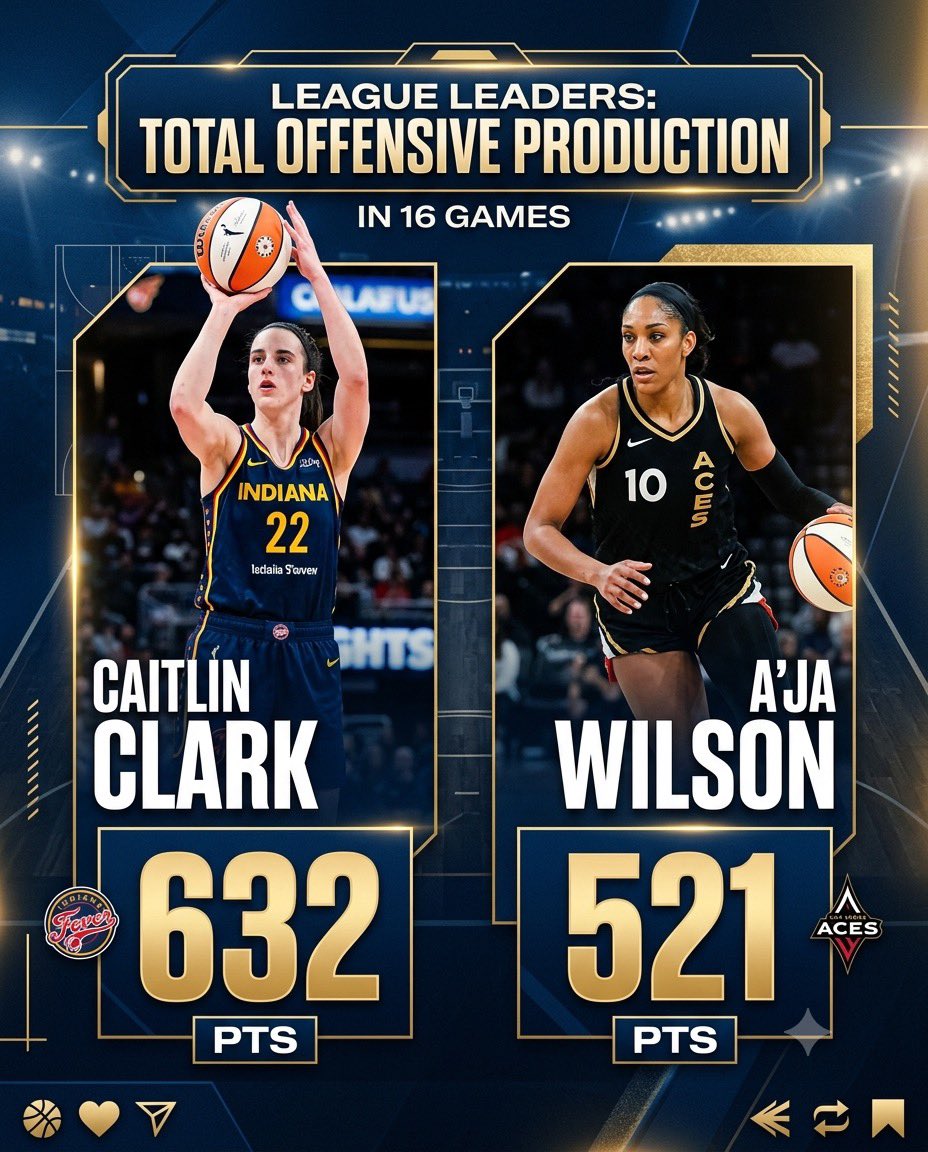
The Indiana Fever have become one of the most closely watched teams in the WNBA, and much of that attention continues to center around Caitlin Clark. As of June 23, 2026, Clark leads the league in total offensive production, further cementing her reputation as one of the game’s most impactful players.
While scoring titles and assist rankings often dominate headlines, total offensive production provides a broader picture of a player’s influence. It measures the overall offensive value a player creates, combining scoring and playmaking into a single metric. In other words, it highlights the players who are most responsible for generating points for their teams.
For Clark, leading the league in this category is nothing new.
During her rookie season, she finished first in total offensive production with 1,350 points generated, surpassing former MVP A’ja Wilson, who finished with 1,242. Now, just over a year later, Clark finds herself back at the top of the league.
WHY TOTAL OFFENSIVE PRODUCTION MATTERS
Basketball is often reduced to points per game, but the reality is much more complex. Elite offensive players do more than score—they create opportunities for teammates, dictate defensive schemes, and control the pace of games.
Clark excels in all three areas.
Her ability to stretch defenses with deep shooting forces opponents to defend further from the basket than they typically would. At the same time, her court vision creates easy scoring chances for teammates. Every possession she orchestrates places pressure on defenses to make impossible choices.
Do they stop Clark from scoring?
Or do they prevent her from creating open looks for everyone else?
Few players in the league place that kind of constant strain on opposing defenses.
WHAT THIS SAYS ABOUT CLARK’S DEVELOPMENT
Many rookie stars experience growing pains before becoming complete players. Clark’s trajectory has been different.
She entered the league as an elite offensive talent and has continued refining her game at an impressive pace. Rather than relying solely on her scoring ability, she has evolved into a complete offensive engine capable of carrying an entire system.
What’s particularly impressive is her consistency.
Defenses have spent more than a season studying her tendencies, designing game plans specifically to slow her down, and throwing multiple defenders her way. Yet she continues to produce at an elite level.
Leading the league in total offensive production despite receiving that level of defensive attention speaks volumes about her basketball IQ and adaptability.
WHAT IT MEANS FOR THE INDIANA FEVER
For the Fever, Clark’s offensive dominance is more than an individual achievement—it is a reflection of the team’s growth.
Indiana’s offense flows through Clark, but the supporting cast has become increasingly effective at capitalizing on the opportunities she creates. Players like Aliyah Boston have benefited from improved spacing and ball movement, while the team’s overall offensive efficiency has continued to climb.
The Fever are no longer viewed as a rebuilding team with future potential.
They are becoming legitimate contenders.
When a player leads the league in total offensive production, it elevates everyone around her. Teammates receive better scoring opportunities, transition chances increase, and opposing defenses are forced into uncomfortable situations.
That ripple effect can change the trajectory of an entire franchise.
THE MVP CONVERSATION CONTINUES TO GROW
Awards discussions inevitably follow players who dominate offensive metrics.
While the WNBA MVP race is always competitive, leading the league in total offensive production strengthens Clark’s case as one of the most valuable players in basketball.
The metric highlights something traditional statistics sometimes miss: value creation.
A player who scores 25 points is impactful.
A player who directly creates 40 to 50 points of offense every night through scoring and assists is transformational.
That distinction helps explain why Clark remains at the center of nearly every major league conversation.
CAN CLARK REPEAT HER ROOKIE-YEAR FEAT?
The fact that Clark led the league in total offensive production as a rookie was remarkable.
Repeating that accomplishment would be even more impressive.
Opposing teams now understand exactly how dangerous she is. Defensive game plans are built around limiting her touches, disrupting passing lanes, and forcing the ball out of her hands. Despite those efforts, she remains the standard by which offensive excellence is measured.
If she maintains her current pace, another league-leading finish is well within reach.
WHAT COMES NEXT FOR THE FEVER?
The most exciting part for Indiana fans may be that Clark’s success is increasingly translating into team success.
Championship contenders typically feature a player capable of generating offense at an elite level while elevating everyone around them. Clark has already demonstrated that ability.
As the season progresses, the Fever’s championship hopes will largely depend on maintaining offensive balance, improving defensive consistency, and staying healthy. If those pieces fall into place, Indiana could find itself in the thick of the title race.
And if Caitlin Clark continues leading the WNBA in total offensive production, the Fever will remain one of the most dangerous teams in the league.
FINAL THOUGHTS
Caitlin Clark’s place atop the WNBA’s total offensive production leaderboard is more than a statistical achievement. It is evidence of her evolution into one of the league’s premier offensive forces and a reflection of Indiana’s rise as a contender.
She led the league in the category as a rookie. She leads it again today.
For the Indiana Fever, that’s not just a sign of individual greatness—it’s a glimpse of what could become a championship-caliber future.