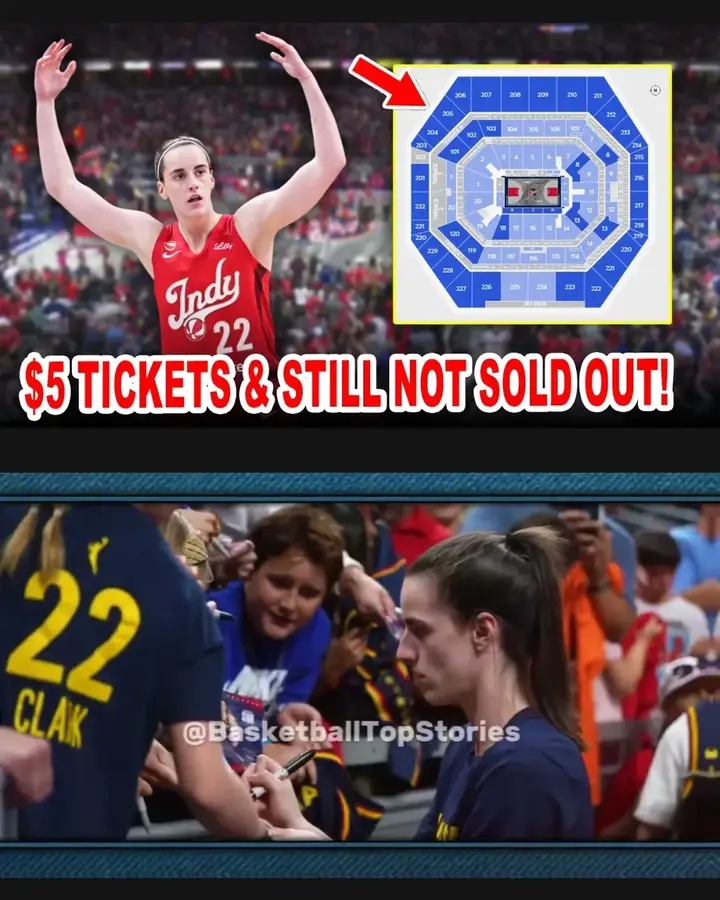
The Indiana Fever entered the 2026 WNBA season expecting to build on the momentum generated by Caitlin Clark’s arrival, but recent events have sparked an uncomfortable conversation around the franchise. Despite one of Clark’s most spectacular performances of the season, the Fever were unable to sell out Gainbridge Fieldhouse, even after ticket prices reportedly dropped as low as $5.
While attendance remains among the strongest in the WNBA, the inability to fill the arena has fueled debate about whether fans are becoming frustrated with the organization’s direction rather than losing interest in its biggest superstar.
EMPTY SEATS SEND A MESSAGE
Clark continues to be the league’s biggest attraction. Television ratings, social media engagement, and online highlights consistently place her well ahead of most players in the WNBA.
Yet the contrast between massive digital audiences and unsold seats has become increasingly noticeable.
During Indiana’s dramatic overtime loss to the Washington Mystics, thousands of seats reportedly remained available despite aggressive ticket promotions. The Fever also introduced discounted merchandise and food offers in an effort to boost attendance.
Although more than 15,000 fans still attended the game—a strong crowd by WNBA standards—the comparison with last season is difficult to ignore. Throughout Clark’s rookie campaign, Fever home games regularly sold out weeks in advance, and resale prices often exceeded face value.
That difference has many wondering whether supporters are becoming dissatisfied with the overall product rather than with Clark herself.
CLARK DELIVERED AN MVP-LEVEL PERFORMANCE
If anyone expected Clark’s performance to be the reason for declining attendance, the game against Washington quickly disproved that theory.
The Fever guard erupted in the fourth quarter, knocking down five three-pointers and drilling a dramatic game-tying shot at the buzzer to force overtime after Indiana erased a double-digit deficit.
It was another reminder of why Clark remains one of basketball’s most exciting players.
Her ability to transform a game in minutes continues to make her appointment viewing for basketball fans worldwide.
Instead of questioning Clark’s impact, many observers have shifted their attention toward whether the organization is maximizing her talents.
DEFENSIVE WEAKNESSES WERE EXPOSED
Indiana’s biggest issue against Washington was not offense—it was interior defense.
The Mystics repeatedly attacked the paint, finishing with a significant scoring advantage near the basket after Aliyah Boston exited the game with an apparent lower-leg injury.
Boston remains the defensive anchor of the Fever.
Once she left the floor, Indiana struggled to protect the rim or slow Washington’s frontcourt.
The game highlighted an issue that several analysts believed existed entering the season: the Fever may not have enough reliable frontcourt depth behind Boston.
Championship contenders rarely rely on one player to carry an entire defensive system, especially over the course of a long season.
ROSTER CONSTRUCTION FACES SCRUTINY
General manager Amber Cox has received growing criticism from sections of the fan base over roster construction.
Many supporters believe the Fever invested heavily in retaining their offensive core while failing to strengthen the frontcourt with another proven interior defender.
When Boston is healthy, that weakness becomes less obvious.
When she is unavailable, however, opponents have repeatedly targeted Indiana inside.
Adding another physical post defender could become one of the organization’s highest priorities before next season if the current trend continues.
STEPHANIE WHITE’S DECISIONS UNDER THE MICROSCOPE
Head coach Stephanie White has also found herself facing increased criticism.
Much of the discussion centers on late-game offensive execution.
Clark has repeatedly demonstrated that she thrives with the ball in her hands during crucial moments, yet some fans believe Indiana’s offense becomes too balanced in overtime or crunch-time possessions instead of leaning more heavily on its franchise superstar.
Kelsey Mitchell remains one of the WNBA’s premier scorers and an essential part of Indiana’s offense.
However, supporters continue debating whether Clark should be initiating more of the team’s decisive possessions when games are on the line.
Finding the right balance between multiple scoring threats and maximizing Clark’s unique playmaking ability may ultimately determine how far the Fever can advance.
WHY THIS MATTERS FOR THE FEVER
Attendance alone does not define a franchise’s success.
However, when one of the most recognizable athletes in women’s basketball history is on the roster, every empty seat naturally becomes part of the conversation.
The Fever still possess one of the league’s largest fan bases, but expectations have risen dramatically since Clark’s arrival.
Supporters now expect playoff contention—not simply exciting individual performances.
That means coaching decisions, roster depth, player development, and front-office strategy will continue facing intense scrutiny.
THE PATH FORWARD
Fortunately for Indiana, many of the problems appear fixable.
A healthy Aliyah Boston immediately strengthens the defense.
Improved frontcourt depth would provide insurance against injuries while giving White greater lineup flexibility.
Offensively, continuing to build around Clark’s elite passing, shooting range, and transition play could unlock another level for the entire roster.
The Fever possess enough offensive firepower to compete with anyone in the WNBA.
Turning that talent into consistent winning basketball now becomes the organization’s biggest challenge.
WHAT THIS COULD MEAN FOR THE REST OF THE SEASON
Indiana’s future still looks bright.
Clark continues producing performances worthy of MVP consideration, Boston remains one of the league’s best young post players, and the supporting cast includes proven veterans capable of contributing in big moments.
If the Fever address their defensive inconsistencies and establish a clearer offensive identity in late-game situations, they remain capable of making a deep playoff run.
But if the same issues continue—particularly interior defense and late-game execution—the frustration currently being expressed by portions of the fan base could grow even louder.
For a franchise built around one of basketball’s biggest stars, expectations have never been higher, and every decision made by the coaching staff and front office will continue to be judged through the lens of championship ambitions.