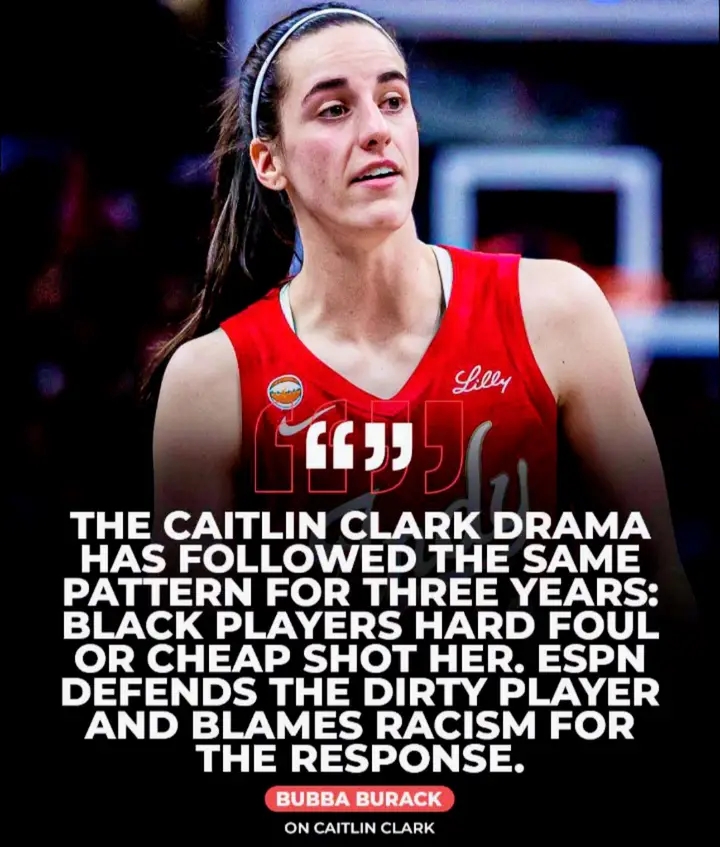
Few athletes in professional sports generate as much discussion as Indiana Fever superstar Caitlin Clark. Every hard foul, controversial whistle, and heated debate involving the reigning WNBA Rookie of the Year quickly becomes national news. But a recent statement from political commentator Bubba Burack has reignited one of the league’s most divisive conversations, arguing that the same pattern has repeated itself for several years.
While the comments have spread rapidly across social media, they also raise larger questions about player safety, media coverage, and how the WNBA handles controversy during one of the most important growth periods in league history.
WHAT WAS SAID?
Burack claimed that Clark has consistently been the target of excessive physical play over the past three years, stretching back to her collegiate career. He further argued that when opponents commit hard fouls against Clark, much of the public discussion shifts toward accusations of racism instead of focusing solely on the basketball play itself.
Those remarks immediately divided fans.
Supporters believe Clark has received unusually physical treatment throughout her college and professional career. Critics argue that the conversation often ignores the reality that physical defense is common throughout the WNBA and that discussions surrounding race become more complicated because of the league’s broader history and demographics.
CAITLIN CLARK HAS BEEN ONE OF THE WNBA’S MOST PHYSICALLY DEFENDED PLAYERS
There is little debate that Clark has absorbed numerous hard fouls since entering the WNBA.
Because of her deep shooting range, constant movement without the basketball, and ability to attack in transition, defenders frequently attempt to disrupt her rhythm with aggressive defensive pressure.
Some of those fouls have been routine basketball plays.
Others have resulted in Flagrant Foul reviews, league investigations, or widespread criticism across television and social media.
As Clark’s popularity has exploded, nearly every physical confrontation involving the Fever has become a viral moment within minutes.
WHY EVERY INCIDENT BECOMES A NATIONAL STORY
Clark’s arrival has transformed the Indiana Fever into one of the biggest attractions in American sports.
Television ratings continue reaching record levels.
Attendance has skyrocketed.
Road arenas regularly sell out when Indiana visits.
That unprecedented attention means every controversial moment receives scrutiny that many previous WNBA stars rarely experienced.
Even relatively routine basketball plays can dominate sports headlines for days simply because Clark is involved.
THE RACE CONVERSATION REMAINS HIGHLY SENSITIVE
One reason these incidents generate such intense reactions is that conversations about Clark often extend beyond basketball.
Some commentators believe criticism of certain players can include racial bias from portions of the fan base.
Others argue that discussions about race sometimes overshadow legitimate conversations regarding officiating and player safety.
Both perspectives continue to fuel heated debates online.
What remains important is separating individual basketball plays from sweeping conclusions about entire groups of players. Hard fouls should be evaluated based on the actions that occurred on the court, while broader social issues deserve thoughtful discussion supported by evidence rather than assumptions.
THE WNBA FACES A DIFFICULT BALANCING ACT
League officials have an increasingly difficult job.
On one hand, basketball is a physical sport, and aggressive defense has always been part of championship-level competition.
On the other, protecting the league’s biggest stars helps ensure the game’s continued growth.
Fans expect officials to consistently enforce rules regardless of which player commits or receives the foul. Maintaining that consistency is essential for preserving trust among players, coaches, and fans alike.
HOW THIS AFFECTS THE INDIANA FEVER
For Indiana, the priority is keeping Clark healthy throughout a long season.
The Fever’s championship aspirations depend heavily on her availability and ability to orchestrate one of the league’s most dynamic offenses.
Physical defenses are unlikely to disappear.
Instead, Indiana must continue finding ways to counter aggressive opponents through improved ball movement, stronger screening, and contributions from teammates who can relieve offensive pressure.
Veteran leadership and increased roster depth will also become increasingly important as opponents continue designing defensive game plans centered around slowing Clark.
WHAT HAPPENS NEXT?
Expect the conversation surrounding Clark and physical play to continue throughout the season.
As the Fever push toward playoff positioning, every nationally televised game will bring renewed attention to officiating decisions and player interactions.
If controversial fouls continue occurring, pressure could grow on the WNBA to further emphasize consistency in officiating and player discipline.
Ultimately, Clark’s impact extends far beyond her scoring ability. She has become the face of one of the fastest-growing periods in league history, making every major storyline surrounding her larger than basketball itself.
FINAL THOUGHTS
Whether fans agree with Bubba Burack’s comments or strongly disagree, one reality is undeniable: Caitlin Clark remains at the center of nearly every major WNBA discussion.
The challenge moving forward is ensuring debates remain grounded in facts. Hard fouls should be judged by the play itself, player safety should remain a priority for everyone, and broader discussions about race or media narratives should be approached carefully rather than reduced to blanket claims.
For the Indiana Fever, the objective is much simpler—keep their franchise superstar healthy, continue building chemistry, and focus on chasing a championship despite the constant spotlight that follows every game.