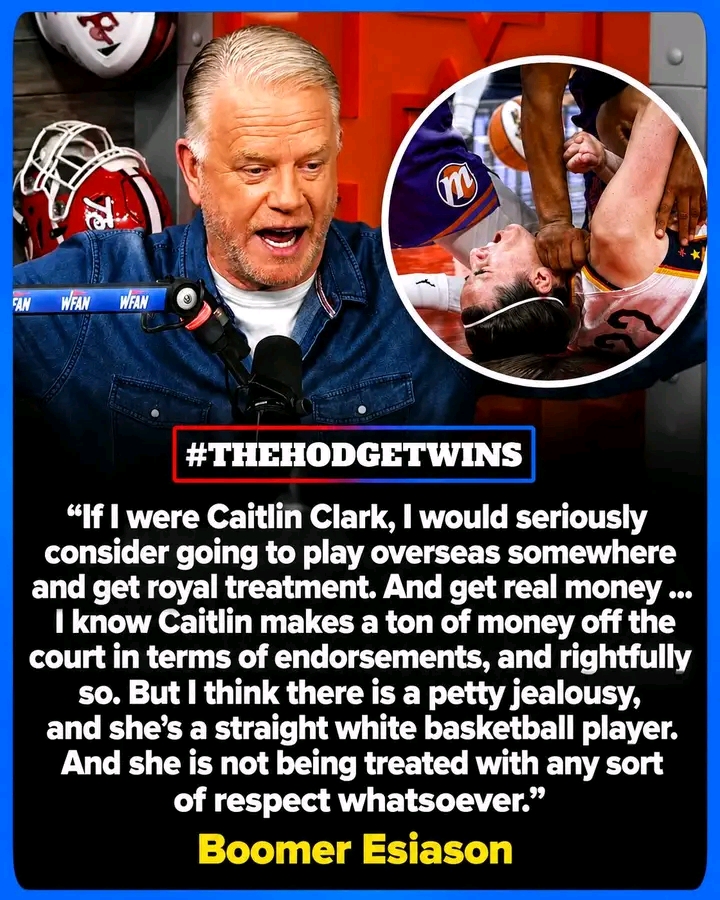
The conversation surrounding Indiana Fever superstar Caitlin Clark has once again moved beyond basketball.
Former NFL MVP Boomer Esiason ignited another wave of debate after claiming that Clark is being unfairly targeted in the WNBA because of what he described as “petty jealousy.” His comments came in the aftermath of another highly physical game in which Clark absorbed a hard hit to the throat during Indiana’s matchup against the Phoenix Mercury.
While physical play has become a recurring storyline whenever Clark steps onto the floor, Esiason’s remarks have pushed the discussion into even more controversial territory by suggesting that factors beyond basketball—including race and sexual orientation—may be influencing how Clark is treated.
Whether fans agree or disagree with his assessment, one thing is becoming increasingly difficult to ignore: the conversation surrounding Clark is now as much about officiating and league management as it is about her remarkable talent.
CLARK’S LATEST HARD HIT RENEWS QUESTIONS ABOUT PLAYER PROTECTION
The Fever guard has consistently been one of the WNBA’s most heavily defended players since entering the league.
Against Phoenix, another physical sequence left Clark taking a shot to the throat, adding to a growing collection of hard fouls that have fueled discussions throughout her young professional career.
Indiana head coach Stephanie White didn’t hide her frustration afterward.
White criticized the officiating, describing the lack of protection for Clark as both “dangerous” and “absolutely unacceptable.” Those strong comments reflected the growing concern within the Fever organization that officials are allowing too much physicality before blowing the whistle.
While basketball has always rewarded tough defense, coaches also expect referees to distinguish between aggressive play and unnecessary contact.
BOOMER ESIASON’S COMMENTS ADD ANOTHER LAYER TO THE DISCUSSION
Speaking on WFAN, Esiason argued that Clark’s treatment isn’t simply about basketball rivalries.
According to the former NFL quarterback, jealousy over Clark’s popularity has become a motivating factor for some opponents. He also suggested that race and sexual orientation may be contributing to the way Clark is perceived around the league.
Those comments immediately divided sports fans.
Supporters of Esiason believe Clark receives unusually physical treatment compared to many other elite players. Others argue that Clark’s style of play, ball dominance, and superstar status naturally attract tougher defensive attention—something nearly every great player experiences.
The debate quickly spread across social media, with opinions split over whether Clark is genuinely officiated differently or whether the heightened media attention magnifies every physical play involving the Fever star.
WHY CLARK ATTRACTS SO MUCH DEFENSIVE ATTENTION
There is little debate about one fact: Clark changes every game she plays.
Her elite shooting range forces defenders to pick her up well beyond the three-point line. Her passing ability stretches defenses, while her court vision creates scoring opportunities for teammates that few guards can match.
Because of those strengths, opposing teams build entire defensive game plans around limiting her influence.
That naturally results in more contact than most players experience.
However, the challenge for officials is determining when physical defense crosses the line into illegal or dangerous play.
Finding that balance has become one of the league’s biggest talking points.
THE FEVER’S CHAMPIONSHIP HOPES DEPEND ON KEEPING CLARK HEALTHY
Indiana’s ambitions extend far beyond simply making the playoffs.
The Fever have assembled one of the league’s most exciting young cores, and Clark serves as the engine that drives the offense.
Every game she misses—or every injury scare she experiences—has the potential to affect Indiana’s postseason positioning.
The Fever have already demonstrated they can compete with the WNBA’s top teams, but sustained championship contention requires their franchise player to remain available.
That reality explains why White has become increasingly vocal whenever she believes Clark isn’t receiving adequate protection from officials.
OFFICIATING WILL REMAIN UNDER THE MICROSCOPE
Every professional league faces criticism over officiating.
The WNBA is no different.
As Clark’s popularity continues bringing record television ratings, sold-out arenas, and increased national attention, every whistle involving her receives instant analysis from fans, analysts, and former athletes.
Officials now find themselves managing games under an unprecedented spotlight.
Calls that once might have generated little discussion now become viral clips within minutes.
That level of scrutiny isn’t likely to disappear anytime soon.
WHAT THIS MEANS FOR THE WNBA MOVING FORWARD
The league faces an important challenge.
It wants defenders to play with intensity while ensuring its biggest stars—and every player—are protected from unnecessary or dangerous contact.
Maintaining that balance will be essential as the WNBA continues experiencing historic growth.
The conversation also highlights how much Clark has transformed the league’s visibility. Every controversial foul, every officiating decision, and every postgame comment now becomes national news.
That increased attention brings tremendous opportunities for the WNBA, but it also places greater pressure on the league to maintain consistency in officiating.
FINAL THOUGHTS
Boomer Esiason’s comments have undoubtedly intensified an already emotional debate surrounding Caitlin Clark and WNBA officiating. While opinions differ on his claims about jealousy, race, and sexual orientation, the broader issue remains difficult to dismiss.
Indiana continues to believe its franchise player deserves better protection, while many around the league insist physical defense is simply part of competing against one of basketball’s brightest stars.
As the Fever continue their pursuit of a championship, expect every hard foul involving Clark to generate headlines—and every officiating decision to face even greater scrutiny.
Ultimately, how the WNBA manages this conversation could influence not only Indiana’s season but also the league’s reputation as it enters one of the most significant periods of growth in its history.