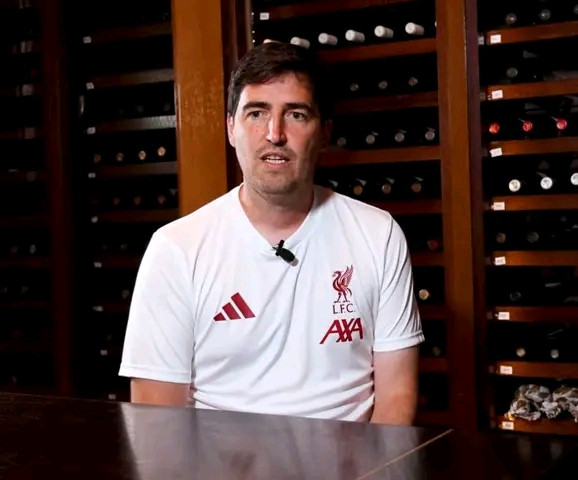
There is something almost quaint about hearing Andoni Iraola talk about being “thin.” It is a word that used to belong to Bournemouth conversations, uttered in a cramped press room at the Vitality Stadium where a manager with a fraction of the Premier League’s resources had to explain, week after week, why his squad could not simply absorb an injury to a key winger or a suspension to a first-choice centre-back the way City or Arsenal could. Now the same word is coming out of the same mouth, except the badge on his tracksuit has changed, and the stakes attached to it have changed with it. Iraola sitting down with Jamie Carragher, discussing Liverpool’s business with the transfer deadline bearing down on the club, and using almost the identical phrasing he once used to describe a mid-table Premier League survivor, tells you something important about the gap between reputation and reality at Anfield this summer.
“We will definitely sign some players,” Iraola told Carragher. “Some deals you have to wait until the end. But the end is the important picture, the one we will have on September 1. Because it is true that we are still quite thin.” Read those words on their own, stripped of context, and you could easily mistake them for a lower-half manager trying to reassure a nervous fanbase that reinforcements are on the way before relegation form takes hold. Instead, this is the head coach of the reigning champions of England, less than two months into the job, telling one of the club’s most decorated former players that the group he inherited is not yet fit for purpose. That is a striking admission, and it is worth sitting with for a moment before getting into what it might mean for the rest of the window and the season that follows.
Iraola’s appointment at Liverpool was one of the more unexpected stories of the managerial merry-go-round. He built his reputation the hard way, first at Rayo Vallecano and then at Bournemouth, turning unglamorous, resource-poor clubs into teams that punched dramatically above their weight through intensity, pressing structure, and a clear tactical identity that did not depend on having the best individual talent on the pitch. At Bournemouth he took a club that had spent much of its recent history flirting with the bottom three and turned it into a side capable of finishing ninth, playing football that neutrals enjoyed watching, and producing players good enough to be poached by the very clubs at the top of the table. That last part is not incidental to the story now unfolding at Liverpool. Dean Huijsen left Bournemouth for Real Madrid. Milos Kerkez left for Liverpool itself, signed under the previous regime before Arne Slot’s exit reshuffled the managerial landscape entirely. Ilya Zabarnyi left for Paris Saint-Germain. Iraola spent two and a half years building a defence from spare parts and helping those spare parts become valuable enough that everyone wanted them, and then watching them walk out the door one by one. It is a peculiar kind of managerial success, being so good at developing players that you cannot keep them, and it is also excellent preparation, in a strange way, for what he now faces at Liverpool, where the departures are of a different magnitude but the underlying dynamic, a squad thinner than the table position suggests, will feel familiar.
Liverpool’s summer has been complicated in ways that go beyond the normal churn of a title-winning squad needing refreshment. Slot’s departure, whatever the precise reasons behind it, left the club needing to appoint a manager relatively late in proceedings, which is never an ideal position for planning a transfer window with the kind of long lead time that top recruitment departments prefer. Iraola arriving in the role means he has had to assess a squad he did not build, identify gaps that may not have been obvious to the previous coaching staff, and try to communicate those needs to a recruitment operation that was presumably already partway through its own plans for the summer. That kind of managerial transition mid-cycle almost always produces some friction, some mismatch between what the manager wants and what the club has already lined up, and Iraola’s comments to Carragher read like a coach trying to manage expectations while that friction gets ironed out behind the scenes.
The specific football context matters here too. Liverpool have been trying to sign Bradley Barcola, a deal that has dragged on for what feels, to supporters, like an eternity, the kind of protracted negotiation that becomes its own subplot within a transfer window. There was also a rejected bid worth fifty million pounds for Yankuba Minteh, a signal that the club is not simply waiting passively for deals to fall into their lap but is actively pushing money at targets and being knocked back, which is its own kind of frustration for a fanbase used to Liverpool getting more or less what it wants in the market. Add those two threads together, a marquee winger negotiation that will not resolve and a expensive bid rebuffed, and you start to understand why Iraola felt the need to step in personally and reassure supporters rather than simply let the club’s communications process handle it. Managers do not usually insert themselves into transfer commentary unless they sense that the silence is doing more damage than a carefully worded quote would.
There is also something instructive in the way Iraola framed his answer. He did not promise specific names. He did not commit to a number of incoming signings, the way some managers do when pressed by supporters desperate for concrete reassurance. Instead he offered a philosophy, essentially telling Carragher and by extension the watching public that deadline day pressure is a normal part of how modern transfer business gets done, that some deals genuinely cannot be completed early because prices need to fall, because other dominoes need to tip first, because a selling club needs to secure its own replacement before it will let a player go. This is the language of someone who has lived through enough transfer windows as a head coach to know that patience, however uncomfortable it feels to supporters scrolling transfer news at midnight, is often the only rational posture available to a manager who does not control the finances directly.
It is worth remembering, too, that Iraola made an almost identical point during his time at Bournemouth, telling BBC Radio Solent in a previous window that his squad would “continue to be thin,” listing specific injury concerns, discussing how many positions realistically needed reinforcement, and being candid that two, three, or four new faces might arrive depending on how negotiations played out. That earlier version of Iraola, managing a club with a fraction of Liverpool’s resources, spoke with the same measured realism he is now bringing to Anfield. He is not a manager who inflates expectations to placate an anxious fanbase, and he is not a manager who panics publicly when business is slow. What has changed is the size of the stage and the intensity of the scrutiny that comes with every word he says as Liverpool’s head coach rather than Bournemouth’s.
Supporters, understandably, hear the phrase “quite thin” applied to the champions of England and feel a jolt of anxiety that would not accompany the same words coming from a manager at a club fighting relegation. There is a fear, not unreasonable given recent history around the Premier League, that title-winning squads can regress quickly if they stand still in the market while the teams around them strengthen. Liverpool’s supporters watched last season unfold with what has been described as real difficulty in the second half of the campaign, and there is a collective anxiety about repeating those struggles if the current window closes without sufficient reinforcement. Iraola’s comments, intended as reassurance, inevitably also function as confirmation of exactly the fear that prompted the question in the first place. Yes, we will sign players, he is telling them, and also yes, the squad genuinely is short of where it needs to be right now. Both things are true simultaneously, and a head coach speaking honestly cannot really offer one without implicitly admitting the other.
What makes the September 1 deadline particularly significant for Iraola’s Liverpool is the way he described it, not as an arbitrary cutoff imposed by football’s governing bodies but as the moment when the actual picture becomes clear. Until that point, everything is provisional. Every current gap in the squad could be filled in the final week, and every current player could still leave if the right offer arrives from elsewhere. Managers often talk about not wanting to judge a transfer window until it closes, and there is a practical wisdom in that stance beyond simply managing public perception. A squad assessed on August 20th looks entirely different from the same squad assessed on September 2nd, and reacting emotionally to the state of affairs in between risks making decisions, whether tactical, in team selection, or psychological, in how a group of players perceives its own adequacy, based on incomplete information.
There is a broader question lurking underneath all of this about what it actually means to inherit a title-winning squad as a new manager. On paper, taking over the champions should be the most enviable job in English football, walking into a dressing room full of proven winners with recent silverware to show for their efforts. In practice, as Iraola appears to be discovering, a champion squad built around one tactical system and one manager’s specific way of playing does not automatically translate into a squad that fits seamlessly with a different coach’s demands. Iraola’s football at Bournemouth was built around a very specific pressing structure, aggressive positional play, and a squad selected and trained specifically to execute that system. Walking into Liverpool, he inherits players who were excellent for Slot’s approach but who may or may not possess exactly the attributes his own system demands. That mismatch, more than any simple numerical shortage of bodies, could be part of what he means by “thin.” It is not necessarily that Liverpool lack enough players in absolute terms, but that they may lack enough players who fit precisely what their new head coach wants to do, and closing that gap requires the kind of targeted recruitment that takes time, negotiation, and, crucially, patience through exactly the sort of drawn-out deals he described to Carragher.
The Minteh bid and the ongoing Barcola pursuit both point toward wide areas of the pitch as a priority, which makes sense given the departures and the demands of Iraola’s system, which typically relies heavily on wide players capable of both defensive work and direct attacking output. If those two deals in particular define how the remainder of the window unfolds, Liverpool’s fortunes in the opening months of the season could hinge substantially on whether the club can convert interest into actual arrivals before the deadline passes. Barcola, if Liverpool do eventually get the deal over the line, would represent exactly the kind of directly attacking, high-intensity forward that fits the profile Iraola built his reputation around at Bournemouth. The fact that the negotiation has stretched on so long is itself telling, whether about valuation disagreements, the selling club’s reluctance, or Liverpool’s own internal calculus about how much to commit, and Iraola’s public patience about it suggests he at least believes the deal remains alive rather than dead.
There is also a psychological dimension to how a new manager handles this kind of public conversation about squad depth. Iraola choosing to have this conversation with Carragher rather than dodge the topic entirely reflects a broader communication style that served him well at Bournemouth, where supporters generally respected him for being straightforward about the club’s limitations rather than pretending everything was fine when it clearly was not. That honesty built trust over time, the kind of trust that allowed Bournemouth’s fanbase to remain patient during difficult stretches because they believed their manager was giving them an accurate picture rather than a comforting fiction. Whether that same approach translates to Liverpool’s fanbase, which operates under entirely different expectations and pressure levels as reigning champions, remains to be seen. Bournemouth supporters could tolerate “thin” because their club’s entire identity was built around overachieving with less. Liverpool supporters, having just won the title, may have far less patience for the same word, even delivered by the same honest manager using the same honest reasoning.
Newcastle away, the opening fixture of Iraola’s competitive Premier League tenure at Liverpool, adds an extra layer of jeopardy to how these comments are received. A difficult result there, especially if it exposes precisely the areas of thinness Iraola has already flagged publicly, will amplify scrutiny on the remaining days of the transfer window exponentially. Every subsequent injury, every below-par individual performance in a position lacking depth, will be filtered through the lens of his own words back to him, a manager who told the world his squad was not yet complete just days before kickoff. That is a risk inherent in the kind of candour Iraola practices, but it is also, arguably, the more honest and ultimately more sustainable approach compared to a manager who insists everything is fine and then has to explain away poor results with excuses that ring hollow given his earlier public confidence.
It is also worth considering what “quite thin” means practically across specific positions rather than as a vague overall descriptor. Squad depth issues rarely apply evenly across every line of a team; they tend to cluster in specific areas, often exactly the positions where key departures have occurred or where a new manager’s tactical demands differ most sharply from what the previous system required. Given the noise around wide attacking targets specifically, it is reasonable to infer that Iraola sees his most pressing needs concentrated there, in players capable of stretching defences, combining directly with forwards, and contributing defensively in his pressing scheme. Whether the eventual late-window arrivals address exactly those needs, or whether Liverpool end up entering the season with gaps papered over by squad players being asked to perform outside their most natural roles, will say a great deal about how smoothly this transitional period goes.
There is a temptation, in moments like these, to read too much doom into a manager’s candid assessment. Iraola did, after all, open his comments by flatly stating that Liverpool “will definitely sign some players.” That is not the language of a manager who fears the window will close with nothing accomplished. It is the language of someone confident enough in the process, even if frustrated by its pace, to reassure supporters that outcomes are coming even if the path to them looks messier and more drawn out than anyone would prefer. Given his track record of building competitive, well-organized squads out of imperfect circumstances at both Rayo Vallecano and Bournemouth, there is a reasonable case for supporters to extend him a measure of trust here, even amid the anxiety. He has, after all, done more with less before. Doing more with slightly less at Liverpool, a club with resources Bournemouth could only dream of, should in theory be a considerably more manageable challenge, even if it does not feel that way during the uncertain, waiting-game days before deadline day finally arrives and the real picture, as Iraola put it,comes into view.