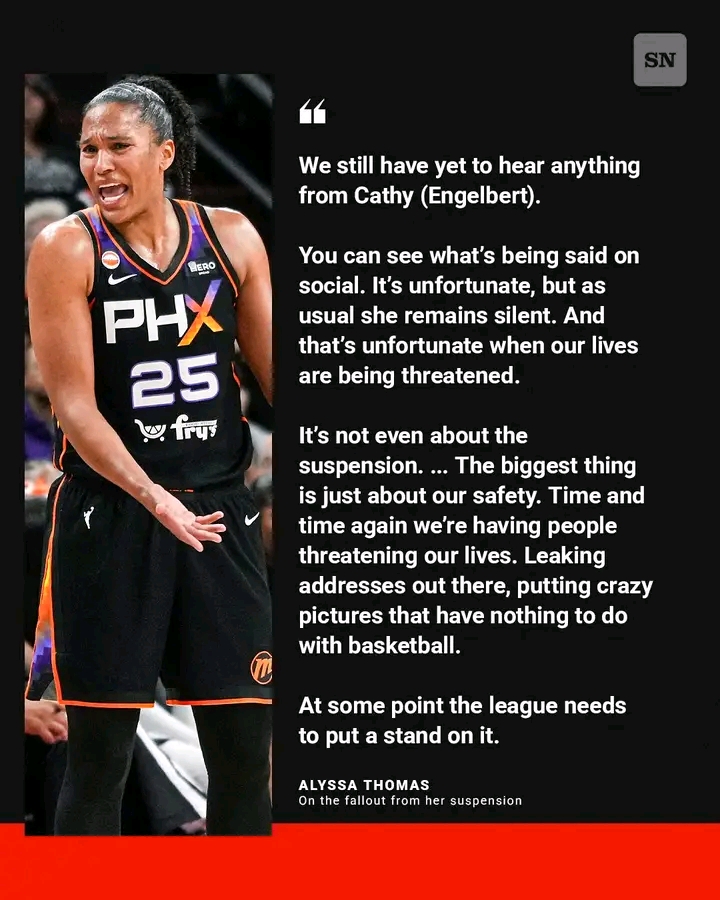
For the first time since her suspension, Alyssa Thomas has publicly addressed the controversy surrounding the disciplinary action, making it clear that the punishment itself is not the issue she wants to focus on. Instead, the veteran WNBA star has turned the conversation toward the intense wave of online harassment she says has followed her ever since the league announced its decision. While Thomas acknowledged that suspensions are part of professional sports and accepted the consequences of her actions, she expressed disappointment that the conversation has extended far beyond basketball and evolved into a relentless campaign of personal attacks across social media. According to Thomas, criticism over a play or a disciplinary ruling is something athletes learn to deal with, but the level of abuse she has encountered has crossed the line from healthy debate into targeted harassment.
Thomas specifically called on WNBA Commissioner Cathy Engelbert, arguing that the league’s leadership has remained largely silent while players continue to face escalating abuse online. She believes the WNBA has a responsibility not only to enforce its rules consistently but also to stand behind its athletes when they become targets of hateful comments, threats, and coordinated online attacks. In her view, disciplinary decisions should never become an excuse for fans to engage in personal abuse, and the league should make it clear that such behavior has no place in the WNBA community. Thomas emphasized that while she understands fans are passionate about the sport, there is a significant difference between expressing opinions about a game and directing harmful messages at individual players.
Throughout her remarks, Thomas stressed that she is not seeking special treatment or asking the league to reverse its decision. She repeatedly stated that she has accepted the suspension and is prepared to move forward professionally. Her frustration, however, lies in what she perceives as the absence of meaningful public support from the league during a period when the criticism has become increasingly personal. She argued that when online harassment reaches extreme levels, players should not be left to navigate the situation alone. Instead, she believes the WNBA should take a stronger public stance by condemning abusive behavior and reinforcing its commitment to protecting everyone associated with the league.
The veteran forward also highlighted the broader impact that unchecked online harassment can have on athletes. Beyond the headlines and social media debates, players are real people who must deal with the emotional and psychological effects of reading hostile messages day after day. Thomas suggested that the issue extends well beyond her own experience and reflects a growing challenge facing professional sports in general. With social media giving fans unprecedented access to athletes, abusive comments can spread rapidly and create an environment that becomes increasingly difficult for players to ignore. She believes leagues should recognize these realities and develop stronger strategies to support players dealing with sustained online hostility.
The discussion has sparked widespread debate among basketball fans, analysts, and former players, many of whom have differing opinions about where responsibility ultimately lies. Some believe sports organizations should take a far more active role in speaking out whenever players become the targets of harassment, regardless of the circumstances surrounding a suspension or controversial incident. Others argue that while leagues can issue statements condemning abuse, controlling behavior across various social media platforms remains an enormous challenge. Even with these differing viewpoints, many agree that the rise of online hostility has become one of the biggest issues confronting modern professional sports.
Thomas’ comments have also renewed conversations about the balance between accountability and player welfare. Most observers accept that suspensions and disciplinary measures are necessary to preserve fairness and integrity within the game. However, many also believe that discipline should not result in athletes becoming the subjects of widespread personal abuse. Thomas maintains that accepting responsibility for actions on the court should not require players to endure continuous attacks on their character or receive hateful messages unrelated to basketball. She believes the league can enforce its rules while simultaneously making it clear that harassment directed at its athletes is unacceptable.
As reactions continue to pour in from across the basketball community, Thomas’ remarks have become part of a much larger discussion about the relationship between sports organizations, players, and fans in the digital era. The increasing influence of social media has transformed how athletes interact with the public, creating opportunities for greater engagement while also exposing them to unprecedented levels of criticism. Thomas hopes her decision to speak publicly about her experience will encourage meaningful conversations about how leagues, teams, and fans can work together to create a healthier environment where competitive passion does not evolve into personal hostility.
Looking ahead, Thomas appears determined to put the suspension behind her and return her focus to basketball, but she also hopes the conversation surrounding online harassment does not fade away once the headlines disappear. She believes professional athletes should feel confident that the leagues they represent will publicly stand against abusive behavior whenever it occurs, regardless of who is involved or the circumstances that led to the controversy. By raising these concerns, Thomas has shifted attention beyond the suspension itself and toward a broader issue that continues to affect athletes across professional sports. Whether or not the WNBA responds directly, her comments have intensified the ongoing discussion about player safety, accountability, and the responsibility of sports organizations to support those who represent their league both on and off the court.
If you’d like, I can also �make it even more SEO-optimized with subheadings and stronger keyword placement for better ranking on Google.