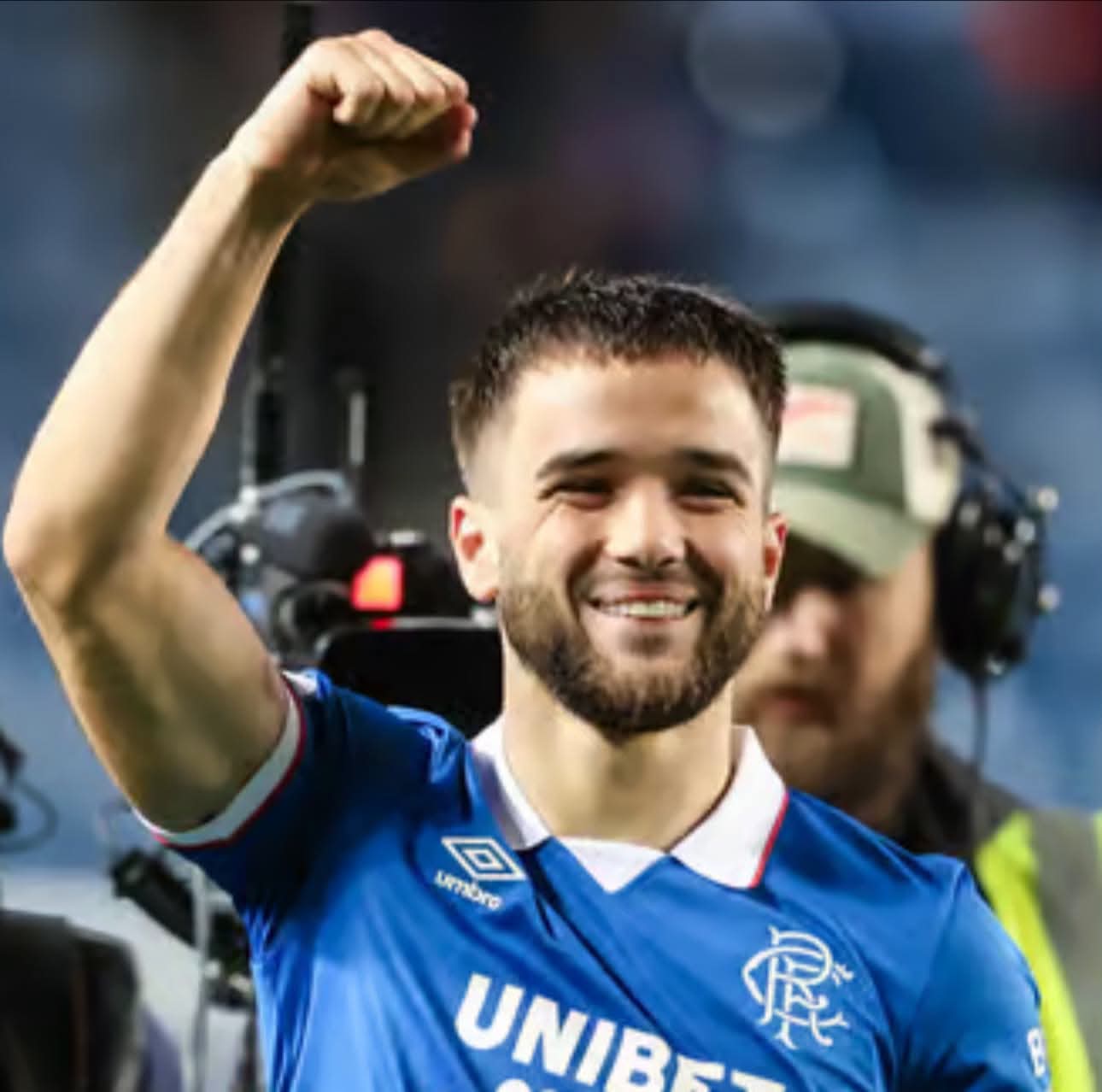
There was something quietly symbolic about Nico Raskin’s evening against Jablonec. Rangers ground out a narrow 1-0 first-leg advantage in their Conference League play-off, Ryan Naderi’s early second-half strike proving the difference, and for long spells the Ibrox crowd barely had cause to think about the Belgian at all. He sat on the bench in a tracksuit, watching Dan Neil marshal the midfield in his place, an unused substitute in a game his club needed to win. Twelve months ago that would have been unremarkable, a rotation call, nothing more. In the current climate, with his name plastered across Spanish sports pages and speculation swirling about a summer exit that never quite materialised, it felt like a small, almost poetic pause in a much bigger story. The best player at a club is rarely on the bench by accident these days, and everyone inside Ibrox understood exactly what was being managed here.
Raskin’s situation this summer has been one of the more fascinating subplots of the Scottish transfer window, not because Rangers were desperate to sell him, but because everybody else seemed desperate to buy him. Real Betis have been credited with direct interest from Manuel Pellegrini himself, a manager who does not tend to chase names for the sake of headlines. Villarreal have gone further, reportedly advancing conversations with Rangers over a fee in the region of twenty million euros plus add-ons, positioning the Belgian as their priority midfield addition as they attempt to freshen up an engine room that lost some of its bite last season. Sevilla have been mentioned. Roma have been credited with interest strong enough to be described as holding an edge over their La Liga rivals at various points. Atalanta, Bologna, Wolves and even Manchester United have all had their names attached to Raskin at one stage or another this window, which tells you less about the reliability of any single report and more about how widely his stock has travelled since the turn of the year.
None of this happened by accident. Raskin arrived at Ibrox in January 2023 from Standard Liège for a fee that, by the standards of what is now being discussed, looks almost embarrassingly small. Reports at the time valued the deal at around one and a half million euros, a fee that reflected a promising but unproven young midfielder rather than the commanding, tournament-tested presence he has since become. He was twenty-one, technically gifted, occasionally loose in possession, and far from the finished article. Standard Liège fans watched him go with a shrug rather than a wrench, the sort of transfer that barely registers outside the two clubs involved. Rangers, for their part, saw a player they believed could grow into their midfield over time, and they were patient enough to let that growth happen without rushing him into a role he wasn’t ready for.
That patience has paid off spectacularly. Raskin’s development at Ibrox has been one of the genuine success stories of recent Rangers recruitment, a reminder that not every value signing needs to be an immediate sensation to eventually become a serious asset. He grew into a box-to-box midfielder capable of doing the unglamorous defensive work while still offering enough craft and composure on the ball to dictate tempo. He became a leader in a Rangers dressing room that has cycled through no shortage of managers and upheavals in the years since his arrival, someone the club could rely on for consistency even as almost everything around him shifted. By the time this year’s World Cup came around, he wasn’t just a useful squad player anymore. He was, by most reasonable assessments, one of the two or three best players Rangers had.
The World Cup itself is where this transfer saga really found its fuel. Raskin was named in Belgium’s squad, and while he didn’t start their opening game, he became increasingly important as the tournament progressed, culminating in a driving substitute appearance in Belgium’s dramatic comeback win over Senegal in the round of thirty-two, replacing Kevin De Bruyne and helping his side claw back from behind. It was the kind of stage that reshapes a player’s market value almost overnight, not because the football itself is necessarily different in quality from a midweek Scottish Premiership fixture, but because of who is watching. Sporting directors, scouts and agents who might never have prioritised a trip to Ibrox on a wet Wednesday suddenly had Raskin’s every touch beamed into their homes on the biggest stage in the sport, and he did not shrink from it.
That is really the story behind the numbers now being floated around his valuation. Before the tournament, most credible market trackers had him somewhere in the region of twelve million euros, a healthy return already on that original one and a half million euro outlay but hardly eye-catching by modern transfer standards. Since Belgium’s run through the World Cup, and with interest piling in from Spain and Italy in particular, that figure has been dragged upwards in the way these things tend to happen once a bidding atmosphere takes hold. Rangers have reportedly set their asking price at around twenty million pounds, a figure that has already proven sturdy enough to see off an approach from Hull City and to give both Villarreal and Real Betis pause for thought as they try to work out whether they can meet it. Some reports have pushed the ceiling even higher, with suggestions the eventual fee could stretch closer to twenty-five million euros once bonuses, sell-on clauses and add-ons are factored in, a figure that would represent one of the biggest sales in the club’s recent history and comfortably eclipse anything Rangers have banked for an outfield player in years.
It’s worth pausing on just how significant that kind of return would be for a club operating in Rangers’ financial bracket. Scottish football clubs, even the biggest two, do not often get to cash in on players at genuinely elite European fee levels. The usual pattern is one of incremental profit, useful sums rather than transformative ones, players moving on for figures that keep the books ticking over without fundamentally reshaping a transfer budget. A sale in the twenty to twenty-five million pound range for a player bought for a tenth of that figure would be a different order of magnitude altogether, the kind of deal that funds not just one marquee signing but potentially several, while also sending a signal to the wider football world about the calibre of player Rangers can develop and eventually sell.
That is precisely why the club has been in no rush to force the issue this summer. Derek McInnes and the Ibrox hierarchy know exactly what they hold in Raskin, and they know that World Cup afterglow has a way of fading fast if a selling club looks desperate. There is a reason Rangers have publicly maintained that no bids have yet arrived that meet their valuation, and a reason the asking price has, if anything, hardened rather than softened since the tournament ended. Contract status matters here too. Raskin signed fresh terms that run until May 2028, which strips any urgency from Rangers’ side of the negotiating table. He is not entering the final year of his deal, he is not a player who could walk for a reduced fee or on a pre-contract in twelve months, and that leverage is precisely why suitors have found themselves negotiating rather than simply naming a figure and expecting Rangers to accept it.
There is also a footballing dimension to why Rangers have been careful about letting Raskin go too cheaply or too hastily. McInnes has been rebuilding his midfield around him this summer, bringing in the likes of Dan Neil, Vanja Dragojevic and others as part of a broader reshaping of the squad following a disappointing third-place finish the previous season. Some of that recruitment looks, with the benefit of hindsight, like a club preparing for life after Raskin, stocking the cupboard in advance of an inevitable departure rather than being caught short by it. But it also means Rangers are not helplessly dependent on his fee to fund the rest of their business, which again strengthens their hand. They can afford to wait for the right offer rather than accepting the first one that lands on the table, and that patience has visibly frustrated suitors who might have expected a selling club in Scottish football’s financial reality to cave more easily.
Villarreal’s interest has been described in various reports as the most advanced of the suitors, with a proposal in the region of twenty million euros plus variables said to be in preparation, a deal that would represent excellent value for a club looking to freshen a midfield ahead of a season that will include European competition. Real Betis, meanwhile, have been characterised as circling with genuine intent but constrained by specific financial conditions that need to be met in Spain before any move can be formalised, a fairly common situation for La Liga clubs operating under strict spending controls even when the manager himself is pushing hard for a signing. Manuel Pellegrini’s reported direct involvement in pursuing Raskin is notable in itself. Managers of his experience and stature do not typically spend political capital pushing for names unless they see something specific in a player’s profile that fits their system, and reports have framed Raskin as being wanted for his combination of defensive discipline and ball-carrying, the kind of player who can sit in front of a back four without becoming a passenger in possession.
Not everyone in the Rangers ecosystem agrees on exactly what Raskin should fetch, and that disagreement has become something of a subplot of its own. Former Rangers captain and pundit Barry Ferguson has been vocal in recent weeks about what he sees as an undervaluation of Raskin relative to other comparable midfielders moving around Europe this summer, pointing out that if rival players with arguably less impressive tournament form are commanding fees north of twenty-five million pounds, then Rangers should be holding out for something similar rather than settling for twenty. It’s the kind of debate that tends to play out endlessly in the media during a live transfer saga, pundits and journalists trying to triangulate a fair value from a mixture of World Cup form, contract length, age, positional scarcity and simple market sentiment, with no single figure ever quite satisfying everyone. What’s clear is that the conversation itself, regardless of where it eventually lands, represents a level of scrutiny and valuation debate that Raskin simply wasn’t attracting eighteen months ago.
Which brings us back to that bench against Jablonec. There was a time not so long ago when a place on the bench for a Rangers player heading toward a big-money exit might have been read as a snub, a manager making a point, a relationship souring in public. That doesn’t appear to be what was happening here. Raskin had been managing a knock, deemed fit enough to be involved but not risked from the start against a Czech side Rangers were expected to beat over two legs regardless, with the second leg still to come and the broader transfer picture still very much unresolved. It was, in other words, ordinary squad management dressed up in extraordinary circumstances, a reminder that even amid all the noise about Seville and Villarreal and nine-figure peseta-era comparisons that inevitably get dragged into these conversations, Raskin is still, for now, a Rangers player with matches to help win and a manager who has to balance his fitness against the rest of a busy season.
Whether he starts the second leg in the Czech Republic, or indeed whether he is still a Rangers player by the time the domestic transfer window slams shut, remains genuinely uncertain, and that uncertainty is precisely what makes this such a compelling story to follow through the rest of the summer. What is not uncertain is the scale of the transformation his stock has undergone since that quiet January move from Standard Liège back in 2023. A player signed for around one and a half million euros, largely unheralded outside Belgium at the time, has become one of the most talked-about midfielders in Scottish football, courted by clubs who play Champions League football as a matter of course, valued at a figure that could sit anywhere between twenty and twenty-five million pounds depending on which report you trust and how the negotiations eventually shake out. That is not just a good piece of business by Rangers’ recruitment staff at the time. It is a reminder of exactly why clubs at every level of the game keep gambling on potential, because every so often, if you’re patient and a little bit lucky, potential turns into precisely this kind of summer.
For Rangers supporters, there is an obvious tension in all of this. Nobody wants to lose their best player, especially not one who has become such a visible leader on the pitch during a period when consistency at Ibrox has been in short supply. But there is also a pragmatic acceptance that runs through most of the fan conversation around Raskin’s situation, an understanding that clubs of Rangers’ size simply cannot afford to turn down life-changing money for a player entering the peak years of his value curve, not when that money can be reinvested to strengthen the squad in multiple positions rather than just one. If Raskin does eventually complete a move to Spain or Italy this summer, it will be remembered less as a loss and more as vindication, proof that the scouting and development pathway that identified him in Belgium and nurtured him through three and a half seasons at Ibrox is capable of producing genuinely elite-level outcomes. And if he stays, either because no offer meets Rangers’ valuation or because he simply prefers to continue his development at a club where he is undeniably the standout name, then Rangers get to keep one of the best midfielders in Scottish football for at least another season, still just twenty-five, still with years of improvement ahead of him, still very much the player every rival scout in Europe is currently watching a little more closely than they were twelve months ago. Either way, that bench appearance against Jablonec will likely be remembered as one of the smaller, quieter moments in what is shaping up to be one of the more significant transfer stories to come out of Scottish football this year