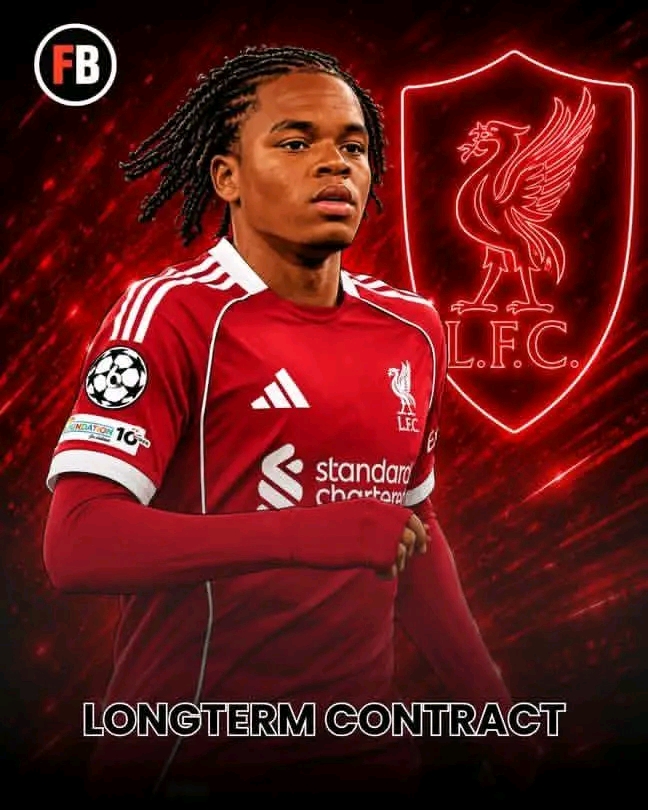
Liverpool have opened talks with Rio Ngumoha over a new long-term contract, and the message coming out of the club is about as confident as these things ever get this early in a negotiation: an agreement is expected, the two sides are aligned on the broad principle, and it is now really just a matter of when rather than if the paperwork gets finalized. The timing of all this is dictated by something entirely outside either party’s control. Ngumoha turns eighteen at the end of August, and it is only once he crosses that threshold that he becomes legally eligible to sign a genuine long-term contract in English football, since anyone under eighteen is restricted to deals of a maximum of three years. That regulation is precisely why his current terms, signed shortly after his seventeenth birthday when he arrived at boyhood dream in unusual circumstances after leaving Chelsea’s academy, run only until 2028 rather than considerably further into the future. Liverpool have known for a long time that this moment was coming, that the day Ngumoha turned eighteen would be the day they could finally lock him down properly, and everything about how this has been handled suggests a club that planned for this exact date well in advance rather than scrambling to react to it.
What makes this particular renewal so significant is not just the player’s age but the trajectory he has been on since bursting into Liverpool’s first-team picture. Ngumoha’s rise from unknown academy prospect to a name genuinely being discussed across European football happened remarkably quickly, accelerated in dramatic fashion by a stoppage-time winner away at Newcastle that made him the youngest goalscorer in the club’s long and storied history. That is not the kind of moment that fades from memory quickly, either for supporters or for the player himself, and it set the tone for a debut season that continued to produce moments of genuine quality, including a goal on his full Anfield introduction against Fulham that only reinforced the sense among those inside the club that they had unearthed something special. For a teenager still adjusting to first-team football, to already have that kind of signature moment attached to his name, a match-winning contribution in the dying seconds against a direct rival, is the sort of thing that shapes a career narrative in ways statistics alone rarely capture. Liverpool supporters do not forget goals like that, and neither, evidently, do rival clubs monitoring the market for the next wave of elite young talent.
That rival interest is really the backdrop against which this entire contract situation has played out. Bayern Munich, in particular, made their interest in Ngumoha unusually public earlier in the year, identifying him as a genuine priority target for the left-wing position and, according to some reports out of Germany, going as far as reaching a verbal understanding with the player’s camp over personal terms. Whether that characterization was entirely accurate or somewhat exaggerated in the way transfer speculation often is, the mere fact that a club of Bayern’s stature was willing to make that level of move for a seventeen-year-old with barely a season of senior football behind him tells you everything about how highly he is regarded outside Anfield as well as inside it. Liverpool’s response, by all accounts, was blunt and immediate. There was no ambiguity in the message sent back to Munich: Ngumoha was not for sale, not that summer, not at any price being discussed, and that was effectively the end of any realistic hope Bayern had of prising him away. RB Leipzig are also understood to have made an enquiry of their own at some point, further underlining just how closely Ngumoha’s situation has been tracked across the continent, but none of that outside interest appears to have shaken Liverpool’s determination to build their long-term plans around him rather than cash in early.
There is a very specific institutional memory at play here that helps explain why Liverpool have moved with this level of urgency and clarity. The club has, in recent years, found itself embroiled in a number of protracted and occasionally uncomfortable contract situations involving key players running down their deals, situations that have sometimes ended with the club losing significant talent for reduced fees or, in the case of a defender like Ibrahima Konate, for no fee at all once a contract was allowed to run into its final months without resolution. Nobody at Anfield wants a repeat of that pattern with a player as central to the club’s long-term vision as Ngumoha appears to be, and getting ahead of the situation now, opening talks well before any awkward final-year uncertainty could develop, reflects lessons that have clearly been absorbed from those previous episodes. It is far easier, and far cheaper in every sense, to secure a rising young talent on improved terms while he is still grateful for the opportunity and still developing his market value than to find yourself negotiating from a position of weakness two years later with major European clubs circling and the player’s representatives fully aware of their leverage.
The structure of the new deal being discussed is itself worth paying close attention to, because it reflects a fairly sophisticated approach to rewarding a player whose value is still very much in the process of being proven at the highest level. Rather than simply handing Ngumoha a flat, dramatically increased salary and leaving it at that, Liverpool are believed to be building in performance-related increases tied specifically to appearance milestones, with the structure designed to reward him further as he establishes himself more consistently in and around the first-team squad. That kind of tiered approach makes obvious sense from the club’s perspective. It protects Liverpool from committing to years of top-bracket wages before Ngumoha has fully proven himself over a sustained run of matches, while still giving the player and his representatives a clear pathway to significant additional reward if his early promise translates into consistent senior-level performance, which by every indication so far seems the more likely outcome than not. For a player his age, that kind of structure can also serve a motivational purpose, giving him tangible, measurable targets to chase rather than simply arriving at a plateau of financial security that removes any incentive to keep pushing his development forward.
Much of the confidence Liverpool have in offering this kind of contract stems from the plans being put in place under new head coach Andoni Iraola, who has been explicit about wanting Ngumoha to play a genuinely significant role in the coming season rather than the more fringe involvement he experienced for spells last season. That contrast matters enormously in understanding why this renewal is happening now and on these terms. Ngumoha started only a handful of Premier League matches under the previous regime, a level of game time that led to some public speculation about his contentment and whether he might eventually push for an exit if his path to regular football remained blocked. Iraola’s stated approach is markedly different, built around the idea of maintaining four genuinely high-quality wide options who can rotate through a demanding fixture schedule without any individual being physically overburdened across a long campaign, which by design creates far more realistic opportunities for a player like Ngumoha to accumulate the kind of regular senior minutes that were harder to come by previously. A club can offer all the reassurance it likes in a contract negotiation, but concrete evidence of an actual pathway to playing time is usually what convinces a talented young player and his advisers that staying is the right decision, and Iraola’s rotation philosophy appears to be providing exactly that kind of concrete reassurance.
It also helps that Liverpool have been active in reshaping their wider attacking options this summer in ways that complement rather than threaten Ngumoha’s situation. The signing of a winger like Victor Munoz has already been completed, adding further depth and competition to the forward line, and the club’s football leadership has been explicit that this kind of investment in the wide areas is not expected to come at Ngumoha’s expense in terms of first-team opportunity. If anything, the framing from those close to the club has been that Liverpool are building a squad with enough attacking quality and depth to compete seriously on multiple fronts, and that Ngumoha is viewed as an essential rather than incidental part of that picture. There has also been continued talk connecting Liverpool to further attacking reinforcements, with reported interest in players like Bradley Barcola circulating throughout the window, a reflection of a club recognizing that its ageing or underperforming attacking options from previous seasons may need refreshing regardless of how well Ngumoha’s own situation develops. None of that speculation appears to have altered the fundamental calculation around Ngumoha himself, who continues to be described by people close to the situation in terms that leave very little room for ambiguity about how the club views him, with well-known transfer journalist Fabrizio Romano among those to describe him as effectively untouchable regardless of whatever other business unfolds around him.
The financial commitment Liverpool are preparing to make also needs to be understood within the context of just how competitive the market for elite teenage talent has become across European football more broadly. Clubs have grown increasingly aggressive about identifying and securing the next generation of star players years before those players reach anything close to their peak value, partly as a hedge against the ever-rising cost of the finished product in the transfer market and partly because the margin for building genuine sporting advantage increasingly lies in identifying talent earlier and more accurately than direct rivals. A player who breaks a decades-old club scoring record as a teenager and draws serious interest from a club of Bayern Munich’s stature within his first full season of first-team involvement is exactly the kind of asset that modern recruitment departments are built to protect at almost any reasonable cost, because the alternative, watching that value walk out the door for a fraction of what it would eventually be worth, represents precisely the kind of strategic failure clubs at Liverpool’s level are desperate to avoid repeating.
There is a broader emotional dimension to this story too, one that tends to resonate particularly strongly with a fanbase that has always taken a special pride in seeing young, homegrown or club-developed talent break through into the first team rather than simply assembling a squad entirely through the transfer market. Ngumoha’s path to Anfield, having arrived from a direct rival’s academy as a teenager before rapidly establishing himself as a first-team contributor, already carries a slightly unusual narrative arc, and the way he seized his opportunity when it arrived, culminating in that dramatic winner at St James’ Park, has clearly captured supporters’ imagination in a way that goes beyond simply appreciating a talented squad player. Securing his long-term future now, before any of the speculation about Bayern Munich or other suitors has the chance to develop into something more serious, will likely be received by supporters as exactly the kind of decisive, forward-thinking business the club’s ownership and football leadership have at times been criticized for moving too slowly on in the past.
Looking ahead, the expectation inside the club appears to be that this will move relatively smoothly toward completion once Ngumoha’s eighteenth birthday passes and the legal framework allows the new terms to actually be signed. There is little sense from anything reported so far that this is a negotiation likely to drag on contentiously or produce the kind of prolonged uncertainty that has characterized other recent situations at the club. Both sides appear genuinely aligned, Liverpool wanting to reward and secure a player they clearly view as central to their future, and Ngumoha, by all indications, entirely happy with the trajectory his career has taken at Anfield and the clarity of role being offered to him under the new coaching setup. That alignment of interests is precisely the environment in which contract renewals tend to get done quickly and amicably, without the drawn-out public back-and-forth that so often accompanies negotiations where one side is trying to extract maximum value while the other resists, or where a player’s representatives are simultaneously exploring options elsewhere in parallel with talks at the current club.
What this all points toward, ultimately, is a Liverpool side that appears to be building its next era of success around a core of emerging young talent handled with considerably more care and foresight than some of the contract situations that have caused frustration among supporters in recent years. Ngumoha represents perhaps the clearest example yet of that shift in approach, a player identified early, protected from external interest through decisive action rather than passive hope, and now set to be rewarded with a contract structure that reflects both his current value and the very real possibility that his best years are still comfortably ahead of him. Whether he goes on to fulfill the full scale of the promise currently being attached to his name remains, as it always does with any player this young, something that can only be proven over years of consistent performance rather than confirmed by a single dramatic goal or a summer of positive headlines. But in terms of the groundwork being laid, the timing of these talks, the structure of the deal being discussed, and the clear tactical plan being built around him by his new head coach, Liverpool appear to be doing almost everything right in ensuring that whatever Ngumoha becomes over the coming years, he becomes it wearing their shirt rather than someone else’s.