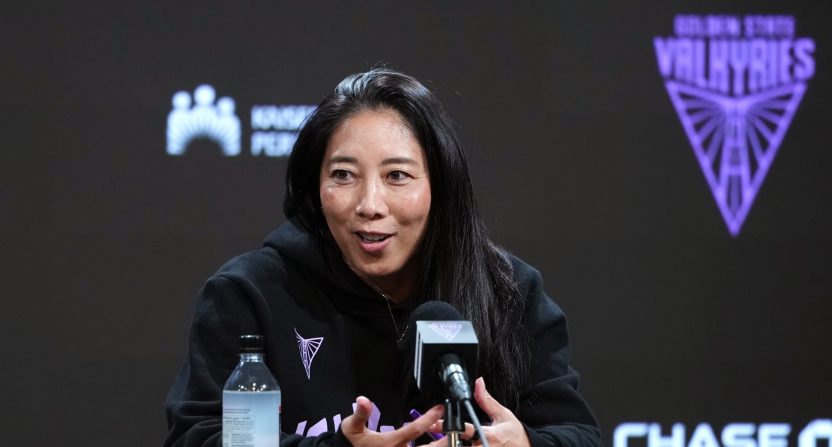
Natalie Nakase, head coach of the Golden State Valkyries, has added her voice to the growing conversation surrounding transgender participation in women’s sports, an issue that has recently gained attention across the WNBA. The discussion intensified after Indiana Fever guard Sophie Cunningham publicly stated that she believes young girls competing in sports should not be required to face biological males. Cunningham’s remarks quickly generated widespread reactions from fans, media members, and figures throughout the basketball community, placing the WNBA at the center of a broader national debate. Although there are currently no transgender women competing in the league, the subject has continued to dominate headlines, leading reporters to ask coaches and players to share their perspectives on one of the most divisive topics in sports today.
The conversation extends well beyond professional basketball and reflects a wider cultural discussion taking place across the United States. Supporters and critics of transgender inclusion in women’s sports continue to present differing viewpoints regarding fairness, participation, and inclusion. Despite the relatively small number of transgender athletes competing at the collegiate level compared to the overall athletic population, the issue has become increasingly prominent in political and media discussions. As a result, WNBA coaches have repeatedly been asked to respond to questions that go far beyond basketball, with many emphasizing the importance of thoughtful dialogue rather than reducing the conversation to simple talking points.
Several coaches around the league have already addressed the matter from their own perspectives. Indiana Fever head coach Stephanie White and Portland Fire head coach Alex Sarama both emphasized the importance of maintaining an open discussion while expressing support for creating an inclusive environment within sports. Meanwhile, Minnesota Lynx head coach Cheryl Reeve argued that the national focus on transgender athletes has overshadowed many other important challenges affecting women’s sports. Reeve suggested that greater education, understanding, and respectful conversation would help people better understand the complexities surrounding the issue instead of allowing it to become a purely political debate.
Before the Golden State Valkyries’ game on Sunday, Natalie Nakase was asked directly about Cunningham’s comments and the ongoing discussion surrounding transgender athletes. Rather than focusing on politics, Nakase answered by drawing from her own life experiences. She explained that sports have always represented a place where people should feel accepted regardless of their background. Nakase shared that throughout her own journey, she faced criticism because of both her height and her Japanese American heritage, experiences that taught her how damaging exclusion can be. Those personal challenges, she said, have shaped the way she approaches leadership and the culture she hopes to build within her team.
Nakase stated that she believes sports should create opportunities for everyone to participate while remaining true to themselves. She explained that her goal is to ensure that every player feels welcomed and respected within the Golden State organization. According to Nakase, no athlete should be made to feel as though they do not belong because of who they are. She emphasized that she supports women and young girls having opportunities to compete, while also expressing that transgender women deserve inclusion. Her comments reflected her belief that acceptance and belonging are core values that should remain central to sports at every level.
Nakase’s remarks quickly generated mixed reactions across social media and among sports commentators. Those who support greater inclusion praised her message as compassionate and consistent with values of equality and acceptance. Others disagreed with her position, arguing that comparisons between gender identity and characteristics such as race or ethnicity overlook questions surrounding competitive fairness in women’s athletics. As has often been the case with this topic, opinions remained sharply divided, with supporters and critics each interpreting Nakase’s comments through very different perspectives. The response highlighted just how emotionally charged and politically sensitive the issue has become both inside and outside the sports world.
The ongoing debate also demonstrates how difficult it has become to find common ground on transgender participation in athletics. Many WNBA coaches have consistently stressed the need for respectful conversations that acknowledge the complexity of the issue while considering both inclusion and competitive integrity. Rather than offering simple answers, they have generally encouraged continued discussion, education, and thoughtful policymaking. Their responses suggest that meaningful dialogue may be more productive than allowing the conversation to become increasingly polarized through political rhetoric and social media arguments.
As the WNBA season continues, it appears likely that questions surrounding transgender participation in sports will remain part of the public conversation whenever players or coaches are asked about the topic. Natalie Nakase’s comments represent one perspective within a broader discussion that continues to evolve across sports and society. While opinions remain deeply divided, her response emphasized creating an environment where athletes feel accepted and respected. Whether consensus can eventually be reached remains uncertain, but the conversation surrounding fairness, inclusion, and the future of women’s sports is expected to continue well beyond this season.