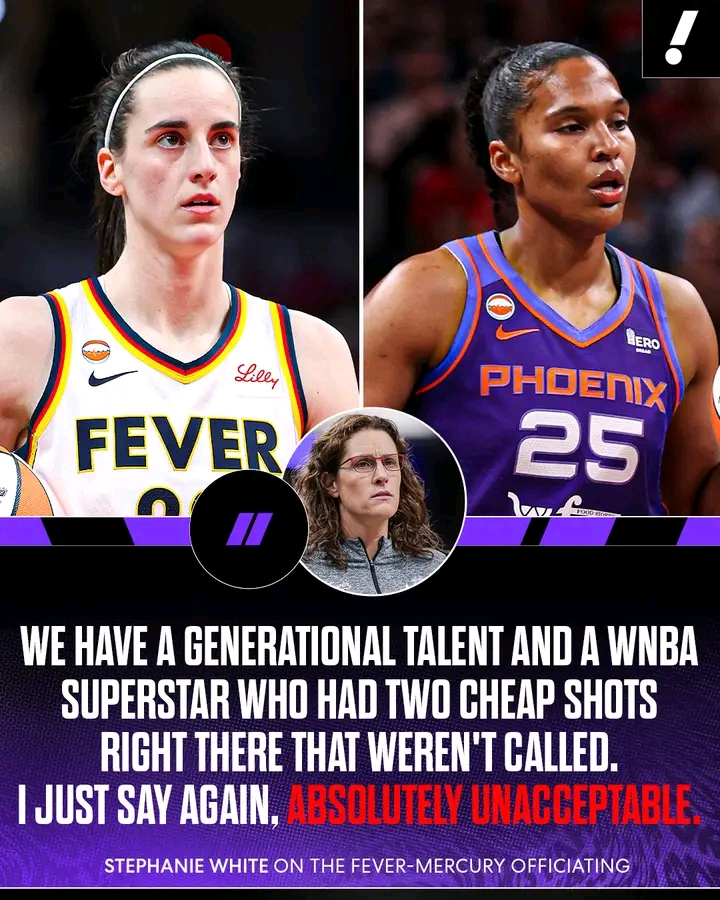
The Indiana Fever may have secured another important result, but much of the postgame conversation centered on officiating rather than basketball.
Head coach Stephanie White did not hide her frustration after a controversial no-call involving Caitlin Clark and Alyssa Thomas during Wednesday night’s showdown between the Fever and Phoenix Mercury. The sequence immediately sparked reactions from fans, analysts, and media members who questioned why officials chose not to blow the whistle despite significant contact.
For White, the issue went beyond a single possession. Her comments reflected growing concerns that have followed the Fever throughout the season as physical play against Clark continues to generate headlines.
WHY THE NO-CALL BECAME THE BIGGEST STORY OF THE NIGHT
Basketball is a fast and physical game, and missed calls are inevitable. However, when the contact involves one of the league’s biggest stars, every decision receives added scrutiny.
Clark has become the face of a new era in women’s basketball. Her presence has helped drive television ratings, attendance records, and national attention for the WNBA. Because of that spotlight, every hard foul, technical foul, and officiating decision involving the Fever star is analyzed from multiple angles.
The no-call against Thomas quickly became another example cited by those who believe Clark is not receiving the same level of protection that many elite players traditionally receive.
White’s reaction suggested she felt the officials missed an important call that could have altered the flow of the game. While coaches often defend their players publicly, her comments carried extra weight because this is far from the first time she has questioned officiating this season.
STEPHANIE WHITE’S GROWING FRUSTRATION WITH OFFICIATING
White has repeatedly expressed concerns about how games involving the Fever are being officiated.
Earlier this season, she criticized referees after several physical contests involving Indiana, arguing that inconsistent officiating can allow games to become unnecessarily heated. Similar concerns surfaced following previous Fever matchups that featured technical fouls, confrontations, and escalating tensions.
The latest incident appears to reinforce a belief within the organization that Clark is absorbing significant contact without always receiving the benefit of the whistle.
Whether fans agree or disagree with White’s assessment, her willingness to publicly challenge officiating demonstrates how strongly the Fever coaching staff feels about protecting its franchise player.
WHY CAITLIN CLARK REMAINS AT THE CENTER OF EVERY DEBATE
Few athletes in professional sports attract as much attention as Caitlin Clark.
Since entering the WNBA, Clark has transformed the visibility of both the Fever and the league. Her popularity means every game receives national attention, and every controversial moment spreads across social media within minutes.
That visibility creates a unique challenge for officials.
On one hand, referees cannot officiate differently simply because Clark is a superstar. On the other hand, repeated incidents involving hard contact inevitably raise questions about consistency.
The controversy surrounding her recent technical foul already had fans debating officiating standards. The latest no-call only adds fuel to that discussion. Clark recently criticized what she viewed as inconsistent decisions from referees following another heated game against Phoenix.
WHAT THIS MEANS FOR THE INDIANA FEVER
The Fever are pursuing much bigger goals than winning arguments with referees.
Indiana enters the heart of the season with legitimate championship aspirations. The roster features a strong core built around Clark, and the team has shown flashes of being one of the WNBA’s most dangerous groups.
However, maintaining composure will be critical.
When players and coaches become consumed by officiating disputes, it can create distractions that impact performance. White understands this balance. She wants her players protected, but she also knows the Fever must remain focused on basketball if they hope to compete for a title.
The best teams often find ways to overcome controversial calls rather than allowing them to define games.
THE ALYSSA THOMAS FACTOR
Alyssa Thomas has built a reputation as one of the league’s toughest and most physical competitors.
Her aggressive style is a major reason she remains one of the WNBA’s most impactful players. Thomas consistently pressures opponents, battles for rebounds, and creates difficult matchups across the floor.
Physical confrontations involving Thomas are rarely accidental. She plays with intensity on every possession, which often places officials in difficult positions when determining where legal defense ends and a foul begins.
That reality makes incidents like Wednesday’s no-call especially subjective. Some observers viewed the contact as worthy of a whistle, while others saw it as part of normal basketball play.
HOW THIS COULD IMPACT THE CHAMPIONSHIP RACE
The larger concern for Indiana is not a single missed call.
Instead, the question is whether ongoing frustrations with officiating could affect the team during crucial late-season games and potential playoff matchups.
Championship contenders are often defined by how they respond to adversity. If the Fever channel their frustration into sharper execution, the controversy could ultimately strengthen the team.
If emotional reactions continue to lead to technical fouls, distractions, or unnecessary confrontations, opponents may look to exploit that vulnerability.
Either way, the spotlight will remain firmly fixed on Indiana.
FINAL THOUGHTS
Stephanie White’s reaction to the no-call involving Alyssa Thomas and Caitlin Clark reflects a broader conversation taking place across the WNBA.
The debate is no longer just about one possession or one referee decision. It is about consistency, player safety, and how the league manages the increased attention that comes with having one of the sport’s biggest stars on the floor every night.
Expect the discussion to continue for days, especially if similar situations occur in future Fever games.
One thing is certain: every controversial whistle—or lack of one—will continue to be magnified as Indiana pushes toward what it hopes will be a championship-caliber season.