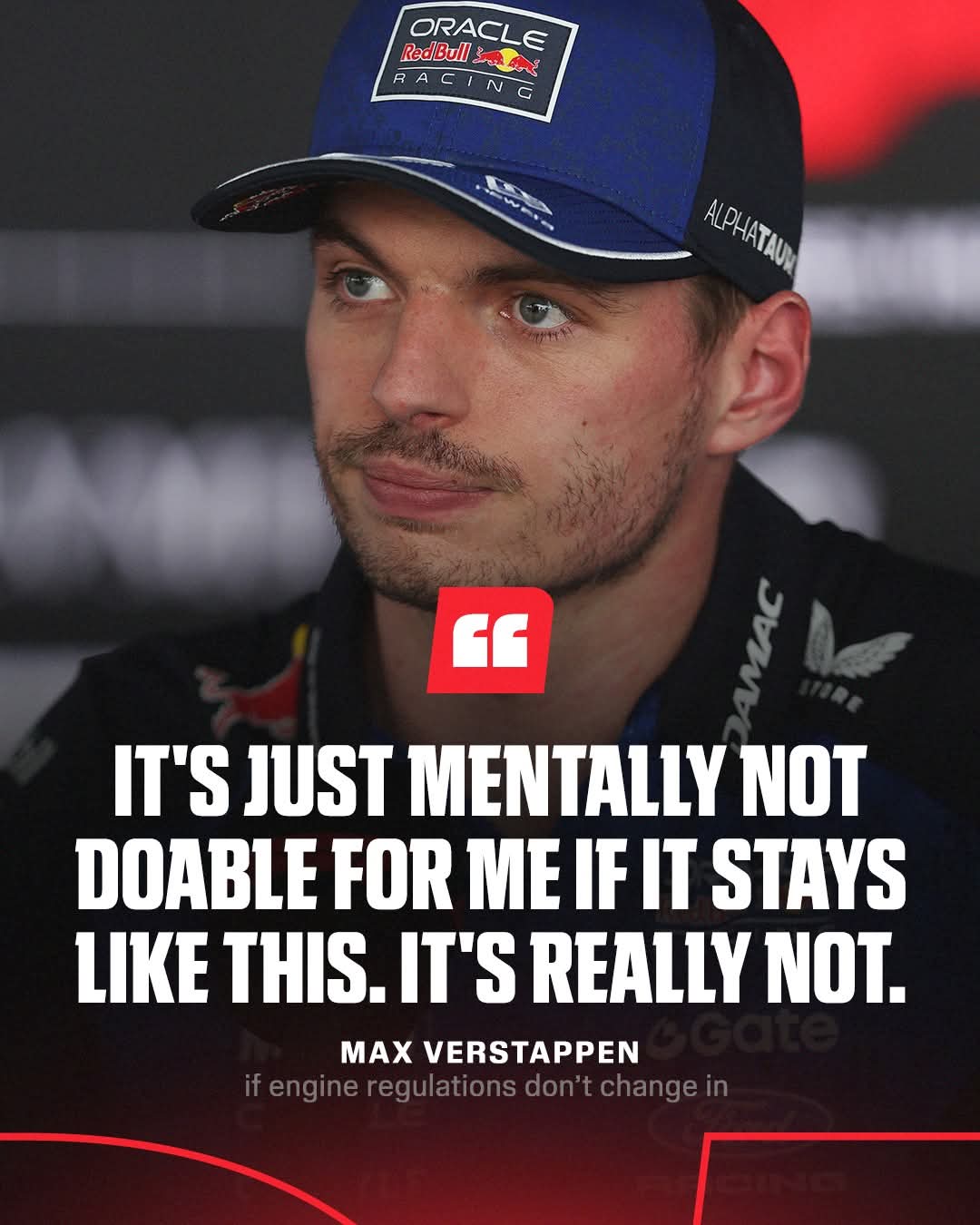
Max Verstappen has delivered one of the strongest statements yet regarding his Formula 1 future, admitting that upcoming regulation decisions could ultimately determine whether he continues competing in the sport. The four-time world champion made it clear that ongoing discussions surrounding the controversial engine regulations are not just technical conversations happening behind closed doors — they could directly affect his long-term commitment to F1.
The current debate centers around Formula 1’s new hybrid engine structure, introduced with a 50/50 split between combustion power and electric energy. While the concept was designed to push technological advancement and sustainability goals, it has drawn heavy criticism from several drivers and teams. Verstappen has been among the loudest voices opposing the system, previously describing aspects of the package as “anti-racing” and comparing its characteristics to elements that reduce the purity of wheel-to-wheel competition.
As discussions continue, a proposal to adjust the power balance toward a 60/40 split in favor of combustion engines has gained traction. The idea behind the revision is to reduce excessive dependence on electrical deployment and create more natural racing dynamics. However, despite an agreement in principle, multiple manufacturers and stakeholders remain divided. Some teams are reportedly pushing for implementation to be delayed until 2028, creating uncertainty over whether meaningful changes will happen in time.
Verstappen’s reaction to the possibility of maintaining the current structure was particularly striking. The Red Bull star admitted that if the regulations remain unchanged, continuing under those conditions would be “mentally not doable” for him. Those words immediately triggered renewed speculation surrounding his future, especially as retirement rumors and alternative racing interests have repeatedly surfaced around the Dutchman over the last several seasons.
The comments also reveal a side of Verstappen that extends beyond pure competitiveness. Throughout his career, he has repeatedly emphasized that enjoyment matters just as much as results. Unlike many drivers who build their entire identity around Formula 1, Verstappen has openly spoken about interests outside the sport, including endurance racing, GT competition, and sim racing. His recent Nürburgring activities and broader motorsport interests reinforce the idea that he has options if F1 moves in a direction he no longer enjoys.
From a wider championship perspective, Verstappen’s position creates a fascinating layer of pressure for Formula 1 itself. Losing a driver of his caliber during the peak of his career would represent a major blow. He remains one of the sport’s biggest stars, one of its most aggressive racers, and arguably its strongest benchmark for raw pace and racecraft. Formula 1 has spent years building narratives around rivalries involving Verstappen, and any genuine threat of departure would likely force the FIA and Formula One Management to carefully evaluate how the sport evolves.
There is also a political battle developing beneath the surface. Teams currently benefiting from existing development paths naturally have reasons to resist rapid changes, while others see the proposed revisions as necessary for improving racing quality. Financial considerations are also becoming a major obstacle, with manufacturers already investing enormous sums into current projects. The result is a situation where competitive interests, engineering philosophies, and long-term business strategies are all colliding.
Looking ahead, the Canadian Grand Prix and the remainder of the season may temporarily shift focus back toward on-track action, but the regulation battle is unlikely to disappear. If the FIA pushes forward aggressively with revisions, Verstappen may remain fully committed to Formula 1’s future. If delays continue and dissatisfaction grows, however, his comments suggest this story could evolve into one of the most significant long-term narratives in modern F1. The possibility of the sport losing a generational talent may no longer be viewed as distant speculation — it is beginning to sound like a warning.