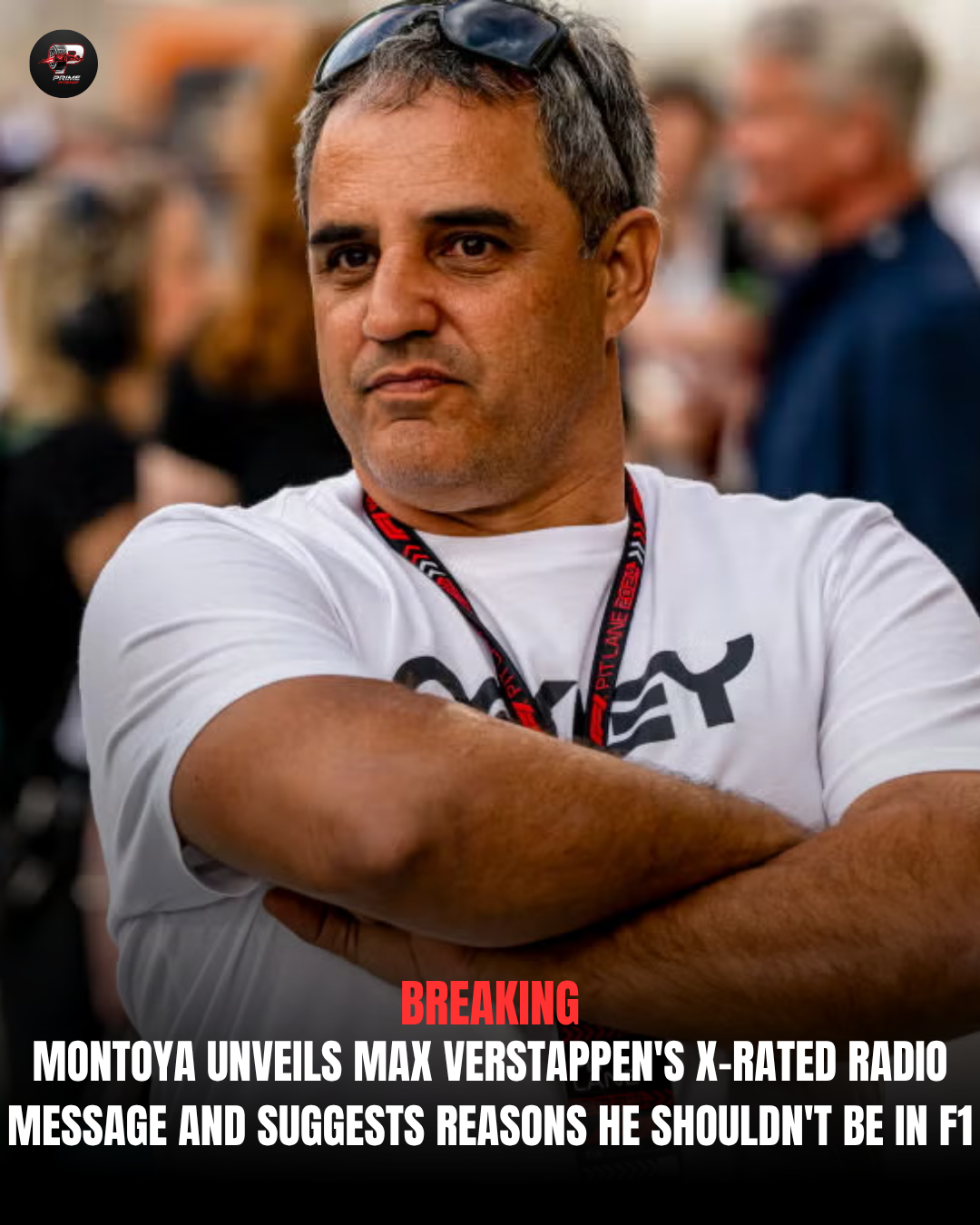
The intense personality of Max Verstappen has once again become one of the biggest talking points in the Formula 1 paddock after former Grand Prix winner Juan Pablo Montoya revealed details of an explosive radio exchange that has reignited debate about Verstappen’s long-term future in the sport.
Montoya, never afraid to speak bluntly about Formula 1’s biggest stars, suggested that Verstappen’s increasingly frustrated attitude toward modern F1 politics, regulations, and media pressure could eventually push the reigning world champion away from the series altogether.
The comments arrive at a fascinating moment in Verstappen’s career. Despite remaining one of the fastest and most dominant drivers on the grid, the Dutch superstar has shown growing signs that his relationship with the modern Formula 1 environment is becoming increasingly complicated.
Verstappen’s Competitive Fire Continues to Dominate Headlines
Throughout his Formula 1 career, Verstappen has built a reputation as one of the most brutally honest and emotionally intense drivers in the sport.
Whether speaking over team radio, confronting rivals after races, or criticizing regulations publicly, the Red Bull driver has never hidden his frustrations when things fail to meet his expectations.
According to Montoya, one particular radio message during a recent race weekend highlighted just how emotionally invested Verstappen remains behind the wheel.
While team radio outbursts are hardly unusual in Formula 1, Montoya implied that Verstappen’s language and tone reflected a driver operating under enormous competitive pressure — and perhaps one growing tired of the increasingly controlled atmosphere surrounding modern Grand Prix racing.
The former Williams and McLaren driver suggested Verstappen’s mentality remains rooted in “pure racing,” a mindset that does not always align comfortably with the political and corporate realities of today’s Formula 1 paddock.
Why Verstappen’s Personality Divides the F1 World
Part of what makes Verstappen such a fascinating figure is that he refuses to behave like a carefully managed corporate athlete.
Modern Formula 1 drivers are often expected to balance media obligations, sponsor appearances, social media branding, and diplomatic communication alongside their racing duties. Verstappen, however, has consistently resisted that polished image.
Instead, he approaches racing with a raw intensity that many fans view as refreshingly authentic.
Supporters argue that his emotional radio messages simply reveal how deeply he cares about performance and competition. Critics, meanwhile, believe some of his reactions can cross the line into unnecessary aggression or negativity.
Montoya appears to fall somewhere in the middle.
The Colombian believes Verstappen’s uncompromising mentality is precisely what makes him extraordinary behind the wheel, but he also hinted that Formula 1’s modern structure may eventually become incompatible with that personality type.
The Growing Signs of Verstappen’s Frustration
Over the past two seasons, Verstappen has repeatedly hinted that he may not remain in Formula 1 for as long as previous champions.
Unlike drivers who openly chase records and longevity, Verstappen has frequently emphasized that his passion lies in racing itself rather than celebrity status or historical statistics.
That distinction matters.
The Dutchman has already explored GT3 competition, endurance racing, and high-level sim racing outside Formula 1. His recent Nürburgring appearances only intensified speculation that he may eventually pursue a broader motorsport career rather than spending another decade exclusively inside the F1 system.
Montoya believes those outside interests reveal an important truth about Verstappen’s mindset.
According to the former F1 star, Verstappen appears happiest when racing environments feel authentic, competitive, and free from excessive political distractions.
That could explain why events like the Nürburgring 24 Hours seem to energize him differently compared to conventional Formula 1 weekends.
The Radio Messages That Reflect Elite Pressure
Team radio has become one of Formula 1’s most powerful storytelling tools in the modern media era.
Every emotional reaction, strategic disagreement, or frustrated outburst can instantly become a global headline within minutes.
For drivers competing at Verstappen’s level, that pressure can become exhausting.
Small mistakes are magnified worldwide, while emotional comments made during high-adrenaline moments are endlessly analyzed across television broadcasts and social media platforms.
Montoya suggested that Verstappen’s recent radio frustration should not simply be viewed as anger, but rather as evidence of the enormous intensity required to remain at the top of Formula 1.
In many ways, that emotional edge is part of what separates elite champions from ordinary drivers.
The greatest competitors in motorsport history — including legends such as Ayrton Senna, Michael Schumacher, and Lewis Hamilton — were all known for moments of extreme emotion under pressure.
Verstappen appears to belong firmly in that category.
Could Verstappen Really Leave Formula 1 Early?
Perhaps the most intriguing aspect of Montoya’s comments was his suggestion that Verstappen may not truly belong within Formula 1’s current culture long-term.
That does not mean the Dutchman lacks the talent or results to remain successful — quite the opposite.
Instead, Montoya hinted that Verstappen’s personality may eventually clash with the increasing commercialization of the sport.
Formula 1 has transformed dramatically over the past decade. Global expansion, streaming audiences, corporate partnerships, and entertainment-driven storytelling have all become central to the championship’s growth.
While Verstappen benefits enormously from that popularity, some insiders believe he remains fundamentally old-school in his mentality.
He appears to value racing purity more than celebrity culture.
That difference could become increasingly important as Formula 1 continues evolving into a global entertainment giant.
Why Nürburgring and GT Racing Matter to Verstappen
One reason speculation about Verstappen’s future continues growing is because of how naturally he has embraced racing outside Formula 1.
His performances in GT3 machinery and endurance racing environments have impressed drivers across multiple disciplines.
At the Nürburgring, rivals openly praised Verstappen’s traffic management, racecraft, and ability to adapt instantly to one of the world’s most difficult circuits.
Those experiences appear to provide something Formula 1 sometimes cannot — freedom.
Unlike the tightly controlled environment of modern F1 weekends, endurance racing often feels less corporate and more connected to traditional motorsport culture.
That atmosphere may explain why Verstappen repeatedly speaks so positively about events like the Nürburgring 24 Hours.
For someone with his racing obsession, the appeal is obvious.
The Verstappen Effect on Formula 1
Regardless of whether Verstappen remains in Formula 1 long-term, one thing is already clear: he has fundamentally changed the modern grid.
His aggressive driving style, relentless pace, and refusal to soften his personality have made him one of the sport’s most polarizing and compelling figures.
Montoya’s comments only reinforce how unusual Verstappen’s mentality truly is.
Most drivers eventually adapt themselves to Formula 1’s political ecosystem. Verstappen, however, still behaves like someone whose primary concern is simply driving as fast as possible.
That authenticity continues to attract huge support from fans who miss the more rebellious personalities of earlier Formula 1 eras.
What Happens Next?
As the 2026 season intensifies, Verstappen’s future will remain one of the biggest storylines in motorsport.
If Red Bull continues providing championship-winning machinery, there is little reason to believe he cannot remain the dominant force on the grid for years to come.
However, Montoya’s remarks highlight an increasingly important question:
Will Verstappen’s love for racing eventually outweigh his desire to remain inside Formula 1’s modern structure?
For now, the Dutch superstar remains fully focused on winning. But every emotional radio message, every endurance racing appearance, and every public criticism of the sport continues adding fuel to speculation that Formula 1 may not contain Verstappen forever.
And if he ever does decide to walk away earlier than expected, it would not be because he stopped loving racing.
It may simply be because he loves racing too much to limit himself to only one world.