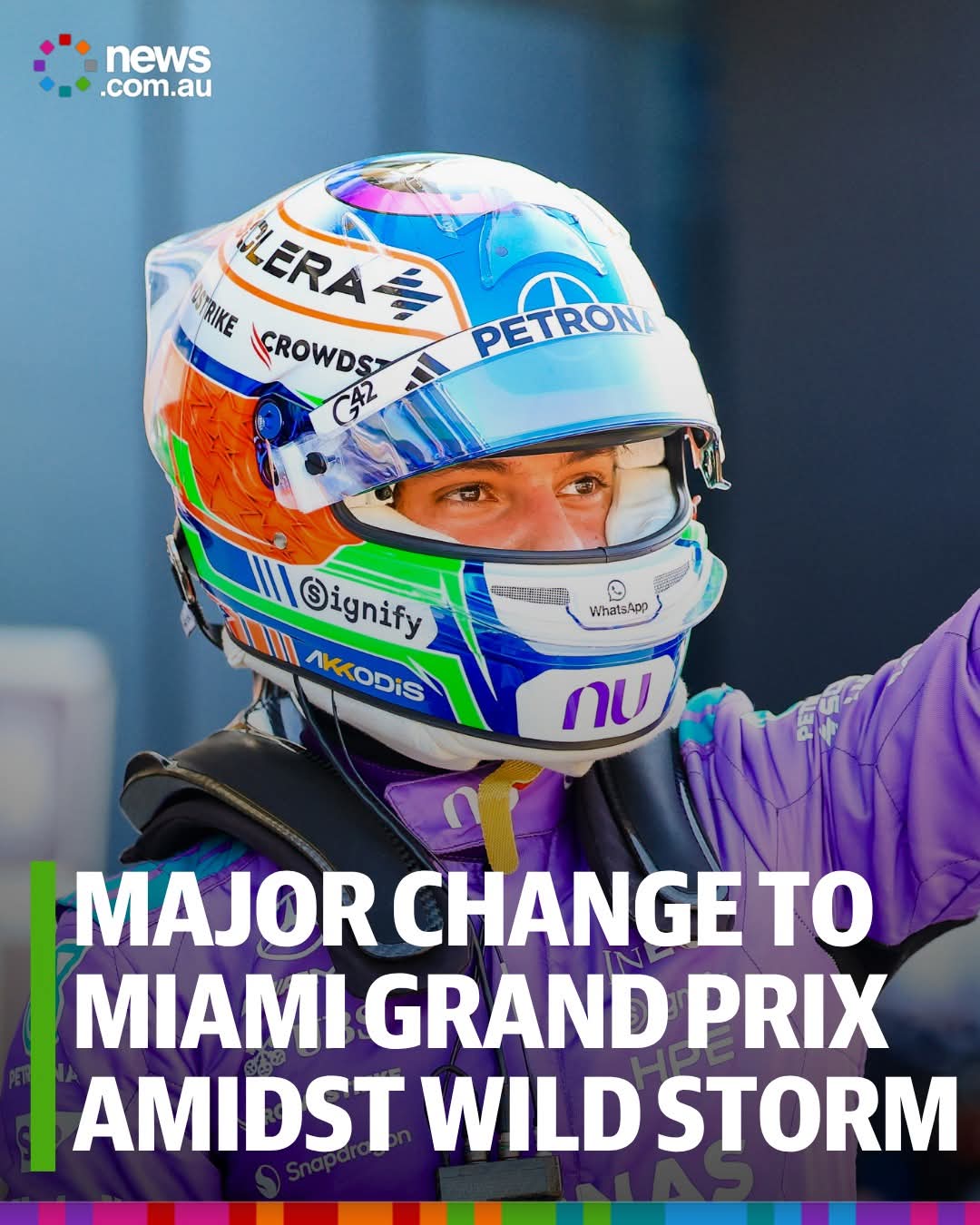
The Miami Grand Prix weekend has taken a dramatic turn, with McLaren failing to convert early dominance into qualifying success, while teenage sensation Andrea Kimi Antonelli delivered a stunning pole position performance that continues to redefine the 2026 season. The race itself has already been shifted forward by three hours due to looming thunderstorms, setting the stage for one of the most unpredictable Grands Prix of the year.
Antonelli’s pole lap was not just fast—it was historic. The Mercedes driver secured his third consecutive pole, placing him alongside legends like Michael Schumacher and Ayrton Senna in the record books. Around the tight and unforgiving Miami circuit near Hard Rock Stadium, the young Italian once again proved his composure under pressure, capitalizing on rivals’ inconsistencies to seize control of the weekend.
For McLaren, however, the story was one of frustration. Despite dominating the sprint race with a commanding 1-2 finish led by Lando Norris and Oscar Piastri, qualifying told a very different story. Piastri struggled with unpredictable car behavior and could only manage seventh, while Norris dropped to fourth. Both drivers cited inconsistent power delivery, shifting wind conditions, and low grip levels as key factors that disrupted their rhythm at the worst possible moment.
Piastri, in particular, described a chaotic session where “something weird happened” during his final lap, costing him crucial time despite setting a strong middle sector. His honest assessment reflects a broader issue for McLaren: raw pace is clearly there, but execution under changing conditions remains inconsistent. Team principal Andrea Stella reinforced this view, noting how incredibly tight the top four teams are and how fine margins now dictate results.
Behind Antonelli, Max Verstappen secured a front-row start for Red Bull Racing, with Charles Leclerc placing Scuderia Ferrari firmly in contention. The grid composition—four different teams in the top four—highlights just how competitive the current era has become. Even minor setup differences or environmental changes can swing the balance dramatically from session to session.
Looking ahead to the race, weather remains the ultimate wildcard. With heavy rain expected, drivers could be entering a “voyage into the unknown,” as Piastri described it, particularly given limited wet running under the new regulations. Wet conditions often neutralize car advantages and amplify driver skill, opening the door for unexpected outcomes. Antonelli’s known struggles with race starts add another layer of intrigue, especially with seasoned rain specialists like Verstappen lurking behind.
From a championship perspective, this weekend could mark a pivotal shift. McLaren’s resurgence in the sprint proves they are genuine contenders, but their qualifying drop-off exposes vulnerabilities. Meanwhile, Antonelli continues to build momentum as a potential title favorite, combining qualifying dominance with growing confidence. If he converts pole into victory—especially in chaotic conditions—it could significantly strengthen his grip on the championship.
Ultimately, Miami is shaping up to be more than just another race. It’s a test of adaptability, precision, and nerve under pressure. With volatile weather, shifting performance hierarchies, and rising young stars rewriting history, Formula 1’s 2026 season may have just reached a defining moment.