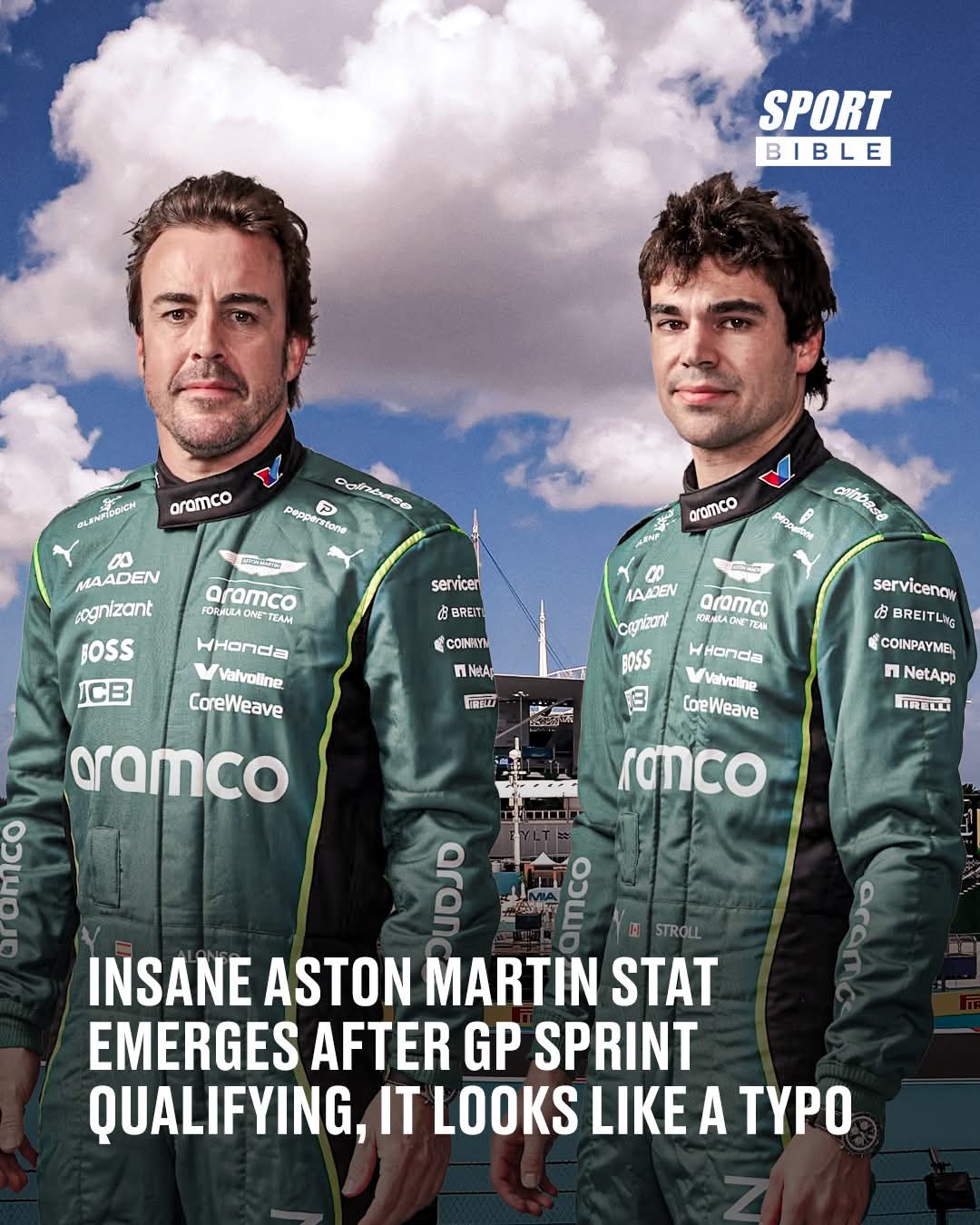
A brutal and almost unbelievable statistic has emerged following sprint qualifying at the Miami Grand Prix—and it perfectly sums up the nightmare start to 2026 for Aston Martin. What initially looked like a timing error quickly turned into a harsh reality, exposing just how far the team has fallen off the pace despite pre-season expectations.
At a circuit built around the Hard Rock Stadium, the contrast between front-runners and backmarkers could not have been more extreme. Lando Norris stormed to pole with a 1:27.8 for McLaren, ahead of Andrea Kimi Antonelli, Oscar Piastri, and Charles Leclerc. Meanwhile, at the very back, Fernando Alonso could only manage a 1:41.3—placing both Aston Martin cars in 21st and 22nd.
The gap is staggering: nearly 14 seconds off the leading time. In Formula 1 terms, that margin is not just uncompetitive—it’s catastrophic. Even more concerning, Alonso’s lap failed to meet the 107% rule threshold, meaning it wasn’t initially classified. Under normal circumstances, that could have resulted in exclusion from the sprint race altogether, underlining just how severe the performance deficit has become.
Perhaps the most damaging comparison comes from outside Formula 1 itself. The Aston Martin lap time was slower than the slowest lap recorded in Formula 2 qualifying, with Cian Shields posting a 1:41.1 and Kush Maini securing pole with a 1:39.8. That means Aston Martin—armed with vastly superior machinery on paper—would have been last even on the F2 grid. For a team that invested heavily and brought in legendary designer Adrian Newey, the optics are nothing short of disastrous.
There was, however, a narrow escape. Thanks to acceptable lap times set during the extended practice session, both Alonso and Lance Stroll were granted permission by the FIA to compete in the sprint race. While this avoids immediate embarrassment of exclusion, it does little to mask the deeper issues plaguing the team’s performance and development trajectory.
Looking ahead, this situation raises serious concerns about Aston Martin’s direction in 2026. A gap of this magnitude suggests more than just a bad setup—it points to fundamental flaws in car design, correlation, or development strategy. If urgent upgrades fail to deliver, the team risks becoming permanently stuck at the back of the grid. In a season where rivals are rapidly evolving, Aston Martin’s shocking Miami statistic could become a defining low point—and a warning sign of a campaign spiraling out of control.