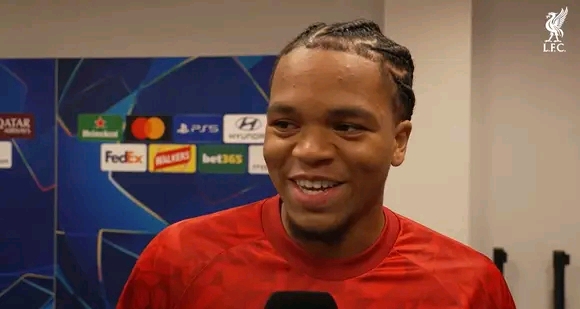
Rio Ngumoha has spent much of the last year being talked about as one of the most exciting teenage talents to come through Liverpool’s academy in a generation, but talk only carries a young player so far. At some point the stage gets bigger, the opposition gets sharper, and a coach has to decide whether the hype is worth the risk of a start. That moment arrived for Ngumoha in the Champions League against Atletico Madrid, and by his own admission, it was about proving something to two people at once: his new head coach, Andoni Iraola, and himself.
There is a particular kind of pressure that comes with a first European start at a club like Liverpool. Anfield under the lights on a Champions League night is not the same animal as a run-out from the bench in a Premier League fixture already drifting toward a comfortable scoreline. It is a different tempo, a different weight of expectation, and for an eighteen-year-old winger, it is precisely the sort of occasion that either confirms a manager’s faith or exposes the gap between potential and readiness. Ngumoha was named in the starting eleven, handed the responsibility of Liverpool’s left flank against a well-organised, physical Atletico side, and he came through it having played his part in a comeback win. That, on its own, tells you plenty. But it was what he said afterwards that gave a clearer picture of where his head is at as he tries to establish himself under a new manager.
Iraola’s arrival at Liverpool was always going to reshape things for the club’s younger players, Ngumoha included. New head coaches bring new demands, new tactical principles, and crucially, new standards for what earns a place in the team. A player can be blessed with natural ability on the ball, capable of beating a man in a phone box and lighting up a training pitch, but that alone rarely satisfies a coach who wants a complete footballer. Ngumoha seems to understand this instinctively, or at least he has been made to understand it quickly. “The manager knows I’m good at attacking but to play you have to be good at defending as well, or you just have to work hard,” he said, and there is something refreshingly honest in that admission. It is not the sound of a young player assuming his attacking quality is enough to guarantee him a starting shirt. It is the sound of someone who has clearly had conversations with his coach about what is actually required to hold down a place in a Liverpool team that is expected to compete on every front.
That kind of self-awareness matters more than people sometimes give it credit for when assessing young talent. Plenty of gifted teenage attackers have stalled in their development not because they lacked the technical tools, but because they never fully grasped the defensive side of the game, the willingness to track a full-back sixty yards, to close down a passing lane, to do the unglamorous running that never shows up in a highlight reel but which every serious coach notices. Ngumoha name-checking that exact requirement, unprompted, in a post-match interview suggests it has been drilled into him clearly and that he has taken it on board rather than simply nodding along in a team meeting. “That’s what he wants from me,” he added, framing the balance between attacking instinct and defensive discipline as the explicit price of admission to Iraola’s side. For a player whose reputation was built on flair, that is not a throwaway line. It is close to a mission statement.
The emotional register of Ngumoha’s comments is worth dwelling on too. He did not talk about the Atletico Madrid start as though it were owed to him, or as though it were simply the natural next step in a young career that has been building momentum. He talked about it as an opportunity that had been extended to him by a coach who did not have to give it, and he treated it with something close to gratitude. “I’m pleased that the gaffer put faith in me and I just wanted to prove to him and prove to myself that I could play at this level,” he said, and in that sentence there are really two separate challenges bound together. The first is external: convincing Iraola, a manager still in the early months of getting to know his squad, forming his own judgments about who fits his system and who does not. The second is internal: convincing himself. Teenagers who step into first-team football at a club of Liverpool’s stature carry more than just tactical instructions onto the pitch. They carry the question of whether they genuinely belong there, whether the level suits them, whether the step up from academy football and cameo appearances to a full Champions League start is one they can actually handle rather than merely survive. Ngumoha appears to have wanted an answer to that question as much for his own peace of mind as for anyone else’s approval.
It says something about the relationship forming between player and coach that Ngumoha frames Iraola’s decision to start him not just as a tactical call but as a statement of belief. “The gaffer, [for him] to put faith in me and to show me that he believes in my abilities and qualities to help the team get a win is really positive. I couldn’t ask for much more,” he said. There is a warmth in how he talks about the manager here, a sense that the trust being extended feels personal rather than purely functional. New coaches often struggle in those first months to build that kind of rapport with younger players who did not choose them and who might reasonably wonder whether a change in the dugout threatens their path into the team. Managerial transitions can be brutal for academy graduates and emerging talents specifically, because a new head coach owes them nothing, has no history with them, and will make selection decisions based on what he sees in training rather than what he has been told about a player’s reputation. For Ngumoha to speak about Iraola in these terms, so early into their working relationship, suggests the Spaniard has gone out of his way to communicate clearly and to make the teenager feel like a genuine part of his plans rather than a peripheral squad option waiting for chances to dry up.
Ngumoha went further in describing what those pre-season conversations with Iraola actually looked like, and it is here that the picture of a coach with a defined attacking philosophy starts to come into focus. “It’s been a pleasure working with Iraola so far. In pre-season he was just getting his ideas across to me and the team and what he wants,” he explained. Pre-season is typically when the real teaching happens at a football club, away from the pressure of competitive fixtures, when a manager has the time and space to install his principles through repetition on the training pitch rather than firefighting problems that emerge in matches. For Iraola, evidently, part of that process involved being very specific with Ngumoha about his individual role within the broader attacking structure. “For me, he wants me to be direct on the ball. He knows my qualities and if I can just get at a man quicker and help put a ball in the box or get a shot off, then that’s my job really,” Ngumoha said, and it is a description that lines up neatly with what many will already associate with the way Iraola likes his wide players to operate: quick, incisive, willing to run at defenders rather than delay, someone who looks to unsettle a backline immediately rather than probing patiently for an opening.
That directness is exactly the kind of attribute that made Ngumoha such an exciting academy prospect in the first place, the sort of raw, fearless one-on-one ability that can’t really be coached from scratch, only sharpened and channelled. Hearing him articulate it as an instruction from his manager, rather than simply a trait he brings naturally, suggests Iraola has identified what makes the teenager dangerous and is actively building it into how he wants Liverpool to attack down that side of the pitch. It is not always guaranteed that a new coach will see eye to eye with a young player’s strengths, particularly one who inherits a squad rather than builds it from scratch. Some managers try to remould emerging talents in their own image, stripping out instinctive qualities in favour of positional discipline. Iraola’s message to Ngumoha appears to be the opposite: keep doing the thing that makes you different, just do it with purpose and end product, and do it inside a framework that also demands defensive responsibility.
That is where the other half of Ngumoha’s comments become significant, because a manager who wants directness and end product from his wide players still has to trust that those same players will do the defensive work when possession is lost. Ngumoha was clear that this expectation had been made explicit to him as well. “Then off the ball as well, you have to work off the ball, whether it’s tracking a full-back and stuff,” he said, almost as an afterthought, but it is really the other side of the same coin. Iraola wants attacking directness with defensive accountability, and he has communicated both halves of that equation to an eighteen-year-old in terms specific enough that the player can repeat them back nearly verbatim months later. That level of clarity from a coach tends to accelerate a young player’s development far more effectively than vague encouragement ever could, because it gives them something concrete to measure themselves against in every single training session and match.
None of this guarantees that Ngumoha’s path from here is a straight line upward. Football rarely works that way, and certainly not for teenagers navigating the jump into regular first-team football at a club competing on multiple fronts. There will be moments when the attacking end product he talks about doesn’t arrive, when the defensive discipline slips under fatigue or pressure, when Iraola opts for a different profile of player to suit a particular opponent or tactical plan. Squad rotation, injuries elsewhere, the emergence of other academy talents, all of these factors will shape how many further Champions League starts Ngumoha earns this season. But what he offered after the Atletico Madrid match was not a guarantee of anything. It was a snapshot of a young player who understands precisely what is being asked of him, who feels trusted by his new manager, and who used his first big European opportunity not just to show off his attacking instincts but to demonstrate that he had absorbed the fuller picture of what it takes to survive at this level.
There is also something worth noting in the phrase he used twice, in slightly different forms, about proving himself. He wanted to prove something to the manager, and he wanted to prove something to himself, and he was careful to give both aims equal weight. That instinct, treating external validation and internal confidence as two separate targets that both need to be hit, is not something every young athlete articulates clearly, even when they feel it. It suggests a maturity in how Ngumoha is processing this stage of his career, an understanding that impressing a coach and genuinely believing you belong are related but distinct challenges, and that satisfying only one of them leaves the job half done.
For Liverpool supporters watching a new head coach settle into the role, moments like this carry extra significance beyond the individual performance itself. They offer a window into how Iraola communicates, how he builds trust with the players who will carry his ideas onto the pitch for years to come, and how he balances demanding standards with genuine belief in emerging talent. A manager who can extract that kind of clarity and confidence from an eighteen-year-old making his first Champions League start, while simultaneously holding him to a defensive standard that many senior professionals still struggle with, is laying down markers about the kind of environment he intends to build at the club. Ngumoha, for his part, sounds like exactly the sort of player who wants to meet those standards rather than resent them.
Whether this becomes the moment people look back on as the real beginning of Ngumoha’s rise into a first-team regular, or simply one bright night among many ups and downs typical of a young winger’s development, is impossible to say with certainty this early. But the substance of what he said afterwards, the specificity of it, the gratitude mixed with ambition, the clear grasp of exactly what his coach wants from him in both phases of the game, all of it points to a player who is taking this opportunity seriously in the fullest sense. He did not simply want to start a Champions League match and enjoy the occasion. He wanted to prove something, to his manager and to himself, and by his own account, he walked off the Anfield pitch that night having done exactly that.