# Alexander Isak and Liverpool Step Out at St James’ Park to Honour Kevin Keegan
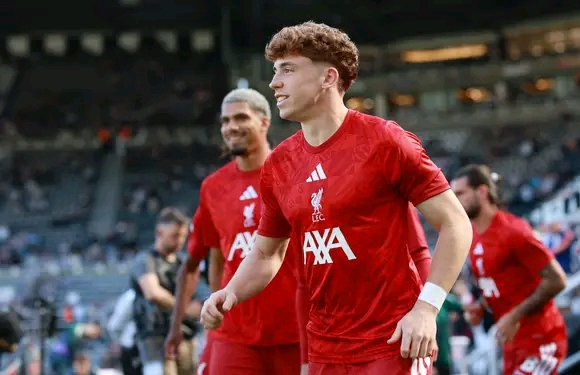
There are football fixtures that matter because of three points, and then there are the rare occasions when the scoreline feels almost secondary to everything happening around it. Sunday’s Premier League opener between Newcastle United and Liverpool at St James’ Park was always going to carry an unusual weight, but as both squads emerged from the tunnel for their pre-match warm-up, that weight became visible in the simplest of details: the training tops. Every player from both clubs walked out wearing shirts printed with “Keegan 7” on the back, a shared gesture of remembrance for a man who shaped the identity of both institutions long before either club became the version of itself we recognise today. Among those players jogging out into the Tyneside air, doing his stretches and lining up for passing drills like any other pre-season ritual, was Alexander Isak, the Swedish striker whose own relationship with this stadium has become one of the most complicated storylines in recent Premier League memory.
The tribute itself had been meticulously planned in the weeks leading up to kickoff. Kevin Keegan passed away in July at the age of 75, and the reaction from supporters at both ends of the country made clear just how far his legacy stretched. Fans had already begun leaving flowers, scarves, and shirts outside St James’ Park within days of the news breaking, an outpouring that eventually had to be managed and repurposed by the club into something more lasting. Some of those very shirts, donated in grief by Newcastle supporters over the following weeks, were used to construct a giant mosaic at the centre of the pitch, a visual centrepiece that both sets of fans could see and understand before a ball was even kicked. It’s the kind of tribute that only works when a figure has genuinely transcended rivalry, and Keegan, in a career that wove Liverpool and Newcastle together in ways few other players or managers ever have, was exactly that figure.
To understand why this moment landed the way it did, you have to go back to the beginning of Keegan’s story, which starts not on Tyneside but on Merseyside. He arrived at Liverpool in 1971, a relatively unknown forward signed from Scunthorpe United, and within a few short years had become the heartbeat of one of the most dominant sides English football has ever produced. Under Bill Shankly and then Bob Paisley, Keegan won three First Division titles, two UEFA Cups, an FA Cup, and, most famously, the European Cup in 1977, scoring in that Rome final before his transfer to Hamburg was even finalised. He was named Footballer of the Year twice during his time at Anfield and became the first Englishman to win the Ballon d’Or, doing so twice in consecutive years while playing in Germany. For Liverpool supporters of a certain generation, Keegan isn’t just a name on a shirt or a chapter in a history book. He is one of the foundational figures of the club’s golden era, the player whose energy and work rate set the tone for the sides that would go on to dominate English and European football for the following decade.
And yet ask a Newcastle supporter about Kevin Keegan and you will get an entirely different, equally passionate answer, because his impact on Tyneside runs just as deep, arguably deeper, given the club’s more turbulent modern history. Keegan signed for Newcastle as a player in 1982, a move that stunned English football at the time. He was in his thirties, still a superstar, and could have gone almost anywhere, yet he chose a Newcastle side that had spent years drifting in the lower reaches of the old Second Division. His arrival was treated less like a transfer and more like a civic event; supporters reportedly stopped traffic to catch a glimpse of him on his unveiling. He helped drag the club back into the top flight before retiring from playing altogether, seemingly closing the book on his Newcastle story. But the most extraordinary chapter was still to come. In 1992, with Newcastle again flirting with relegation into the third tier of English football, Keegan returned as manager, and what followed became one of the most romanticised periods in the club’s history. The Entertainers, as that Newcastle side of the mid-1990s came to be known, played a brand of attacking, cavalier football that captured the imagination of the entire country, not just the Toon Army. They came agonisingly close to winning the Premier League title in the 1995-96 season, ultimately falling short to Manchester United in a campaign remembered as much for its drama and heartbreak as for the football itself. Keegan’s number seven, worn during his playing days, has taken on an almost mythic status at St James’ Park ever since, which is precisely why the club chose that number for Sunday’s tribute rather than any number tied to his time as manager.
It’s this dual legacy, this rare distinction of being adored in near-equal measure by two fanbases who otherwise share little affection for one another, that made Sunday’s ceremony possible. Before kickoff, both sets of supporters observed a minute’s applause rather than a minute’s silence, a deliberate choice that reflected the celebratory tone the clubs wanted to strike rather than pure mourning. Keegan’s image adorned the front cover of the matchday programme. Newcastle’s renowned supporter group, Wor Flags, known for their elaborate pre-match choreography, put together a full stadium display in his honour, blanketing the stands in imagery and colour associated with his two spells at the club. For a ground that has seen its share of iconic occasions in recent years, from cup finals to Champions League nights, this had a different, more solemn texture to it, even with the noise and colour surrounding it.
Against that backdrop, Alexander Isak’s presence in a Liverpool training top felt almost impossible to separate from the occasion itself, whether anyone involved wanted it that way or not. Isak’s relationship with Newcastle United has become one of the more bitter transfer sagas in recent Premier League history, and it is impossible to write about his return to St James’ Park without acknowledging just how raw those wounds still are for large sections of the home support. He arrived at Newcastle in 2022 from Real Sociedad in a deal worth around £60 million, a marquee signing for a club that had just emerged from the early stages of its Saudi-backed ownership era and was beginning to dream bigger than it had in decades. What followed was, by almost any measure, a spectacular three years. Isak scored more than fifty league goals in black and white, played a starring role as Newcastle qualified for the Champions League, and was on the scoresheet when the club finally ended a trophy drought stretching back over half a century by winning the Carabao Cup. For a period, he was as beloved on Tyneside as almost any player in the modern era of the club, a status that made what happened next all the more jarring for supporters who had watched him become part of the fabric of the place.
The transfer itself, completed last summer in a deal reported to be worth in the region of £125 million, a British transfer record, did not happen cleanly or amicably. Isak effectively withdrew his labour in the buildup, missing Newcastle’s pre-season tour, citing a minor injury, and eventually training away from the first team entirely, first at his former club Real Sociedad and then, upon returning to England, separately from his teammates at Newcastle’s own training ground. Eddie Howe, the Newcastle head coach at the time, was notably firm in his public comments, insisting that no player could expect to train with the group as normal after conducting himself the way Isak had during the standoff. The saga dragged on for weeks, with Liverpool reportedly having an initial bid in the region of £110 million rejected before eventually meeting Newcastle’s valuation as deadline day approached. Isak later published a statement accusing the club of breaking promises made to him about being allowed to leave, language that only deepened the sense of betrayal many supporters felt. His parting Instagram message, thanking the city and its supporters for three unforgettable years, was seen by some as a genuine attempt to mend bridges and by others as too little, arriving only after the damage had already been done. One prominent supporters’ group summed up the mood at the time with a blunt two-word farewell that needed no further explanation.
That context is essential to understanding just how strange Sunday’s scene really was. Here was a player who, twelve months earlier, had effectively gone on strike to force his way out of a club, walking out onto that same club’s pitch wearing a shirt that honoured a man synonymous with loyalty, romance, and giving everything for the shirt you wear. Kevin Keegan’s story, at both Liverpool and Newcastle, was built on a kind of footballing devotion that feels increasingly rare in an era of transfer requests and release clauses. He chose Newcastle as a fading superstar when he didn’t need to. He came back as manager and turned a sleeping giant into the most talked-about team in the country, purely, it often seemed, because he loved the place and its people. Isak’s route back to Tyneside could hardly have been more different, and it is little wonder that Newcastle’s new head coach, Matthias Jaissle, felt compelled in the days before the match to publicly urge the club’s supporters to direct their energy toward backing their own team rather than venting their frustration at the Swede. Jaissle, taking charge of his first competitive fixture in the job, spoke about wanting the crowd’s energy to lift his players rather than consume the entire occasion, a delicate balancing act given everything swirling around the build-up.
For Liverpool’s part, the day carried its own significance well beyond the Keegan tribute. Andoni Iraola took charge of his first competitive match as the club’s head coach, inheriting a Liverpool side attempting to bounce back from a difficult 2025-26 campaign under new stewardship. Mohamed Salah’s departure left an obvious creative and goalscoring void, and with Hugo Ekitike sidelined by a torn Achilles picked up the previous season, the responsibility of leading the line fell squarely on Isak’s shoulders from the opening whistle. Iraola spoke candidly in the days before the match about what he sees in his new striker, describing him as an unusually complete number nine capable of both dropping deep to link play and attacking space in behind, while also being honest about the defensive and pressing habits Isak still needs to refine after a debut Liverpool campaign disrupted by a series of injuries, including a broken leg. Iraola didn’t shy away from the scale of the challenge either, calling it a genuinely massive season for the striker, one in which fitness and consistency, not just talent, would determine whether the transfer fee attached to his name would ever feel justified in the eyes of Liverpool’s own supporters.
There is something almost theatrical about the way football stages these collisions between the personal and the historical, and Sunday’s warm-up captured that tension perfectly. On one hand, you had a genuine, heartfelt tribute to a man whose career embodied everything supporters say they want from a player: commitment, romance, a willingness to give a club everything he had. On the other, you had one of the tribute’s most prominent participants standing as a living symbol of the opposite impulse, a player whose departure from the very club hosting the ceremony was defined by exactly the kind of self-interest Keegan’s story seems to reject. Neither club appeared inclined to let that irony derail the occasion. If anything, the joint tribute seemed designed to rise above it entirely, a reminder that some figures in football’s history matter more than any single transfer saga, however bitter, and deserve a moment untangled from the noise of the current news cycle.
Once the whistle finally blew and the warm-up shirts were swapped for match kits, the atmosphere shifted, as everyone inside St James’ Park knew it eventually would. Newcastle’s home form under Howe in recent seasons had made the stadium one of the most intimidating away trips in the Premier League, and with a sold-out crowd fuelled by both the emotional weight of the pre-match ceremony and the anticipation of finally venting their feelings about Isak’s departure, the noise inside the ground on kickoff was always going to be considerable. Isak himself had spoken in the days leading up to the match about feeling increasingly sharp physically after a pre-season built around gradually building his fitness following last year’s injury troubles, telling Liverpool’s own media that every match was taking him closer to where he needed to be and that the mentality within Iraola’s new-look squad felt strong heading into the opener. Whether that private confidence translated into anything resembling a positive reception from the home stands was, unsurprisingly, never really in doubt.
What made Sunday’s occasion so memorable, though, wasn’t really about who won or lost, or even about how Isak performed against the crowd baying for something close to the opposite of what Keegan represented. It was about the rare sight of two fiercely proud, historically significant football clubs setting aside their usual instincts for competition and hostility to collectively acknowledge a debt they both owed to the same man. Kevin Keegan gave Liverpool some of its most celebrated years as a player and gave Newcastle two of the most romantic chapters in its entire history, first as a returning hero in the twilight of his playing career and then as a manager whose teams are still spoken about with a kind of reverence usually reserved for trophy winners, even though the biggest prize ultimately slipped away. Few figures in the modern game could plausibly unite two fanbases separated by more than two hundred miles and decades of mutual indifference, if not outright rivalry, but Keegan managed it in death much as he did in life, through the sheer force of what he gave to the people who watched him play and manage.
As the players finished their warm-up and made their way back down the tunnel to prepare for kickoff, the Keegan 7 shirts were folded away and replaced by the usual colours of Premier League combat. The mosaic at the centre of the pitch, built from thousands of shirts laid by grieving fans in the weeks after his death, would remain visible throughout the match, a quiet backdrop to whatever unfolded over the following ninety minutes. For Isak, the day represented just one match in what Iraola and Liverpool hope will be a long, productive season leading their attack. For Newcastle, it represented both a painful reminder of the summer just gone and a poignant tribute to everything the club has been at its best. And for everyone inside St James’ Park, whichever side of the divide they stood on, it was a rare moment when football paused, however briefly, to remember that some legacies matter more than the rivalries built on top of them.