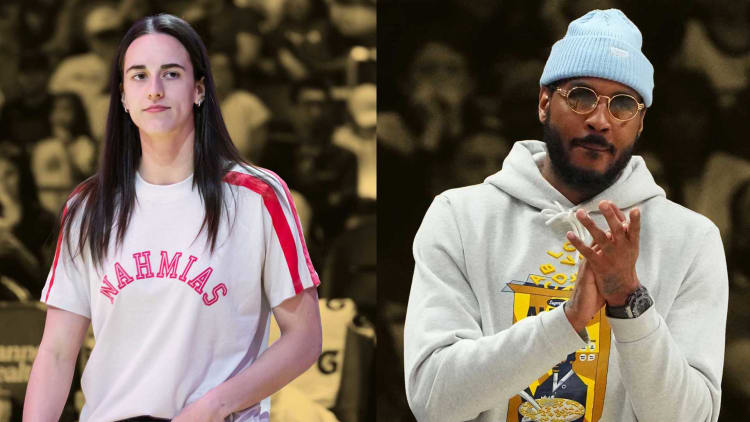
When Reggie Miller recently compared Caitlin Clark to Payton Pritchard, the reaction across the basketball world was swift. Many fans felt the comparison didn’t fully reflect Clark’s stature or influence in the WNBA. Although Miller clarified there was no disrespect intended, and Clark herself later acknowledged the moment lightheartedly, the debate quickly gained momentum. Adding his voice to the discussion, Carmelo Anthony offered a different take—one that placed Clark alongside some of the NBA’s brightest stars.

Anthony highlighted Clark’s ability to control tempo and manipulate defenses, traits often associated with Dončić. Like the Dallas Mavericks star, she uses angles, pacing, and court vision to create scoring opportunities for herself and her teammates. At the same time, her unpredictability as a shooter and playmaker draws parallels to Haliburton, who similarly keeps defenders guessing with his range and decision-making. Clark’s offensive orchestration, Anthony implied, goes far beyond the role of a complementary guard.
The comparisons gain even more weight when considering Clark’s early professional résumé. In her rookie season with the Indiana Fever, she silenced doubts about whether her collegiate dominance would translate to the pros. She captured Rookie of the Year honors, finished fourth in MVP voting, and helped elevate her team’s competitiveness. Much like Dončić did upon entering the NBA, Clark immediately proved she belonged among the league’s elite.
Ultimately, while surface similarities to Payton Pritchard may exist in shooting confidence or intensity, Anthony’s assessment centers on impact. Clark is not merely a skilled scorer—she dictates games, elevates teammates, and reshapes defensive schemes. And while comparisons can help frame discussions, Clark continues to carve out her own lane, establishing herself as a singular force whose influence extends beyond women’s basketball into the broader sport itself.