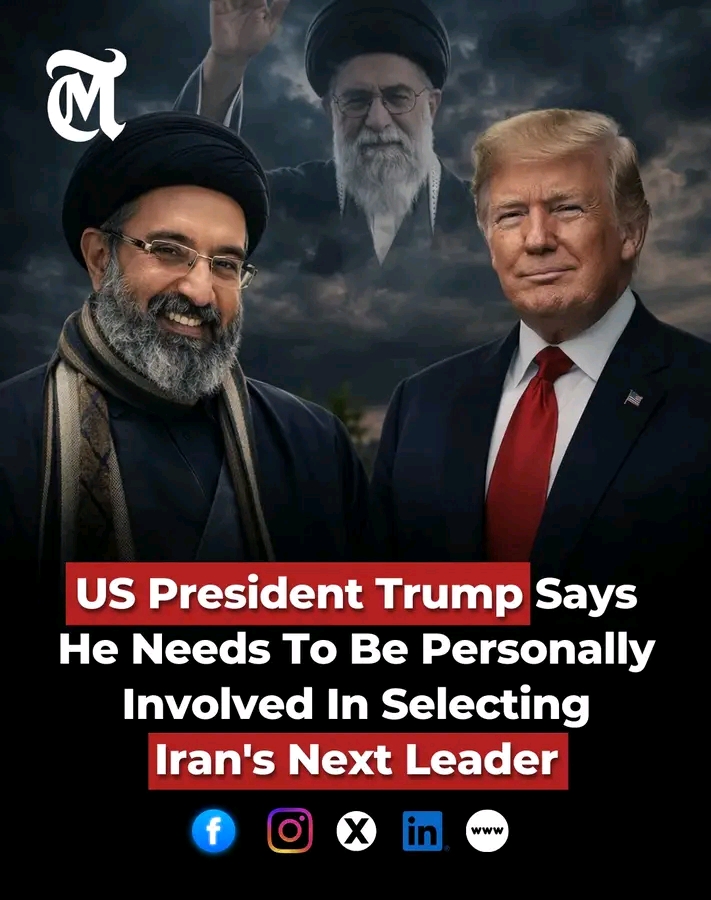
U.S. President Donald Trump has sparked international controversy after stating that he believes he must be personally involved in the selection of Ali Khamenei’s successor as Iran prepares to appoint a new supreme leader. The remarks come amid a tense geopolitical environment and ongoing conflict in the Middle East.
In an interview reported by international media, Trump said he intends to play a role in determining who will lead Iran next. According to the report, the U.S. president argued that the future leadership of Iran is too important for the United States to ignore and insisted that Washington should have influence over the outcome.
Trump specifically rejected the possibility of Mojtaba Khamenei, the son of the late Iranian leader, taking power. He reportedly described the potential successor as unacceptable and said the United States wants a leader who could bring “harmony and peace” to the country.
The comments come at a sensitive moment for Iran. Following the death of Ali Khamenei during recent military strikes linked to the escalating regional conflict, Iran’s clerical body responsible for leadership selection has been working to determine who will replace him. Iranian officials have confirmed that an interim leadership structure has been formed while the process continues.
Trump’s statement has raised questions among analysts and diplomats, as Iran traditionally chooses its supreme leader through the Assembly of Experts, a powerful clerical body within the Iranian political system. Any suggestion of foreign involvement in that process is likely to provoke strong reactions from Iranian authorities and the wider international community.
Experts warn that such remarks could further inflame tensions between Washington and Tehran, especially as military operations and retaliatory strikes continue across the region. The possibility of outside influence in Iran’s leadership transition could also complicate diplomatic efforts aimed at stabilizing the situation.
For now, Iran has not yet officially announced its next supreme leader. However, the leadership transition is being closely watched worldwide, with many governments concerned about how the choice could shape the future of the region and its relations with the United States.