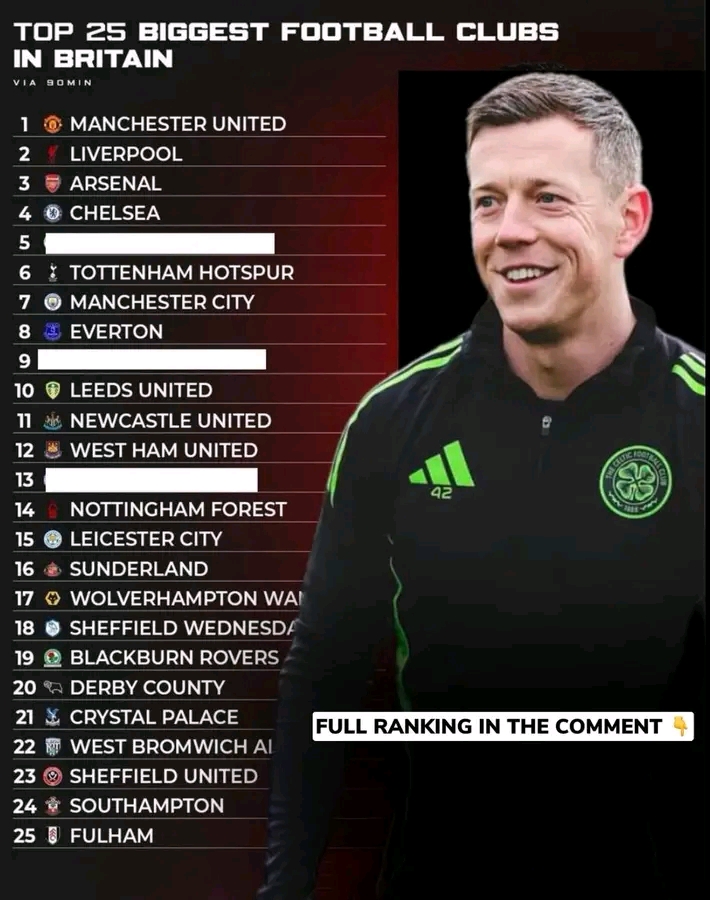
The landscape of football in Great Britain is defined by a fierce debate over history, fanbases, trophies, and modern financial dominance. When compiling a definitive list of the top 25 biggest football clubs across England, Scotland, Wales, and Northern Ireland, traditional heavyweights like Manchester United, Liverpool, Arsenal, Chelsea, and Manchester City predictably dominate the upper echelons. Modern Premier League riches have propelled clubs like Tottenham Hotspur, Aston Villa, and Newcastle United into global brands, supported by massive broadcast revenues and commercial appeal. However, the true flashpoint of any British football ranking emerges when looking northward across the border, where the exact positioning of Scotland’s two mega-clubs leaves the Scottish Premiership in complete disbelief.
For decades, supporters in Glasgow have argued that Celtic and Rangers belong in the elite top five of all British football clubs, pointing to their unmatched history, immense global followings, and legendary stadium atmospheres. Both sides of the Old Firm boast stadium capacities exceeding 50,000 to 60,000, regularly pulling in over one million matchgoing fans per season and placing them alongside the biggest super-clubs in Europe for overall attendance. Between them, Celtic and Rangers hold over 100 domestic league titles, multiple European trophies, and an international diaspora of supporters that rivals almost any team in English football. Yet, in contemporary lists evaluating Britain’s top 25 clubs, their placement frequently drops below several mid-table English sides, sparking intense debate.
The shock across the Scottish Premiership stems from how heavily modern analytical models weigh TV revenue, squad market values, and Premier League broadcasting exposure. While clubs such as West Ham United, Everton, Leeds United, Nottingham Forest, and Leicester City routinely secure higher rankings due to their inclusion in the cash-drenched English top flight, Celtic and Rangers are often placed in the lower half of the top twenty, or even pushed toward the fringe of the top 25. Scottish football pundits and fans find this dynamic staggering, arguing that placing mid-tier English clubs ahead of institutions that regularly compete in European football and draw massive crowds misses the fundamental soul of what makes a football club truly “big”.
This ranking controversy highlights the growing divide between historical stature and modern financial power in modern football. While smaller English teams benefit from multi-billion-pound TV deals, Celtic and Rangers generate world-class attendance figures despite operating within a significantly smaller domestic broadcasting economy. Further down the top 25, historic English clubs like Sunderland, Wolverhampton Wanderers, Sheffield Wednesday, and Championship-level outfits round out the list based on stadium capacity and legacy. Ultimately, the controversial placement of Glasgow’s titans serves as a reminder of the complex tension between traditional heritage and modern commercial metrics in British sports.