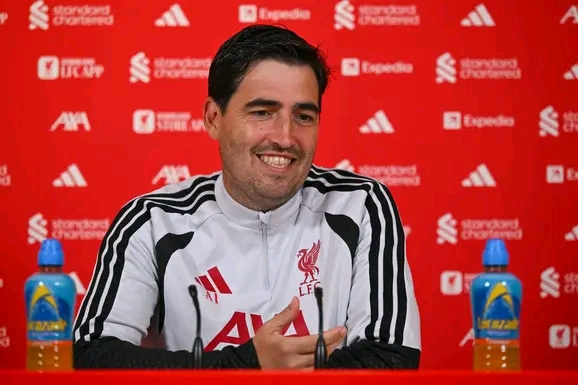
There is a particular kind of press conference that football fans have learned to read like tea leaves, and Andoni Iraola gave one of the finest examples of the genre this week when he was asked, yet again, about Bradley Barcola. The Liverpool head coach has become something of a master at saying a great deal while confirming almost nothing, and his latest round of answers on the France international will do little to calm the nerves of supporters counting down the days until the transfer window closes. “I hope we can have good news soon,” he offered, a line that on the surface sounds like boilerplate managerial caution but which, in the context of a deal reportedly worth in the region of £120 million, carries the unmistakable whiff of something close to completion. Iraola is not a man given to loose talk in front of the cameras, so even a carefully hedged phrase like that one is enough to send the rumour mill into overdrive.
What makes this particular saga so fascinating is not just the size of the fee being discussed, but the timing and the context surrounding it. Liverpool have spent much of the summer searching for a way to replace the irreplaceable, working out how a squad built around Mohamed Salah’s goals and assists for the better part of a decade should look without him. That is not a problem that gets solved overnight, and it is certainly not one that gets solved by signing just anybody. The club have been patient, perhaps to a fault in the eyes of some supporters, waiting for the right value and the right fit rather than panic-buying the first available winger who came onto the market. Barcola, if and when the deal is finally rubber-stamped, represents the culmination of that patience: a genuine talent, still only in his early twenties, who has already won a Champions League and established himself as one of the most dangerous wide players in French football.
Iraola’s insistence that he cannot discuss players who are not yet Liverpool’s is standard operating procedure for any manager in his position, but it is worth remembering just how often that kind of caution turns out to be a smokescreen for deals that are, in practical terms, already agreed. Journalists covering the story have suggested that personal terms and the framework of a fee have been settled for some time now, with the remaining work largely administrative rather than substantive. That is the nature of modern transfers: the headline agreement between two clubs is often only the beginning of a longer process involving medicals, image rights, agent fees, and a dozen other details that never make it into the public conversation but which can hold up an announcement for days or even weeks. Fans understandably find this frustrating. They see the reported figures, they see the growing consensus among well-sourced reporters that a deal is close, and they want confirmation now rather than later. But football simply does not work that way, and managers like Iraola know better than anyone that getting ahead of the paperwork can cause more problems than it solves.
There is also something refreshingly honest about the way Iraola framed his own position in this saga. “I don’t know what’s going to happen,” he admitted, a rare moment of a top-level coach acknowledging the limits of his own control over a process that ultimately depends on lawyers, negotiators, and the whims of a selling club thousands of miles away in Paris. It would have been easy for him to project false confidence, to tell reporters that everything was sorted and supporters had nothing to worry about. Instead, he chose honesty over spin, telling the assembled media that patience was required from everyone involved, himself included. “We have to be patient,” he said, and then, in a line that will surely be replayed and requoted endlessly over the coming days, added that he would “be comfortable on September 2” but that, right now, nobody truly knows how things will unfold. That date is significant. It marks the point at which the transfer window in England finally slams shut, the moment when speculation gives way to certainty and squads are locked in for the months ahead. For a manager trying to plan a title defence or a European campaign, that kind of finality is worth its weight in gold, even if getting there requires enduring weeks of uncertainty first.
What is perhaps most revealing about Iraola’s comments, though, is the sense of clarity he projects about what Liverpool actually need, even as he refuses to name names. “I have in my head what I want,” he said, “we spoke since the beginning what we want. It’s a matter of closing the deal.” This is not the language of a manager scrambling to identify a target at the eleventh hour. This is the language of someone who has known exactly what profile of player he wants for months, who has presumably been in constant dialogue with the club’s sporting director and recruitment staff since the early days of pre-season, and who is now simply waiting for the mechanics of the negotiation to catch up with a strategic decision that was made a long time ago. That distinction matters enormously. Deadline day chaos, the kind that produces panicked loan moves and players signing in car parks at five minutes to eleven, is usually a symptom of poor planning. What Iraola is describing sounds like the opposite: a deliberate, methodical pursuit of a specific target that simply takes time to complete because of the sums of money involved and the reluctance of a selling club to let a prized asset go cheaply or quickly.
The broader context here is impossible to ignore. Liverpool’s front line has, for the best part of two seasons now, been heavily weighted towards the left-hand side of the pitch. Cody Gakpo has thrived cutting in from the left, Rio Ngumoha has emerged as one of the most exciting young talents in the country operating in similar areas, and the club’s earlier business this summer brought in Victor Munoz, another player who is at his most dangerous drifting inside from a left-sided starting position. That has left a curious imbalance in the squad, with Federico Chiesa often cited as the only truly natural option on the right, and even he has featured sparingly over the past two years, hampered by injuries and a struggle to fully establish himself since his move from Juventus. Barcola himself is predominantly left-footed and has made his name playing on the left for Paris Saint-Germain, which raises an interesting tactical question about exactly how he would be deployed at Anfield. Iraola has shown throughout his time in England that he is not precious about wingers sticking rigidly to one flank, often rotating his wide players and asking them to adapt to whichever side the game demands. It would not be a surprise, then, to see Barcola used interchangeably, cutting in from the left in some matches and stretching the play from the right in others, particularly if Liverpool decide that his individual quality is worth accommodating even at the cost of tactical symmetry.
That question of symmetry, though, is precisely why so many close to the club believe Barcola will not be the only attacking addition before the deadline. The suggestion that Liverpool are also exploring other options on the right flank has been circulating for weeks, with a handful of names linked with varying degrees of seriousness. Reports have connected the club with interest in wingers from clubs across Europe, and while transfer speculation of this kind should always be treated with a healthy dose of scepticism, the pattern of Liverpool’s business this summer suggests a club trying to solve more than one problem at once. Signing Barcola addresses the raw talent question, but it may do little to address the specific positional imbalance that has nagged at the squad since Salah’s departure was confirmed. A club with Liverpool’s ambitions, competing on multiple fronts domestically and in Europe, cannot afford to enter a gruelling season with only one recognised wide forward genuinely comfortable playing on the right. Depth matters, especially in a campaign that will likely stretch well into the following spring if the team performs as expected.
There is a version of this story where Liverpool’s summer business is remembered as slow and frustrating, a drawn-out saga that tested the patience of supporters who watched rival clubs complete their business with weeks to spare. There is another version where it is remembered as shrewd and disciplined, a refusal to overpay in a market that has become increasingly inflated, culminating in a marquee signing that proves worth every ounce of the wait. Which version prevails will depend entirely on what happens between now and the deadline, and more specifically on whether Barcola’s move is confirmed with enough time left for him to be integrated before the intensity of the season truly ramps up. Pre-season integration matters more than casual observers sometimes appreciate. A player signed in the final hours of the window, thrown straight into a matchday squad without the benefit of even a handful of training sessions with his new teammates, is rarely able to make an immediate impact. If Liverpool want Barcola contributing meaningfully from September onwards rather than October or November, closing this deal sooner rather than later becomes even more important.
It is also worth considering the psychological dimension of all this from Iraola’s perspective. Managing a football club through a protracted transfer saga is not simply about waiting for paperwork to be finalised; it involves managing the mood of a dressing room, the expectations of supporters, and the narrative that builds around the club in the media. Every press conference becomes an opportunity for reporters to probe for fresh information, and every non-answer risks being interpreted, rightly or wrongly, as evidence of either confidence or crisis. Iraola’s measured tone throughout this saga suggests a manager who understands that game well. He has neither promised the world nor sounded panicked, choosing instead to project calm competence even as he admits, quite openly, that he does not control the timeline. That kind of composure filters down. Players pick up on the tone set by their manager in public, and a calm, measured Iraola talking about being “comfortable” once the window closes is far more reassuring to a dressing room than a manager who looks rattled by the uncertainty of ongoing negotiations.
There is a temptation, when a transfer saga drags on this long, to assume that something must be going wrong behind the scenes, that a deal taking weeks rather than days is evidence of complications or last-minute doubts creeping in. Sometimes that assumption is correct. But just as often, a lengthy negotiation is simply a reflection of the sums involved and the leverage each side is trying to extract before finally agreeing terms. A fee reportedly north of £120 million is not the kind of money that changes hands casually. Selling clubs, particularly ones as well-resourced and unwilling to be seen as pushovers as Paris Saint-Germain, will use every ounce of leverage available to them to extract the best possible terms, whether that means a higher upfront fee, more generous add-ons tied to appearances and trophies, or a sell-on clause that protects their interests if the player is moved again in future. Buying clubs, in turn, try to structure deals in ways that protect themselves against risk, spreading payments over instalments and building in performance-related conditions rather than handing over the full amount in one lump sum. All of that takes time to iron out, and none of it necessarily reflects any lack of will on either side to get the deal done.
For Liverpool supporters, the coming days will likely feel like an exercise in patience they did not sign up for. Deadline day has a way of magnifying every rumour, every cryptic social media post from a well-known transfer insider, every grainy photograph of a private jet landing at an airport somewhere in Europe. Iraola’s comments this week will not put an end to that speculation; if anything, they are likely to intensify it, given how close to confirmation his words suggest the club actually are. But there is also something valuable in a manager who resists the urge to overpromise, who tells his supporters honestly that even he does not have full visibility into how the coming days will unfold. It is a small thing, but it speaks to a broader culture of honesty that clubs and managers would do well to embrace more often, rather than the carefully stage-managed spin that so often characterises the modern transfer window.
Whatever happens between now and the deadline, Iraola’s phrase about being comfortable once September the second arrives feels like the right way to frame the next week for everyone connected with the club. There will be speculation, there will be reports that contradict each other within hours, and there will almost certainly be moments where fans convince themselves a deal has collapsed only for fresh reports to suggest otherwise an hour later. That is simply the nature of the modern transfer window, amplified by social media and a 24-hour news cycle that thrives on uncertainty. But if Iraola’s instincts are correct, and if the good news he is hoping for does indeed arrive in the coming days, Liverpool could enter the new season with the attacking reinforcements many believe are essential to replacing the goals and creativity lost when Salah moved on. Barcola alone will not solve every problem, and Iraola himself seems to recognise as much given his repeated insistence that the club’s business may not stop with just one more signing. But as a statement of intent, as a marker of the ambition that still exists at Anfield even in a summer defined by patience rather than splashy early business, a deal of this magnitude would send an unmistakable message to the rest of the Premier League. For now, though, all anyone can do is wait, read between the lines of carefully worded press conferences, and hope, as Iraola himself put it, that the good news arrives soon