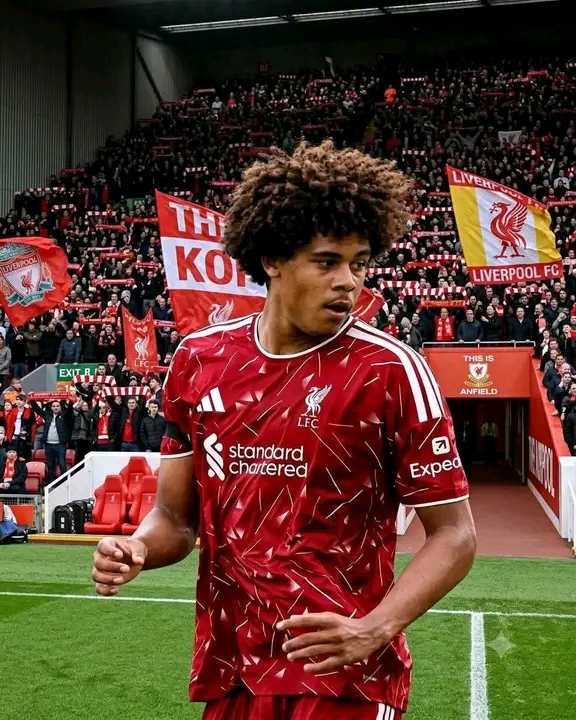
Liverpool’s summer transfer window has thrown up plenty of talking points, but few stories carry the intrigue of the situation surrounding eighteen-year-old centre-back Ifeanyi Ndukwe. Barely months after completing his move to Anfield, the towering defender is now on the verge of heading back out of the door, this time on a season-long loan to La Liga side Levante. For a player so recently and enthusiastically brought into the fold, this may look on the surface like a curious step. In reality, it is a carefully calculated piece of squad management shaped almost entirely by post-Brexit work permit rules rather than any doubts about his ability.
To understand why Liverpool are sending a player they clearly rate so highly out on loan before he has even kicked a competitive ball for the club, you have to go back to January. That was when the Merseyside giants agreed a deal in principle with Austria Wien to sign the then seventeen-year-old, a move that had been building for months after Ndukwe’s performances for Austria at the Under-17 World Cup in Qatar caught the eye of scouts across Europe. He was a key figure as Austria reached the final of that tournament, a remarkable achievement in itself for a nation not traditionally associated with major honours at underage level, and it was that run which persuaded Liverpool to move decisively and beat off interest from elsewhere, including a strong push from Inter Milan. The fee, reported to be in the region of three million euros, or somewhere around two point six million pounds, was seen as shrewd business for a defender many scouts believe has the physical tools and composure to eventually establish himself in a Premier League back line.
FIFA regulations meant Ndukwe could not actually move to England until he turned eighteen, a birthday that fell in March, so the transfer was always going to be completed in two stages: an agreement early in the year followed by a formal switch once he became old enough to relocate. That is precisely what happened over the summer, with Ndukwe officially arriving at Liverpool and being integrated into the club’s pre-season plans. What followed surprised a lot of observers. Rather than being quietly absorbed into the Under-21 setup and eased in gradually, Ndukwe was thrust into first-team training and given genuine minutes in high-profile friendlies. He featured against Sunderland, Wrexham, Leeds United, Como and, most notably, in a 3-2 defeat to Monaco at Anfield, where he lined up alongside club captain Virgil van Dijk and, by most accounts, looked entirely unfazed by the occasion.
It is worth pausing on just how much attention that Monaco performance in particular generated. Standing at six feet six inches tall, Ndukwe already cuts a similar physical profile to van Dijk himself, and pundits and journalists covering the game were quick to note the comparison, not just in stature but in the calmness he showed on the ball. Reports out of Merseyside described a defender who reads the game well beyond his years, who is comfortable playing out from the back under pressure, who favours progressive forward passing rather than simply clearing his lines, and who possesses excellent recovery pace for someone of his size. Add to that a willingness to engage physically and make decisive tackles, and it is easy to see why Liverpool’s recruitment staff, led by the club’s director of global talent Matt Newberry, identified him early as a player who could realistically break into the senior picture sooner rather than later.
All of that promise, however, has run straight into the practical realities of post-Brexit immigration rules that continue to shape how English clubs manage young foreign talent. Because Ndukwe does not currently hold a UK work permit, he is simply not eligible to play competitive football for Liverpool this season, no matter how well he performed in pre-season friendlies, which do not count toward the points system that governs these decisions. To qualify automatically for a Governing Body Endorsement from the Football Association, a player needs to accumulate fifteen points across several weighted categories, with factors including the number of competitive minutes played, the strength of the domestic league he is playing in, involvement in continental competition, and appearances for his national team all feeding into the total. It is a bureaucratic hurdle that has tripped up plenty of promising young overseas signings since Brexit came into force, and Liverpool have clearly decided the most sensible route forward is to loan Ndukwe out to a league that will help him accumulate those points as efficiently as possible.
That is where Levante enter the picture. La Liga sits in Band One of the FA’s classification system for the purposes of the points calculation, which means Ndukwe would begin earning credit toward his eventual work permit simply by being named in matchday squads, with additional points accruing the more he actually plays. Given the scale of his ambitions and the interest already shown in him, it is not hard to see why Liverpool and his representatives settled on a top-flight Spanish club as the ideal landing spot rather than accepting a move to a lower-ranked league that would slow down his path back to Anfield. Reports out of Spain, including from Radio Marca in Valencia and journalist Nacho Sanchis, suggested Levante moved decisively once they identified Ndukwe as a target, with the Valencian club reportedly light on options at centre-back, fielding only three senior defenders heading into the new campaign. That shortage gave them every incentive to offer a promising teenager a genuine pathway into the first team rather than parking him in the reserves, which appears to have been a significant factor in Liverpool’s willingness to sanction the move.
According to widely credited transfer insider Fabrizio Romano, the two clubs reached a verbal agreement on the structure of the deal, with Levante agreeing to cover the entirety of Ndukwe’s wages for the season, a straightforward loan arrangement without Liverpool contributing to his salary during the spell away. Crucially, and tellingly, the agreement does not include any option or obligation to make the move permanent. That detail matters. Loan deals with buy clauses attached often signal a selling club hedging its bets or preparing to cash in if things go well elsewhere; the absence of such a clause here strongly suggests Liverpool see this purely as a development loan, a means to an end, with every intention of welcoming Ndukwe back into first-team contention once his permit situation is resolved. Sources close to the move have indicated a break clause has also been negotiated, giving Liverpool the option to recall him as early as January if his form and accumulated points make him eligible sooner, or if injuries elsewhere in the squad create an opening.
That timing detail feeds into a broader picture of just how much confidence Liverpool retain in the player even as they send him abroad. His representatives at the agency More than Sport by AS1 have been vocal in stressing that the club has made clear to them it remains fully committed to Ndukwe’s long-term development, pointing to the trust shown in him during those pre-season friendlies as evidence the interest is genuine rather than a polite formality before quietly offloading him. It is not unusual for loan exits to be accompanied by diplomatic language designed to soften the blow for a young player and his camp, but in this case the specifics line up: regular involvement in senior training, minutes against sides like Monaco and Como, and a structure to the loan that keeps the door open for an earlier-than-expected return. This does not read as a club moving on from a player; it reads as a club navigating a regulatory obstacle as efficiently as it can while keeping its prized asset within reach.
Ndukwe’s situation also carries longer-term consequences that go beyond simply where he plays this season. Under Premier League homegrown status rules, a player needs to be registered continuously, or cumulatively, with a club inside the English or Welsh football associations for three seasons, or thirty-six months, by the end of the season in which he turns twenty-one, in order to qualify as homegrown regardless of his actual nationality. Because Ndukwe is now heading out on loan to a club outside England, that clock effectively resets or at least gets interrupted, meaning he will not be able to accumulate the necessary registration time before turning twenty-one in 2029. In practical terms, this means that once he does eventually return to Liverpool and establish himself, he will occupy one of the club’s seventeen non-homegrown squad slots rather than a homegrown one from the 2029/30 season onward, a subtle but real difference in how he will be treated within Liverpool’s squad-planning framework for years to come.
It is a situation not entirely without precedent at Anfield. Liverpool fans with long memories will recall the case of Calvin Ramsay, who joined from Aberdeen as an eighteen-year-old and looked on course to qualify for homegrown status by the time he turned twenty-one, only for a loan spell at Kilmarnock in Scotland to disrupt the necessary three seasons of continuous registration within the English or Welsh associations. Ramsay’s situation has since served as something of a cautionary tale within the corridors at Anfield, and it is reasonable to assume the club went into the Ndukwe transfer with eyes wide open about the homegrown implications of any loan move that took him outside domestic football. The fact they proceeded regardless suggests that securing his long-term development and getting him playing competitive senior football took clear priority over squad-classification technicalities that, while relevant, will only really bite years down the line.
Beyond the paperwork and eligibility calculations, there is a genuinely compelling football story here too. Levante finished last season just above the relegation zone, level on points with both Osasuna, who finished seventeenth, and a Real Mallorca side that ultimately went down, saved only by a superior head-to-head record in an unusually congested lower half of the table. Despite that precarious finish, the club were, remarkably, only nine points off the European qualification spots at one stage, a reminder of just how tightly bunched La Liga can be outside its established elite. They open the new campaign away at Osasuna, and for a young defender looking to make an instant impression, arriving at a club fighting to establish itself away from the bottom of the table, and one that is short of senior defensive options, could hardly be a more favourable environment for winning regular starts. Few loan destinations offer a more direct route to consistent first-team football than a top-flight side that genuinely needs bodies at centre-back.
It is also worth noting that Levante were far from the only club chasing Ndukwe’s signature this summer. Reports throughout August described interest from clubs in Portugal, Germany, Denmark, France, Spain and Belgium, underlining just how highly regarded the teenager has become in a remarkably short space of time. His agent, Georg Lederer, confirmed to Danish outlet Tipsbladet that discussions were ongoing with a number of interested parties, including sides in Denmark, while Sky Sport Austria reported that a rival Spanish club and a Portuguese outfit had also progressed talks to advanced stages before Levante ultimately won the race. That level of competition for a player who has not yet played a single competitive senior minute speaks volumes about the impression he made during Liverpool’s pre-season programme and about how quickly word travels in modern football recruitment circles when a young defender with obvious physical tools and technical polish becomes available.
For Liverpool supporters, the news will likely be met with a mixture of understanding and mild disappointment. There is a natural frustration in seeing a player who looked so composed and assured in pre-season, someone many were already picturing as a future long-term partner for Van Dijk or an eventual successor to him, being sent away just as he seemed ready to contribute. Andoni Iraola’s side head into the new Premier League season with defensive options that include Van Dijk, Jeremy Jacquet, Ronald Araujo, who arrived on loan from Barcelona, and Giovanni Leoni, who remains sidelined with an anterior cruciate ligament injury and is expected back around the end of September. With Araujo’s arrival effectively covering the gap that Ndukwe’s inexperience and permit issues would have left anyway, the timing of the loan makes practical sense: Liverpool are not short-changing their immediate squad depth by sending Ndukwe to Spain, since his replacement, in the loanee sense, has already walked through the door.
There is also a case to be made that a season of regular senior football, in a demanding league against experienced professionals, will do more for Ndukwe’s development at this stage of his career than a season spent largely on the bench or in the Under-21 setup at Liverpool waiting for paperwork to catch up with his ambitions. Plenty of young defenders have benefited enormously from being thrown into unfamiliar, high-pressure environments abroad rather than being cocooned in a familiar academy structure, and Liverpool’s willingness to send him to a club fighting relegation issues of its own, rather than a safer mid-table side, suggests a calculated bet that adversity and responsibility will accelerate his growth. If he performs well and racks up the necessary points for a work permit, the break clause reportedly built into the deal means Liverpool retain the flexibility to bring him home as early as January, giving Iraola the option of assessing him in a Premier League environment sooner than a standard season-long loan would typically allow.
What happens next will depend heavily on how quickly Ndukwe adapts to senior football and how much game time Levante’s coaching staff are prepared to hand a teenager barely out of his first year as a professional. Given the club’s shortage of options in central defence, early involvement seems likely, and if his pre-season form at Liverpool is any indication, there is every reason to think he could establish himself as a regular starter reasonably quickly. Liverpool, for their part, appear content to let the process play out patiently, trusting the infrastructure they have built around identifying, signing and developing talent like Ndukwe to eventually deliver a defender ready-made for the demands of the Premier League.
There is also a wider context worth considering here, one that speaks to how Liverpool’s recruitment department has evolved its approach to signing young players in recent years. The Ndukwe deal did not happen in isolation. It followed months of scouting work that began at the Under-17 World Cup, continued through a January agreement that locked in the transfer before rival clubs could intervene, and culminated in a summer move timed precisely to coincide with his eighteenth birthday, the earliest point FIFA rules would allow him to relocate. That level of planning reflects a club that has become increasingly sophisticated about identifying talent early, securing agreements before prices rise, and then building a bespoke pathway for each individual signing rather than applying a one-size-fits-all development template. Giovanni Leoni’s arrival from Italy last year followed a similar pattern, as has the recruitment of several other young defenders across Europe, suggesting Liverpool view central defence specifically as a position where getting ahead of the market on teenage talent offers a genuine competitive advantage over rivals still relying on established, more expensive options.
The work permit complication, frustrating as it may be for supporters eager to see Ndukwe in a red shirt sooner rather than later, is really just one more variable in that broader strategic calculation. Clubs signing young non-domestic talent since Brexit have had to build flexibility into their planning, treating loan spells not as a sign of failure or a step backward but as a necessary bridge between signing a promising teenager and actually fielding him competitively in England. Chelsea, Manchester City and several other Premier League clubs have gone through comparable processes with their own young overseas signings in recent seasons, loaning players to clubs in leagues that offer favourable points classifications specifically to accelerate the path toward eligibility. Liverpool’s handling of Ndukwe fits neatly into that now-familiar pattern, and the fact that a break clause has reportedly been included, giving the option of an earlier recall in January, shows a club trying to minimise the time lost rather than simply parking the situation for a full twelve months and hoping for the best.
None of this diminishes the excitement that has built around Ndukwe since his performances started generating headlines. Scouts who watched him at the Under-17 World Cup in Qatar described a defender who rarely looked rattled even against superior opposition, someone comfortable stepping into midfield with the ball at his feet rather than simply hoofing it clear under pressure, a trait that immediately marks a young centre-back as a potential fit for the modern, possession-based systems favoured by most elite European clubs. His performances for Liverpool over the summer only reinforced that reputation, particularly the composure he showed when paired directly alongside Van Dijk against Monaco, a fixture in which plenty of far more experienced defenders have looked overwhelmed by the pace and intensity of continental opposition. It was not just his positioning or his passing that stood out either; multiple reports pointed to his willingness to engage physically, to win individual duels, and to recover ground quickly when caught out of position, attributes that suggest a player already thinking about the full picture of what senior defending demands rather than relying purely on raw physical gifts.
Liverpool’s willingness to loan such a player out, rather than attempt to find some workaround to keep him around the first team in a non-playing capacity, also underscores just how seriously the club takes actual competitive minutes as part of a young player’s development. There would have been little value in Ndukwe training daily with the first team while unable to appear in a single Premier League fixture, watching from the stands every weekend as the season unfolds around him. A year of regular senior La Liga football, even at a club fighting to stay clear of the relegation zone, will expose him to far more valuable lessons than another season of behind-closed-doors training sessions ever could. Facing hardened, experienced strikers week in and week out, dealing with the tactical demands of a relegation battle, and learning to manage the emotional highs and lows of competitive senior football are all experiences that simply cannot be replicated on the training ground, no matter how good the coaching staff or how talented the teammates involved.
For now, all eyes turn to the final formalities of the move. According to multiple reports, the remaining paperwork is expected to be completed quickly, with Ndukwe set to travel to Spain in the coming days to finalise his medical, sign his contract, and begin working with his new teammates ahead of Levante’s opening fixture away at Osasuna. Once that happens, the focus will shift entirely to performances on the pitch, where the true test of whether this loan achieves its intended purpose will actually play out. Liverpool fans will be watching from a distance.