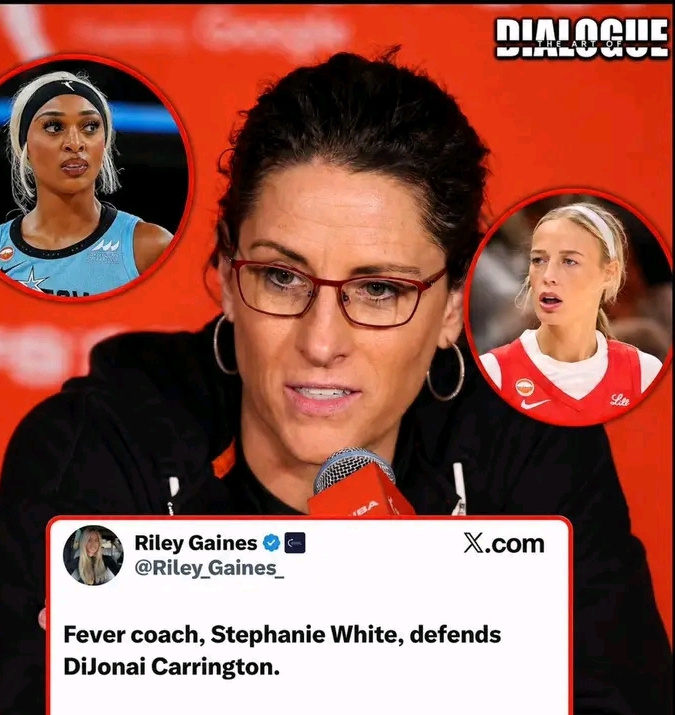
Stephanie White Faces Backlash After Supporting DiJonai Carrington Following Sophie Cunningham Incident
Indiana Fever head coach Stephanie White has found herself at the center of a growing debate after appearing to show support for DiJonai Carrington following the heated on-court altercation involving Sophie Cunningham. The incident has sparked strong reactions from basketball fans, with some questioning whether White should have taken a different approach because Cunningham plays for her own team. While emotions were already running high following the confrontation, White’s apparent stance has added another layer to an already controversial situation and raised questions about where a coach’s loyalty should lie when one of her players becomes involved in an intense exchange with an opponent.
The situation quickly attracted the attention of conservative activist and former NCAA swimmer Riley Gaines, who publicly criticized the idea of a coach appearing sympathetic toward an opposing player after an altercation involving one of her own athletes. Gaines argued that such a reaction would be unusual in the NBA, suggesting that a men’s basketball coach would be far more likely to stand firmly behind his own player rather than publicly defend or support someone from the opposing team. Her comments have fueled a wider discussion about whether professional sports coaches are expected to protect their players at all costs or whether there are circumstances where acknowledging an opponent’s perspective is simply part of maintaining professionalism.
From White’s perspective, however, supporting or understanding Carrington’s position does not necessarily mean turning against Cunningham. Coaches are often placed in difficult situations where they have to separate personal loyalty from their responsibility to evaluate what happened objectively. An altercation can involve multiple moments, reactions and emotions, and a coach may believe that acknowledging the other side does not diminish their support for their own player. White’s position could therefore be interpreted as an attempt to look at the entire situation rather than immediately choosing a side based solely on team affiliation.
That distinction is important because professional basketball is filled with moments where emotions boil over. Players compete aggressively, physical contact happens frequently and disagreements can escalate within seconds. Coaches are expected to defend their athletes when necessary, but they are also responsible for keeping their teams focused and preventing situations from becoming even more hostile. In that sense, White’s reaction could be viewed as an effort to keep the situation from becoming a larger feud rather than an indication that she has abandoned Cunningham. Supporting one player does not automatically require a coach to condemn another, particularly when the full circumstances surrounding an incident are still being discussed.
Still, critics believe White’s position sends the wrong message. From that perspective, a head coach has a responsibility to make her players feel that she will stand behind them whenever they become involved in a confrontation. Cunningham has developed a reputation for playing with tremendous intensity, and supporters may understandably expect her coach to defend her when an opponent becomes involved in a physical exchange with her. For those critics, White’s willingness to acknowledge Carrington’s side of the situation could be interpreted as a lack of loyalty, especially when the incident involved one of the players under her direct leadership.
Gaines’ comparison with the NBA has therefore become an important part of the conversation. Her argument is essentially that professional sports coaches are normally expected to protect their own locker room first, particularly when emotions are high and one of their players has been involved in a controversial incident. Whether that comparison is completely fair is another question. The WNBA has its own culture, personalities and competitive dynamics, and situations cannot always be judged by automatically comparing them with the NBA. Coaches in both leagues may respond differently depending on the circumstances, the players involved and what they believe is best for maintaining control.
At the same time, the controversy highlights the complicated role White now occupies with the Fever. As head coach, she has to balance relationships with individual players while also maintaining authority over the entire team. Every public comment can be analyzed by fans, players and media members, especially when it involves a controversial moment. If White was attempting to recognize that Carrington’s reaction had some context, that does not necessarily mean she was intentionally criticizing Cunningham. However, because the incident has attracted so much attention, even a seemingly measured response can be interpreted as taking a side.
Ultimately, whether Stephanie White was wrong depends largely on what people believe a coach’s primary responsibility should be in moments of conflict. Those who prioritize unconditional team loyalty may argue that White should have defended Cunningham without hesitation. Others may believe that a coach can support her player while still acknowledging that an opponent may have had understandable reasons for reacting the way she did. White’s response has clearly opened a debate about coaching, loyalty and sportsmanship, and Riley Gaines’ criticism has only made the discussion louder. For now, the controversy appears less about choosing between Cunningham and Carrington and more about how coaches should respond when competition crosses into a heated personal confrontation.