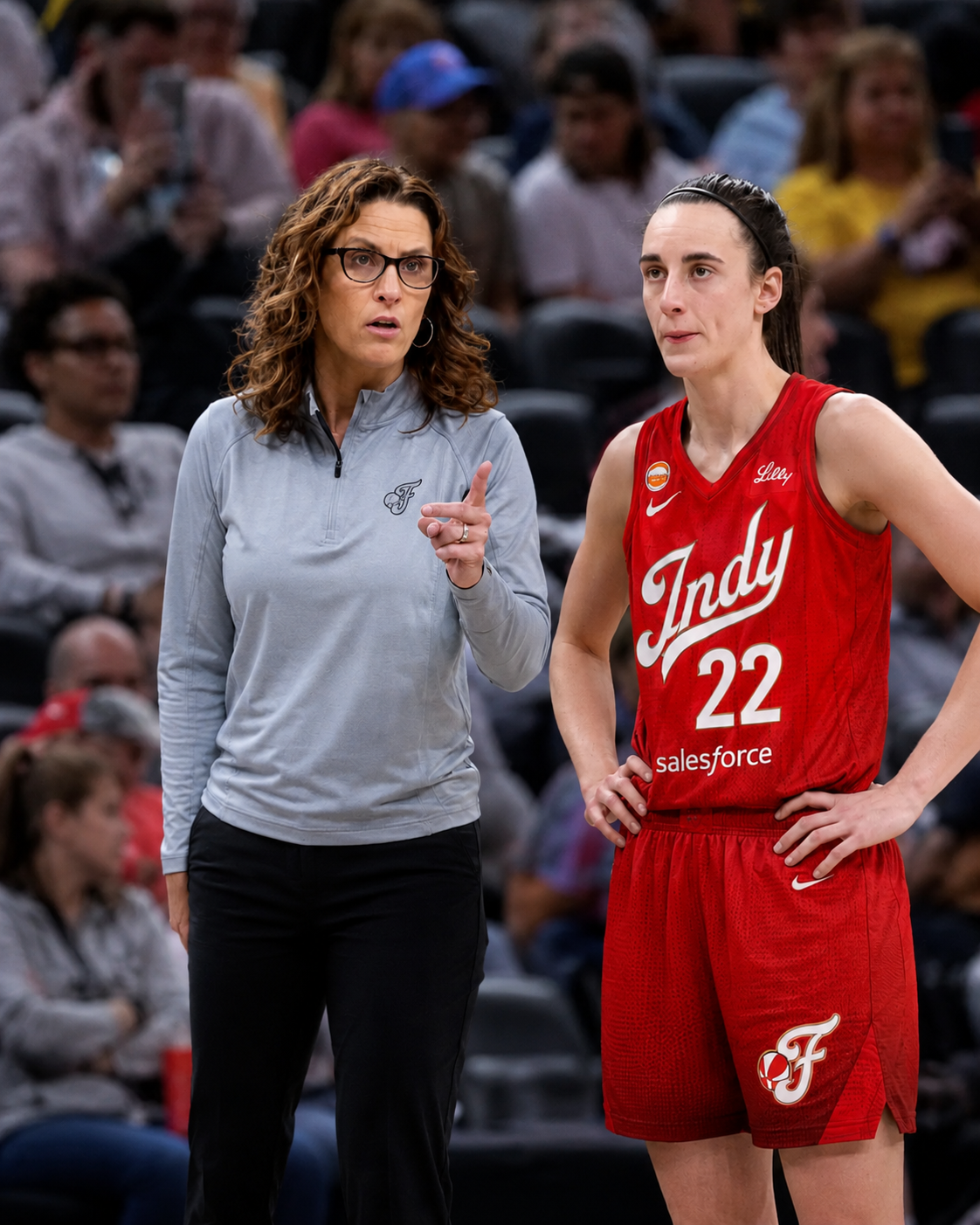
The Indiana Fever have no shortage of talent, but following their loss to the Los Angeles Sparks, the conversation has shifted away from the players and toward head coach Stephanie White. While injuries have forced the coaching staff to make difficult decisions throughout the season, White’s handling of Caitlin Clark’s return has become one of the biggest talking points among fans and analysts alike.
Clark, who recently returned from a back injury, was limited to just 16 minutes against Los Angeles and played in short three-minute bursts. The strategy was designed to ease the franchise star back into game action while protecting her health, but it also prevented her from establishing any offensive rhythm. White later explained that the restriction was intended to rebuild Clark’s conditioning after time away from the court.
WHY THE ROTATION DECISION HAS DIVIDED FANS
Managing a superstar’s workload after an injury is always a balancing act. On one hand, protecting Clark from aggravating her back issue is a responsible long-term decision. On the other, many supporters believe the stop-and-start substitution pattern hurt both Clark and the team’s overall offensive flow.
Clark has built her reputation on controlling the pace of games, creating opportunities for teammates, and finding her shooting rhythm through extended stretches on the floor. Frequent substitutions disrupted that rhythm, making it difficult for Indiana to generate consistent momentum against the Sparks. The Fever ultimately struggled offensively for long periods and never looked fully in sync.
CAITLIN CLARK’S RETURN WAS ABOUT MORE THAN STATISTICS
Although Clark showed flashes of her elite playmaking ability, the box score only told part of the story. Her limited minutes reduced her overall impact, and she later acknowledged that the playing pattern made it difficult to settle into the game. Even so, simply getting back on the court represented an important milestone in her recovery.
For Indiana, the bigger objective remains having Clark healthy when the most important games arrive. The Fever know they cannot afford another setback with the face of the franchise, especially as the playoff race becomes increasingly competitive.
STEPHANIE WHITE’S BIGGER CHALLENGE
White now faces one of the toughest coaching responsibilities in the WNBA: balancing immediate results with the long-term health of her biggest star.
Every coaching decision involving Clark is magnified because of her popularity and her enormous influence on the Fever’s offense. If Indiana wins while limiting her minutes, the cautious approach is praised. If the team loses and Clark appears unable to find a rhythm, criticism follows almost immediately.
Reports ahead of Indiana’s next game indicated that White planned to abandon the three-minute rotation strategy while still keeping Clark on a controlled workload of approximately 20 to 25 minutes, suggesting the coaching staff also recognized the need for a more natural game rhythm.
WHAT THIS MEANS FOR THE FEVER MOVING FORWARD
The Fever’s ceiling this season depends heavily on a fully healthy Caitlin Clark. When she is on the floor for extended stretches, Indiana becomes one of the league’s most dangerous offensive teams thanks to her passing, deep shooting range, and ability to elevate teammates.
Expect White to gradually increase Clark’s workload over the coming games while monitoring her recovery closely. If that process goes smoothly, the Fever could quickly regain the offensive identity that made them one of the league’s most exciting teams.
For now, however, every substitution pattern and rotation decision will remain under the microscope. The debate surrounding White’s coaching choices is unlikely to disappear until Clark is back playing her normal minutes—and once that happens, Indiana will hope the focus returns to winning basketball games rather than coaching decisions.