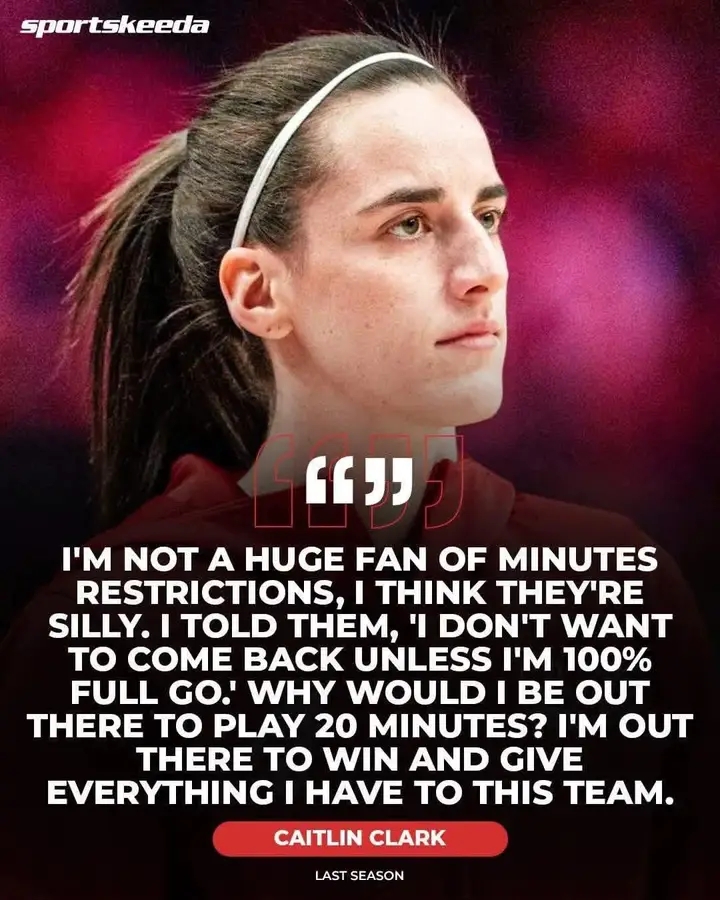
The Indiana Fever are taking a cautious approach with Caitlin Clark, even if it goes against the competitive mindset that made her one of basketball’s biggest stars. After previously making it clear that she wasn’t a fan of playing under minutes restrictions, Clark now finds herself in an unfamiliar situation—limited to short bursts of roughly two to three minutes at a time as she works her way back into full game action.
While the approach may frustrate both Clark and Fever fans eager to see their superstar dominate, it highlights the organization’s commitment to protecting its franchise player for the long haul rather than chasing short-term success.
WHY THE FEVER ARE BEING EXTRA CAREFUL
Returning from injury is rarely a straightforward process, especially for elite athletes whose playing style demands explosive movement, quick changes of direction, and constant defensive effort. Clark’s game relies heavily on high-intensity possessions, whether she’s launching deep three-pointers, attacking the basket, or creating opportunities for teammates.
Instead of allowing her to play extended stretches, Indiana’s coaching and medical staff have opted to rotate her in small intervals. These brief appearances allow trainers to monitor her conditioning, recovery, and physical response without exposing her to excessive fatigue.
Although the strategy may seem overly conservative, it reflects modern sports science, where preventing setbacks often takes priority over immediate results.
A COMPLETE CHANGE FROM LAST SEASON
Clark has never hidden her desire to stay on the court. Throughout her rookie campaign, she embraced heavy workloads and consistently wanted to compete for as many minutes as possible.
Her competitive fire became one of her defining characteristics. Whether the Fever were leading or trailing, Clark wanted the ball in her hands and preferred to play through difficult moments rather than watch from the bench.
That mentality has made the current situation somewhat ironic. The player who openly disliked minutes restrictions is now experiencing one of the strictest workload management plans of her professional career.
The difference, however, is that this restriction is not about limiting performance—it’s about protecting health.
WHAT THE SHORT STINTS ACCOMPLISH
Playing in two-to-three-minute intervals serves several important purposes.
First, it allows Clark to gradually rebuild her game fitness without overwhelming her body.
Second, it enables the coaching staff to evaluate how she responds after each shift on the floor, making adjustments if necessary.
Finally, it reduces the risk of aggravating any lingering issues that could result in a longer absence.
These carefully managed rotations may not be exciting for fans, but they provide valuable data that can help determine when Clark is ready to resume her normal workload.
HOW THE FEVER MUST ADAPT
With Clark unable to play extended minutes, the Fever must rely on their depth and collective execution.
The responsibility shifts to the rest of the roster to maintain offensive rhythm whenever Clark heads to the bench. Ball movement, perimeter shooting, and defensive intensity become even more important during those stretches.
This situation also creates opportunities for Indiana’s supporting players to gain confidence and prove they can contribute consistently.
If the Fever can remain competitive while carefully managing Clark’s return, they’ll emerge as a deeper and more balanced team once she is fully healthy.
THE LONG-TERM BENEFITS COULD OUTWEIGH THE SHORT-TERM FRUSTRATION
It’s understandable that fans want to see Clark playing 35-plus minutes every night. She’s one of the WNBA’s biggest attractions and transforms Indiana’s offense whenever she’s on the floor.
However, rushing her return could carry significant risks.
History across professional sports has shown that players who come back too quickly from injuries often suffer setbacks that extend their recovery timelines.
Indiana appears determined to avoid that scenario, even if it means sacrificing some immediate production.
WHAT THIS MEANS FOR THE FEVER’S PLAYOFF HOPES
The Fever’s ultimate goal isn’t simply getting Clark back on the court—it’s ensuring she’s healthy when the season reaches its most important stage.
If Indiana can successfully navigate this recovery period, the team could be in an excellent position later in the year. A fully recovered Clark provides elite scoring, playmaking, leadership, and the ability to change games in an instant.
The patience shown now may ultimately pay dividends during the playoff race, when every possession becomes more valuable.
FANS MAY NEED A LITTLE MORE PATIENCE
Watching Clark play only a few minutes before heading back to the bench isn’t what anyone envisioned. Yet these temporary restrictions should be viewed as part of a larger plan rather than a cause for concern.
As her conditioning improves and medical evaluations continue to produce positive results, those short appearances are expected to become longer rotations until she eventually resumes her normal role.
For now, Indiana’s priority is clear: protect its franchise cornerstone, ensure a complete recovery, and position the team for sustained success instead of risking another setback.
FINAL THOUGHTS
Caitlin Clark’s competitive nature means she’ll always want to play as much as possible. That’s part of what makes her special. But sometimes the smartest decision is also the most difficult one.
The Indiana Fever’s cautious workload management may frustrate fans in the present, but if it helps Clark return at full strength for the remainder of the season, it could prove to be one of the organization’s most important decisions. In the bigger picture, a healthy Caitlin Clark gives Indiana its best chance to compete at the highest level and continue building toward championship contention.