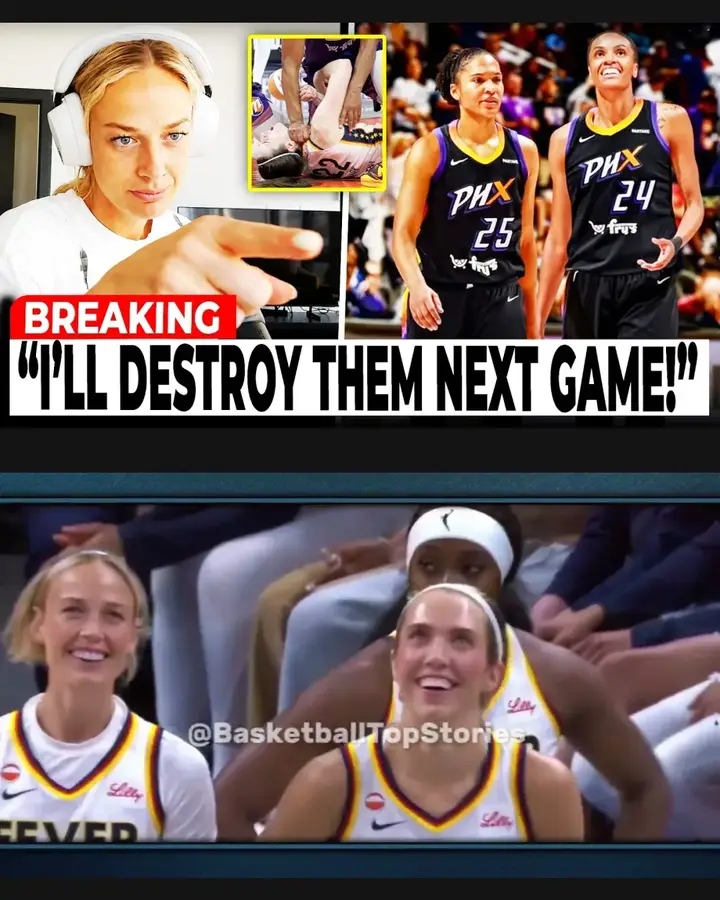
The Indiana Fever’s rivalry with the Phoenix Mercury has become one of the biggest talking points of the 2026 WNBA season, and it isn’t just because of the basketball.
Instead, the conversation continues to center on physical play, officiating standards, and how the league protects its biggest stars. Following Indiana’s dramatic 111-109 loss to Phoenix on June 24, Fever guard Sophie Cunningham publicly voiced her frustration over what she believes has become a recurring issue involving Caitlin Clark.
Speaking on her podcast, Cunningham said she and her teammates would have immediately defended Clark had they witnessed certain incidents in real time. Her comments quickly spread across social media, fueling another wave of debate about whether WNBA officials are doing enough to protect one of the league’s most marketable players.
While opinions remain divided, one thing is certain: this controversy has become much bigger than a single regular-season game.
CUNNINGHAM’S COMMENTS PUT THE SPOTLIGHT ON PLAYER PROTECTION
Cunningham has never been shy about expressing her views, and her latest remarks reflected the growing frustration many Fever fans have voiced throughout the season.
She explained that neither she nor several teammates realized the extent of the contact Clark absorbed during the game until reviewing the footage afterward. Cunningham added that if they had recognized what was happening during live action, they would have stepped in to support their teammate.
Those comments resonated with Indiana supporters because they reinforced the image of a team growing increasingly protective of its franchise centerpiece.
For a Fever squad with championship ambitions, chemistry extends beyond offensive execution and defensive schemes. It also includes standing together when games become increasingly physical.
THE INCIDENT THAT SPARKED THE CONTROVERSY
The June 24 matchup featured several physical plays involving Clark and Mercury star Alyssa Thomas.
Following a league review, the WNBA upgraded one play to a Flagrant 2 foul and suspended Thomas for one game after determining that reckless contact had been made to Clark’s throat area.
That decision acknowledged that the play warranted additional discipline beyond what was called during the game itself.
However, it also sparked another debate.
Many fans believed the punishment should have been more severe, while others argued the league handled the situation appropriately according to its disciplinary standards.
Regardless of which side fans supported, the suspension became one of the biggest WNBA stories of the season.
WHY OFFICIATING HAS BECOME A LEAGUE-WIDE DISCUSSION
The controversy isn’t solely about one player or one game.
Instead, it highlights a broader conversation surrounding consistency in WNBA officiating.
Throughout Clark’s young professional career, several games have generated debate over whether defenders are allowed to play more physically against her than against other stars.
Supporters point to numerous hard fouls and non-calls as evidence that officials need to intervene sooner before games escalate.
Others counter that Clark receives the same physical treatment that many elite guards have faced throughout WNBA history.
Both viewpoints continue to circulate across basketball media, making every controversial whistle—or lack thereof—an even bigger story.
SOPHIE CUNNINGHAM HAS CONSISTENTLY SUPPORTED CLARK
One reason Cunningham’s comments attracted so much attention is that her support for Clark didn’t begin after joining Indiana.
Even before becoming Clark’s teammate, Cunningham regularly praised the former Iowa superstar for helping elevate the league’s popularity.
She has frequently credited Clark and the highly talented rookie classes of recent years for bringing record television audiences, sold-out arenas, and unprecedented media coverage to women’s basketball.
That history gives additional context to her latest remarks.
Rather than appearing as a reaction made in the heat of the moment, Cunningham’s comments fit a pattern of publicly backing Clark both on and off the court.
CAITLIN CLARK REMAINS THE FACE OF THE FEVER’S TITLE HOPES
Despite the controversy, the Fever’s primary focus remains basketball.
Clark continues to be the engine of Indiana’s offense, creating scoring opportunities for herself while consistently setting up teammates like Kelsey Mitchell and Aliyah Boston.
When Clark exited the June 24 game after sustaining contact during multiple physical sequences, Indiana’s offensive rhythm understandably changed.
The Fever ultimately lost by only two points, leading many observers to wonder how the game might have unfolded had Clark remained on the floor for the closing stretch.
Although no one can know the outcome with certainty, the narrow margin naturally intensified discussion after the final buzzer.
PHYSICAL PLAY IS PART OF CHAMPIONSHIP BASKETBALL
Every championship contender eventually faces increasingly physical opponents.
Teams understand that limiting elite scorers often requires aggressive defensive strategies.
The challenge for officials is distinguishing between tough, legal defense and unnecessary or reckless contact.
Finding that balance has become more important than ever as television audiences continue to grow and more casual fans begin following the WNBA.
Consistent officiating not only improves competitive fairness but also helps maintain confidence in the league’s product.
THE FEVER ARE BUILDING A STRONG TEAM CULTURE
One encouraging takeaway for Indiana is the sense of unity developing inside the locker room.
Whether through public comments or on-court support, Cunningham has demonstrated that teammates are prepared to stand behind Clark when games become heated.
That collective mindset can become a competitive advantage over the course of a long season.
Championship teams often build trust through adversity, and Indiana has experienced no shortage of emotional moments during its rise into contention.
If the Fever continue channeling those moments into stronger teamwork rather than distraction, they could emerge even more dangerous later in the season.
WHAT THE WNBA CAN LEARN FROM THIS CONTROVERSY
This incident may ultimately encourage continued evaluation of replay procedures and officiating consistency.
The league has invested heavily in growing its audience, and maintaining confidence in officiating will remain an important part of that growth.
When controversial plays dominate headlines more than the basketball itself, everyone—from players to coaches to league officials—has an interest in improving transparency and consistency.
That doesn’t necessarily mean changing the physical nature of the sport.
Instead, it means ensuring similar plays receive similar rulings regardless of the players involved.
WHAT COMES NEXT FOR INDIANA
The Fever cannot afford to dwell on one controversial night.
Their attention now shifts toward climbing the standings and strengthening their position for the postseason.
Clark remains one of the league’s most dynamic playmakers, Boston continues to anchor the frontcourt, Mitchell provides elite scoring, and Cunningham brings veteran toughness and leadership.
If Indiana stays healthy and continues improving defensively, the Fever have every reason to believe they can compete for a WNBA championship.
The June 24 controversy may eventually fade, but it has already reinforced one important reality.
This Indiana Fever team believes in protecting one another, and that shared mentality could prove just as valuable as any offensive or defensive adjustment during a championship chase.