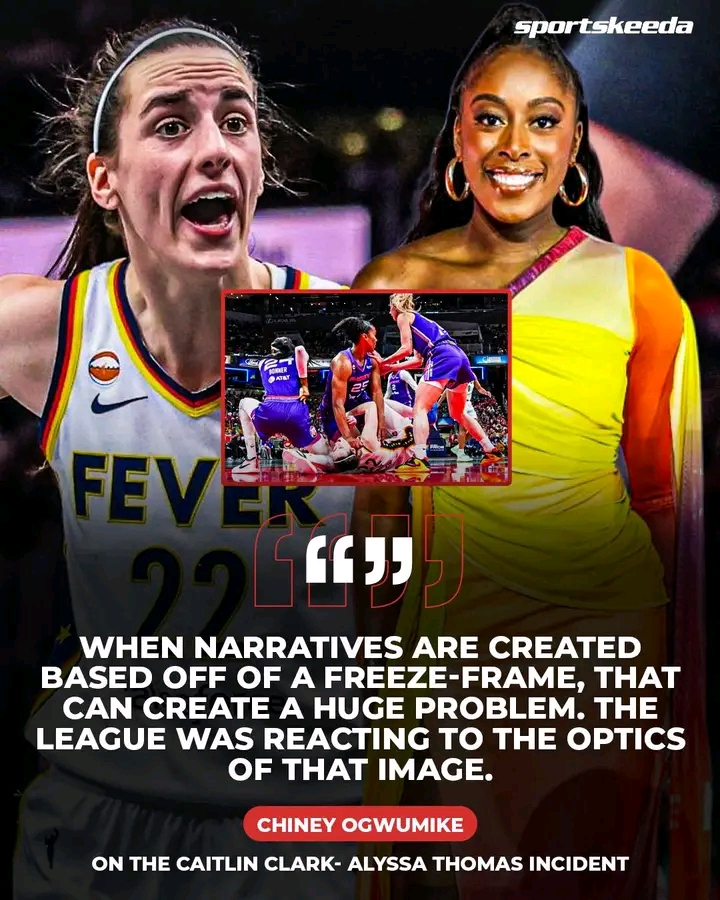
ESPN analyst and former WNBA player Chiney Ogwumike has come under intense scrutiny following her remarks on a controversial on-court incident involving Indiana Fever star Caitlin Clark and Phoenix Mercury forward Alyssa Thomas. The episode, which occurred during a recent matchup, has reignited debates about player safety, officiating consistency, and the treatment of the league’s biggest draw in the rapidly growing WNBA.
In the second quarter of the Mercury’s 111-109 victory over the Fever, Clark drove to the basket and fell to the floor amid a scramble for the loose ball. As players including Thomas converged, video footage showed Thomas appearing to thrust her fist into Clark’s neck area before stepping over the fallen guard. No foul was called in real time, but the WNBA reviewed the play post-game, upgrading it to a Flagrant Foul 2 for “reckless” non-basketball contact. Thomas received a one-game suspension.
The incident quickly went viral, with many fans and analysts viewing it as another example of physical targeting of Clark, the league’s transcendent rookie-turned-superstar whose popularity has driven record viewership, attendance, and revenue. Clark’s supporters argued the lack of an immediate call highlighted inconsistencies in officiating and a tolerance for “cheap shots” against high-profile players.
Ogwumike, appearing on ESPN platforms, offered a more nuanced take that emphasized context over the dramatic freeze-frame imagery. She noted that both Clark and Thomas—known for playing physically and sometimes embellishing contact—got up and continued playing without immediate issue. Ogwumike suggested the suspension stemmed largely from the “optics” of the slow-motion replay, warning that narratives built on isolated frames can distort reality and unfairly amplify backlash.
“When narratives are created based off of a freeze-frame, that can create a huge problem,” Ogwumike said. She acknowledged broader officiating challenges this season, including higher foul rates contributing to elevated scoring, but stressed the need for better real-time situational awareness in high-profile matchups to prevent reactive league decisions.
Her comments drew swift criticism from Clark’s fanbase and some media voices, who accused Ogwumike of downplaying a dangerous play and prioritizing league harmony over player protection. Social media erupted with accusations of bias, with hashtags like #DefendCaitlin trending as users shared clips of the neck contact alongside past physical incidents involving Clark. Critics argued that minimizing the event ignores the cumulative toll of hard fouls on the Fever guard, who has already dealt with injuries this season.
Defenders of Ogwumike and Thomas countered that basketball is a physical sport and that overreactions risk painting veteran players as villains while elevating Clark to untouchable status. Thomas, a respected veteran known for her edge and leadership, has faced heightened online vitriol, prompting concerns about fan behavior crossing into toxicity.
The controversy underscores deeper tensions in the WNBA’s boom era. Clark’s arrival has brought unprecedented growth, but it has also exposed fault lines around stardom, physicality, and media narratives. League officials continue to emphasize player safety while navigating the balance between competitive intensity and star protection.
As the season progresses, incidents like this highlight the challenge of managing scrutiny in a league under a brighter spotlight than ever. Whether Ogwumike’s perspective fosters healthier dialogue or further divides fans remains to be seen, but one thing is clear: Caitlin Clark’s presence continues to magnify every on-court moment.