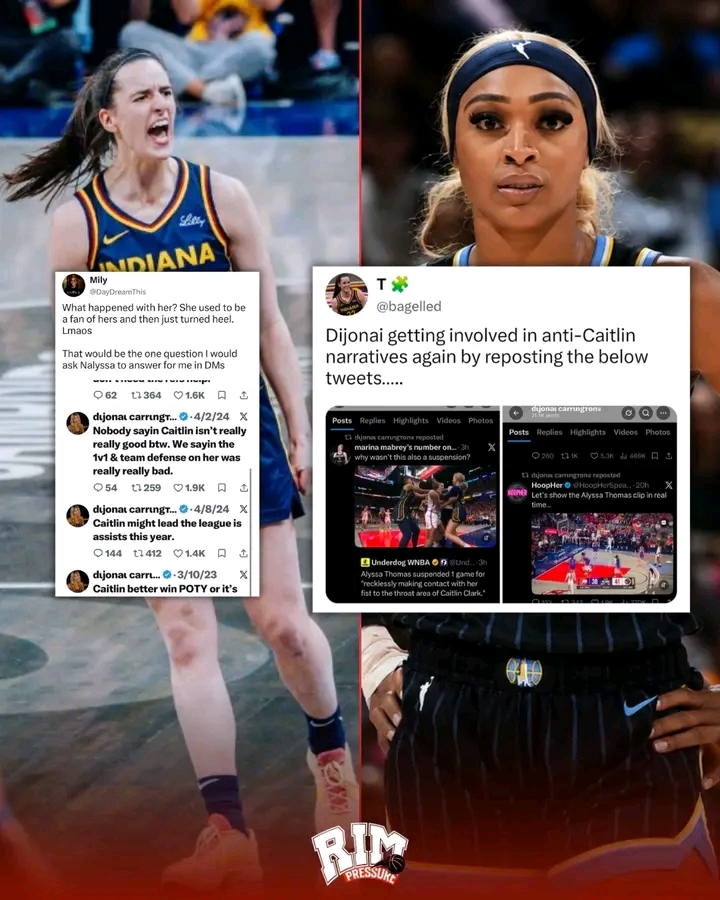
The WNBA never seems to stay out of the headlines for long, and the latest controversy has fans once again debating player safety, social media narratives, and whether the league has done enough to protect its biggest stars.
This time, Chicago Sky guard DiJonai Carrington has found herself at the center of online criticism after publicly supporting former teammate Alyssa Thomas while also drawing attention for social media activity that many Caitlin Clark supporters viewed as fueling anti-Clark conversations.
What makes the situation even more surprising to many fans is that Carrington and Clark are represented by the same agency, Excel Sports Management. While sharing an agency doesn’t mean athletes must agree publicly, it has added another layer to an already emotional debate across the basketball world.
WHY FANS ARE UPSET
The controversy follows one of the most talked-about games of the WNBA season between the Indiana Fever and the Phoenix Mercury.
After the league reviewed a physical play involving Alyssa Thomas and Caitlin Clark, officials upgraded the incident to a Flagrant 2 and suspended Thomas for one game, citing reckless contact to Clark’s throat. The punishment came after the play was not penalized during the game itself.
Many Fever supporters argued that the discipline was too lenient, believing stronger action was needed to discourage dangerous plays against one of the league’s biggest stars. Others felt the league struck the right balance by acknowledging the incident while avoiding an excessively harsh suspension.
Into that heated discussion stepped DiJonai Carrington.
Carrington publicly defended Thomas, her former Connecticut Sun teammate, a move that immediately divided fans. Supporters praised her loyalty, while critics accused her of dismissing legitimate concerns about player safety.
THE SOCIAL MEDIA FIRESTORM
Social media has become an extension of every major sports rivalry, and the WNBA is no exception.
Carrington’s online interactions were quickly analyzed by fans, with many interpreting them as encouraging criticism of Caitlin Clark. Whether that interpretation is fair remains a matter of opinion, but the backlash demonstrates just how polarized conversations surrounding Clark have become.
Few athletes generate as much discussion online as Clark. Nearly every hard foul, controversial call, or viral clip now sparks thousands of comments within minutes.
That environment makes even seemingly minor social media activity a major talking point.
DOES SHARING THE SAME AGENCY MATTER?
One of the biggest surprises for fans is that both Carrington and Clark are represented by Excel Sports Management.
In reality, athletes represented by the same agency are independent professionals with different personalities, teammates, friendships, and opinions. Agencies negotiate contracts and business opportunities—they do not dictate players’ public viewpoints or relationships.
Still, many fans expected more neutrality given the shared representation, helping fuel another wave of online debate.
THE BIGGER ISSUE: PLAYER SAFETY
The controversy extends beyond two individual players.
Indiana Fever head coach Stephanie White has repeatedly voiced frustration over what she believes is inconsistent officiating involving Caitlin Clark. Following the Mercury game, White criticized officials for failing to call what she described as obvious fouls before the league later intervened with postgame discipline.
That has reopened an important conversation:
- Are officials doing enough to protect star players?
- Is physical defense crossing the line too often?
- Should dangerous plays receive harsher automatic penalties?
These questions will likely remain central throughout the remainder of the season.
WHAT THIS MEANS FOR THE INDIANA FEVER
For Indiana, every game matters in an increasingly competitive playoff race.
The Fever have built much of their offense around Caitlin Clark’s elite shooting, passing, and pace. When Clark is unavailable—or limited by injury—the entire identity of the team changes.
Clark is currently dealing with back soreness following the Mercury game, causing her to miss additional action while the team prioritizes her recovery.
If Indiana hopes to make a deep postseason run, keeping its franchise player healthy will be every bit as important as improving defensively or finding more scoring depth.
HOW THIS COULD IMPACT THE WNBA CHAMPIONSHIP RACE
Championship teams usually overcome adversity, but repeated controversy can become a distraction.
The Fever must avoid allowing outside noise to affect their focus.
Meanwhile, opponents know every matchup against Indiana now comes with enormous national attention. Every hard foul, technical foul, or controversial whistle is likely to dominate sports headlines within hours.
The league itself also faces pressure to maintain consistency in officiating. Players, coaches, broadcasters, and fans will continue watching closely to see whether future incidents receive similar discipline.
FINAL THOUGHTS
Whether fans agree with DiJonai Carrington’s comments or not, the latest controversy highlights how emotionally charged WNBA conversations have become.
Supporting a former teammate is understandable. So is fans’ concern about player safety after repeated physical incidents involving Caitlin Clark.
The bigger story isn’t simply one social media post or one suspension—it’s the growing spotlight on the WNBA as every controversial moment receives national attention.
As the playoff race heats up, expect every Fever game, every officiating decision, and every viral interaction to face unprecedented scrutiny. If the league can maintain consistency while keeping its stars healthy, the remainder of the season could deliver one of the most compelling championship races in recent WNBA history.